Science

Mostly Cloudy with Showers 14° London Hi 15°C / Lo 8°C

Telescopes that could see the future

Scientists hope probes to be launched soon will help them predict how the Universe may end
By Steve Connor, Science editor


INDEPENDENT GRAPHICS

A pair of space telescopes to be launched later this month will help to answer some of the biggest questions in the Universe – such as how did we get to where we are now, and where are we likely to end up.

Each telescope is designed to probe the deepest recesses of space to unravel the origins of matter, from the earliest beginnings of the Universe some 13.7 billion years ago to the creation of the stars, galaxies and planets.

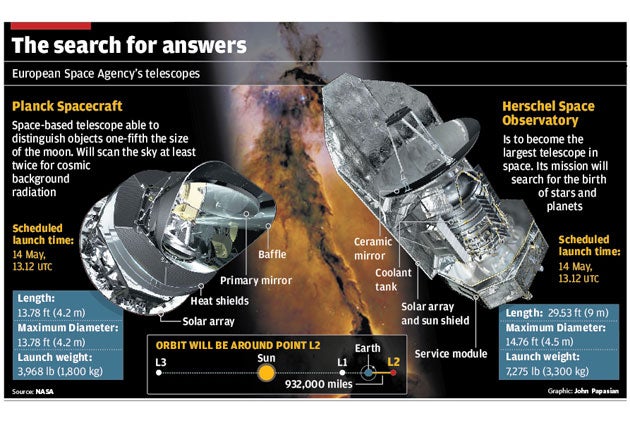
One of the telescopes, called Planck, will study in unprecedented detail the ancient "fossilised" radiation left over as a relic of the Big Bang. The analysis could help to explain how the Universe formed through a process of rapid expansion, called inflation, in the first fractions of a second after the Big Bang itself.

The other telescope, called Herschel, will concentrate on the invisible, infrared radiation emitted by the star-forming regions of the galaxies in the hope of explaining how stellar objects, from stars like the Sun to planets such as Earth, can form from clouds of cosmic gas, dust and debris.

Scientists involved in the twin mission hope that the data gleaned from instruments on board each telescope will enable them to fill in the remaining mysteries of how the Universe came into existence, how it evolved and how it is likely to end – if indeed it ever will.

"We're looking at the physics at the very beginning of the physical universe," said Professor David Southwood, director of science at the European Space Agency, which is scheduled to launch the satellites from its station in Kourou, French Guyana on 14 May. Instruments on board the Planck telescope, named after the German physicist Max Planck, will be kept at minus 272.7C – just 0.3 degrees above absolute zero – in order to detect the cosmic background radiation left over from the Big Bang.

"These results will allow us to test our theories of the Big Bang and could completely change our understanding of the origin and development of our Universe and even predict its future," said Professor George Efstathiou of Cambridge University.

"By understanding the process of inflation, we make contact with fundamental physics."

Herschel, meanwhile, will gather infrared radiation emitted from the vast dust clouds of space where stars and galaxies are forming. With its 3.5-metre-wide mirror, Herschel will be the biggest telescope in space, said Professor Matt Griffin of Cardiff University.

"The results could reveal how stars like the Sun are forming in our own galaxy today, how the galaxies grew and evolved over cosmic time, and how planetary systems can develop from the dust and gas around young stars," Professor Griffin said.

Both telescopes will be launched on the same Arianne V rocket, which will take them to their final, and separate, resting orbits about 1.5 million kilometres (930,000 miles) from Earth.

It will take about six months before the first data is received at a listening station built near a monastery in Western Australia, 125 miles from Perth.

Post a Comment

View all comments that have been posted about this article.

Offensive or abusive comments will be removed and your IP logged and may be used to prevent further submission. In submitting a comment to the site, you agree to be bound by the Independent Minds Terms of Service.

Comments

Nah, search for quastions...
[info]solipsistident wrote:
Friday, 1 May 2009 at 11:32 pm (UTC)
Rather misleading stuff, philosophically seen.

Well, why would some bright scientist suddenly come up with THE answer...!?

At it's very best we expand our horizon. Isn't that what science is about? Being inquisitive, always asking new questions.

Stop feeding the trolls cheap candy! It causes their teeth to rot away.

It's high time we collectively learn to focus our mind the way nature seemingly has intended. Our journey isn't headed towards some final purpose. The purpose is being part of the journey. Let's keep the trip eternally exciting...
Re: Nah, search for quastions...
[info]vhawk1951 wrote:
Saturday, 2 May 2009 at 11:05 am (UTC)
yes, let's have more vivifying questions , answers are dead
predict the unpredictable
[info]pt6615 wrote:
Saturday, 2 May 2009 at 07:55 am (UTC)
There is always something 'else' - more exciting that fuels such experiments we only get the 'you know my darling...' answers. It's approximately 30% of all the facts that is publicized...
inflation
[info]observer_2009 wrote:
Saturday, 2 May 2009 at 08:05 am (UTC)
am i wrong inflation is only a possible explanation for observations not a measurement so why not say so or am i being pedantic if so sorry ?

Roger Penrose always qualifies his discussions on the standard model including inflation and a more advanced standard model might not include inflation ?

Planck and Herschel and their measurements hopefully will direct the theoretical people ?
Hubble expansion?
[info]kodak321 wrote:
Saturday, 2 May 2009 at 09:04 pm (UTC)
I think your're being slightly pedantic. Inflation offers an explanation based on theoretical assumptions. It fits the observed, but soon we will have measured data. I don't think the author said otherwise. However, he should have explained the Big Bang theory and inflation theory - background information's essential in this field of investigation and reporting.
a load of rubbish
[info]jayoosi wrote:
Saturday, 2 May 2009 at 11:39 pm (UTC)
Rather than using giant expensive hula-hoops to answer "where are we likely to end up".... I could answer this question for free. It takes just one look at the injustice and incomprehensible suffering of the Palestinians in the Middle East, and the collaboration of the West with the apartheid State of Israel (to an extent that the West decided to boycott an anti-racism summit recently to stand shoulder to shoulder with their Zionist pals under the title, 'racist we stand, divided we fall')...that, and the growing resentment of the West in the non-Zionist (racist) world amongst many other 'obvious' things.... we are all likely to end up in Hell... save your millions and stop chatting rubbish...Spend the cash on redeveloping Somalia for instance.... at least this may end the current circus in the Gulf of Aden, with Nuclear powered subs chasing naked hungry fishermen, and failing!


Pakistan and USA will hunt Osama
[info]famulla wrote:
Sunday, 3 May 2009 at 09:09 am (UTC)
Pakistan and USA will hunt Osama and we will collect the cash, Good news. What is my share in these terrorists? stories? WE will see future and we will know when we are dying. Great stuff. We fear no one, no Chimes shoes will come to USA and No swine flue in UK, No more nukes only spears and gun with powders we had. We are safe as the tress that lived long ago until men come and chop these off. We are safe from ICE and Water, heat and food shortages. We can grow rice in the Sand. Moon water and Mars and for out building. Burn the 1984, it is not read, and it is rubbish.
A pair of space telescopes to be launched later this month will help to answer some of the biggest questions in the Universe ? such as how did we get to where we are now, and where are we likely to end up.
Diplomats' anger at Tory plans to create right-wing EU group.
We will call this EU for UK Leftists. I need many votes for this. Please
Now we can read them faster. I love speed, give me speed, not the movie, the net so I know who spits where.
A pair of space telescopes to be launched later this month will help to answer some of the biggest questions in the Universe ? such as how did we get to where we are now, and where are we likely to end up.
I thank you
Firozali A. Mulla
Temperature of Planck instrument is incorrect
[info]chriswhite27 wrote:
Tuesday, 5 May 2009 at 10:39 am (UTC)
The instruments on board Planck are cooled to 0.1 degrees above absolute zero. Those on Herschel are cooled to 0.3 above zero.

Most popular