The Jam Busters: Can maths keep us moving?
With car use increasing all the time, in a few years we could be facing global gridlock. Can the calculations of mathematicians and engineers keep us moving?
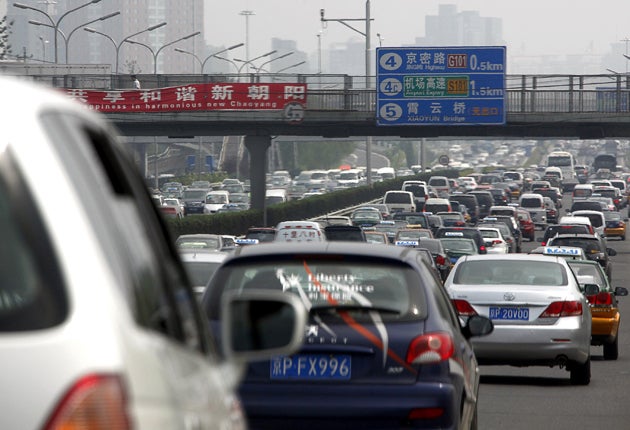
Here is a sobering thought: it is estimated that there are more than 750m vehicles on the planet, and that this mechanical population is swelling by more than 50m newcomers each year.
At the current rate, the total number of cars on the road will double by 2025. All those vehicles need to go somewhere – but, increasingly, they don't.
While the combustion engine brings movement to the masses, and gives us the freedom of choice to live and work where we want, it also regularly leaves us gridlocked, sitting impotent and immobile in traffic jams, gently simmering in our own frustration.
Congestion is nothing new. Archaeologists have discovered evidence of horse-and-cart jams in the ruins of Pompeii. But, health implications aside, traffic congestion is more than ever having a huge economic impact. In the UK, jams cost the national purse £20bn-£30bn a year. In car-addicted America, where each year the driving population cumulatively spends around 500,000 years stuck in traffic, the congestion cost is around $100bn (£65bn).
In Moscow, now regarded as the most congested business city in the world, jams cost some $12bn a year, and the city would need to build 400 more kilometres of road to ease the 650 jams that happen each day. In the face of this global gridlock, road planners and traffic controllers are increasingly turning to science for solutions.
As far back as the 1950s, mathematician Sir Michael James Lighthill was using wave theory to understand the complexities of traffic flow and interaction. Today the traffic-science sector attracts computer programmers, engineers and even astronomers, along with traditional mathematicians. With a tsunami of new motor vehicles already sweeping across developing nations such as China and India, and road capacity full in Europe and America, research into road-network optimisation is vital to keep the planet moving.
Today's jambusters arm themselves with powerful computer-simulation tools to construct virtual highways containing thousands of virtual vehicles which interact with each other and gives clues as to why seemingly random congestion occurs. Although roads carrying vehicles at a certain density will always become congested, traffic scientists puzzled for years over those annoying jams that occur on free-flowing roads for no apparent reason. In the mid-Nineties, researchers in the US first built simulations which mirrored this effect. Within the computer programme, virtual cars would organise themselves spontaneously into distinctive patterns. Other models found a similar effect, where vehicle flows turned suddenly sluggish and stopped, as if they had crystallised. The commonly held view was that these patterns were caused by sheer weight of traffic.
Boris Kerner, a researcher working at the Daimler Chrysler Research Centre in Germany, studied the traffic state between freely flowing cars and a full-scale traffic jam, which he called "synchronised traffic flow". He discovered that on carriageways where the traffic was moving in this manner vehicles appeared to have jelled into a type of unified, moving mass. This condition allowed waves of dense traffic to pass upstream along a motorway. More recently, a team of mathematicians from the University of Exeter discovered that these congestion waves were not due to sheer weight of traffic, but were down to driver action.
The Exeter team developed a computer model that simulated the impact of unexpected events on motorways, such as lorries changing lanes. They discovered that under certain conditions, when cars are bunched in a specific density and travelling at a specific speed, a single driver over-reacting can set off a braking shockwave that will build momentum and travel back along a motorway for miles.
As the initial driver brakes, the car behind has to brake, and so on until cars bunch into clumps and stop-start congestion develops. Eventually, several miles back, traffic grinds to halt. The process is akin to an automotive butterfly effect, where a nervy tap of the brake pedal on the M1 at Luton can cause someone to miss an appointment in Milton Keynes an hour later.
Researchers in Japan observed a similar "wave" pattern when they put 22 vehicles on a 23-metre, single-lane circuit and asked drivers to cruise steadily at 30km an hour. Initially the traffic moved freely, but small fluctuations soon appeared in distances between cars and built into larger pockets of congestion. These clusters, which scientists call "jamitons", spread backwards through the traffic like a shock wave. Scientists studying the same phenomenon at MIT in the US discovered that "jamitons" share similar characteristics to the detonation waves created by explosions.
Of course, scientific theory is not always needed to explain gridlock. The causes of some jams, such as the recent 100km queue in China, which snared drivers for days on the main north-south motorway to Beijing, are easily identified. That monster jam was blamed on roadworks, a broken-down car and an overload of trucks carrying coal from Mongolia to the capital. Stranded drivers struggled to travel two miles a day and the queue generated its own economy, with industrious hawkers selling provisions to motorists at vastly inflated prices.
Thanks to its breakneck development, Beijing is now one of the top global traffic hotspots along with Sao Paolo, Mexico City, Johannesburg, New Delhi, Moscow, London, New York, Los Angeles and Tokyo.
According to Tim Rees, head of traffic behaviour at research and development consultancy Transport Research Laboratory (TRL), major city road layouts have a lot to answer for. "Any city serviced by motorways which merge as they approach it will be prone to congestion," he says. "When traffic merges vehicles have a tendency to cut across lanes moving into gaps in the traffic flow, causing drivers behind to slow or brake. That leads to a ripple effect which can stretch back 20 miles. Ideally, to alleviate this type of effect, drivers should stay on the inside lane for a mile or so after merging with motorway traffic – but that rarely happens."
TRL developed the traffic management system that controls the flow on the London orbital M25 motorway. This system, one of the most advanced in the world, uses real-time data collected from monitors on the carriageway and analysed by TRL experts to set strategic variable speed limits to try to alleviate problems before they materialise. As traffic builds to conditions where waves are likely to form, controllers set speed limits to regulate traffic flow at either 60mph or 50mph. Further back, a 40mph limit is set at the rear of the predicted congestion zone to help regulate traffic through it.
However, even with the best technology in the world, sometimes demand on roads is just too high and jams are unavoidable. Theoretically, in order to keep a constant flow of 60mph, the ideal number of cars on a road should be between 1,800 and 2,000 per lane, per hour. On a four-lane stretch of the M25 this would mean 8,000 cars per lane per hour. With up to 200,000 vehicles a day during busy periods, demand far exceeds supply.
Solutions to the global gridlock problem are myriad, and range from the sublime to the ridiculous. On the M42 a "hard-shoulder running" pilot scheme, whereby the hard shoulder was opened to alleviate congestion, proved successful and greatly reduced journey times and congestion.
TRL have also looked into the possibility of sending out vehicles, like the pace cars in motor racing, to slow traffic down before congestion builds on busy motorway section. Restricting road use by banning certain motorists from driving one day a week, depending on their car registration number, is used in China. Engineers there are also developing an electric bus on stilts that will carry 1,400 people and run on rails, allowing cars to drive underneath it.
However, according to Gabor Orosz, assistant professor of mechanical engineering at the University of Michigan and one of the architects of the Exeter University study, the solutions lie in marrying macro-level systems, like the M25 variable speed limit system, with micro-level technology built into cars.
He says: "In our research we discovered there is a region between a smooth-flowing state and a jam state where congestion build-up depends on the driver behaviour. This region is typified by between 15 and 50 cars per kilometre depending on conditions and here, congestion waves are likely to be caused if a driver brakes too hard. This is the region where we can do the most for traffic in terms of controls and regulations.
"We realised that if you build radar into the bumper of a car and have an on-board computer that can control braking and acceleration, you can control the car through this type of traffic profile to optimise the chances of avoiding congestion. We tell the computer how to drive and the computer reaction time is much faster and more proportionate than a human's. It is like an auto-pilot system, but with limited capability. We call it Automatic Cruise Control. In theory an ACC car would get to a congestion area and signage would advise the driver to enable the ACC, which would take the driver smoothly through the zone."
Until we can entrust our computer-controlled cars to smooth out the traffic however, the best advice scientists have to alleviate jams is to drive smoothly and steadily. Alternatively, of course, you could just take the train.
Join our commenting forum
Join thought-provoking conversations, follow other Independent readers and see their replies
Comments
Bookmark popover
Removed from bookmarks