The Stars: May
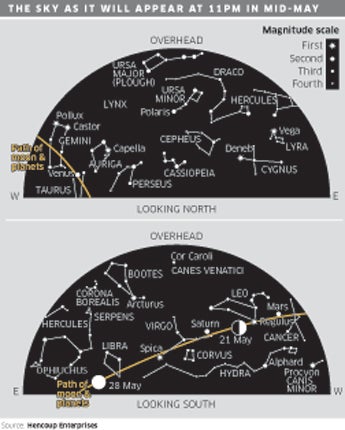
Since the Greek astronomer Ptolemy observed Polaris (the Pole Star) 2000 years ago, it has brightened more than two-and-a-half times.
This is 100 times more than theory would predict, and astronomers are baffled as to why. And William Shakespeare, it turns out, had it all wrong with Julius Caesar declaiming: "I am as constant as the northern star". Now we know the star is far from constant.
Polaris fluctuates in its short-term luminosity as well. The star belongs to a family called "Cepheid variables". These stars pulsate in size and brightness, and are important in determining distances of remote galaxies. Yet Polaris – the brightest Cepheid – still puzzles astronomers.
Cepheids are giant stars: Polaris is 30 times wider, and – on average – 2200 times brighter than the Sun. The Hubble Space Telescope has even allowed astronomers to weigh it; by following the motion of a companion star spotted orbiting close by, astronomers calculated that the Polaris is seven times heavier than the Sun. In the mid-1980s, the Pole Star's light began fluctuating less and less: heading towards a Shakespearean constancy. But – in the last decade – fluctuations have picked up. And no-one knows why.
Locate this celestial puzzle by tracing a line from the end of the Plough. Polaris is always due north, so you can use it to find your way home. Shakespeare had this in mind; all the other stars move around the sky but the Pole Star appears fixed – or "constant" – as it lies almost directly above the North Pole. In fact, Earth's poles swing around over a period of 26,000 years, so the star nearest to the pole gradually changes. At the time of the Trojan Wars, the "pole star" was Kochab. In 14,000 years time, it will be the beautiful Vega.
What's Up
Venus is the undisputed "star" of the month, illuminating the western sky like a lantern, and on 15 and 16 May, it forms a lovely pair witht the narrow crescent Moon.
To the left are four bright objects – but two are planets (the stars twinkle, the planets don't). Starting in the west, we have Mars, travelling from Cancer towards Leo, and fading as our faster-moving planet Earth leaves it behind. Next along is Regulus, the blue-white star marking the heart of Leo, the celestial lion. Third is pale yellow Saturn, though you'll need a telescope is to spot its famous rings. Finally, Spica; the brightest in the constellation of Virgo, the virgin.
Look out for shooting stars coming at the beginning of the month. These annual Eta Aquarid meteors are fragments of Halley's Comet, burning up in Earth's atmosphere. But the show will be spoilt this year by bright moonlight.
Diary
5: Maximum of Eta Aquarid meteor shower
6: 5.15 am Moon at Last Quarter
14: 2.04 am New Moon
21: 0.42 am Moon at First Quarter
26: Mercury at greatest elongation west
28: 0.07 am Full Moon
Join our commenting forum
Join thought-provoking conversations, follow other Independent readers and see their replies
Comments
Bookmark popover
Removed from bookmarks