Science

Partly Sunny with Showers 10° London Hi 14°C / Lo 9°C

War, what is it good for? It made us less selfish

Scientists explain how altruism evolved over 200,000 years of conflict
By Steve Connor, Science Editor

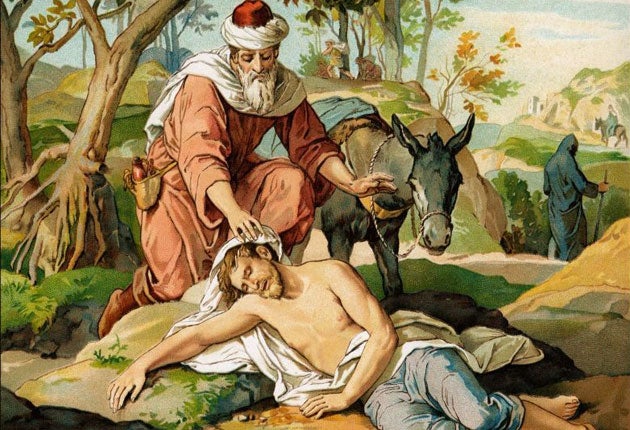
'The Good Samaritan' from 'The Life of our Lord'

Alamy

'The Good Samaritan' from 'The Life of our Lord'

One of the defining characteristics of being human is the supreme act of personal sacrifice needed to lay down one's life for the good of the group – but could such altruism be hard-wired in our genes as a result of Darwinian evolution?

Biologists have argued for decades about the evolution of altruism and long ago came to the conclusion that Darwinian natural selection cannot explain acts of supreme personal sacrifice except those directly connected with helping the survival of close blood relatives who share similar genes.

But now a study has suggested that altruism in prehistoric human societies may after all have resulted from a form of natural selection caused by a state of near-continual warfare between competing tribes of hunter gatherers, an idea that Charles Darwin himself first suggested in his 1873 book The Descent of Man.

A scientist has suggested that because so many of the 200,000 years of human history were spent during our hunter-gatherer phase, before the invention of agriculture, less than 10,000 years ago, this long period in our evolutionary history shaped our social behaviour. Moreover, he believes that altruism may have evolved directly as a result of tribal warfare because personal sacrifice was the key that enabled one group to be victorious over another.

Samuel Bowles, of the Santa Fe Institute in New Mexico, said: "Warfare was sufficiently common and lethal among our ancestors to favour the evolution of what I call parochial altruism, a predisposition to be co-operative towards group members and hostile towards outsiders.

"Biologists and economists have doubted that a genetic predisposition to behave altruistically – to help others at a cost to oneself – could evolve, excepting the help extended to close genetic relatives."

In his study, published in the journal Science, Dr Bowles takes on the proponents of the selfish-gene theory of human evolution by suggesting that natural selection worked on groups of people co-operating together, rather than just individuals.

Drawing on archaeological data from the Stone Age and ethnographic studies of latter-day tribes of hunter-gatherers, Dr Bowles concluded that it was possible for altruism to have evolved by Darwinian selection – if the warfare was intense enough between competing tribes and there were sufficient genetic differences between these human groups.

He has showed that genetic differences between human groups were indeed greater than previously thought, and that warfare was a near-continual activity that must have shaped early human social behaviour. As a result, altruistic acts of personal sacrifice helped one group to survive in favour of another, he said.

Dr Bowles said that the "altruistic warrior" theory is just one scenario that could explain the evolution of altruism in early human societies. "[The] willingness to take mortal risks as a fighter is not the only form of altruism... more altruistic and hence more co-operative groups may be more productive and sustain healthier, stronger, or more numerous members, for example, or make more effective use of information," he said.

Ruth Mace, an anthropologist at University College London, said Dr Bowles' study went against the accepted idea of the selfish-gene theory which long ago rejected the proposal that natural selection worked at the level of the group rather than the individual.

"Recent literature on social evolution has reopened the debate, arguing that in some circumstances group selection might be important, especially in a cultural species like humans," she said.

In a separate study published in Science, scientists proposed that a key driver that led to the evolution of the other defining attributes of being human – such as sophisticated tool making and the development of art and culture – resulted from population growth rather than biological changes.

Scientist from University College London say they believe the sudden emergence of human cultural traits such as art came about when population density passed a certain threshold, allowing the free exchange of ideas.

Post a Comment

View all comments that have been posted about this article.

Offensive or abusive comments will be removed and your IP logged and may be used to prevent further submission. In submitting a comment to the site, you agree to be bound by the Independent Minds Terms of Service.

Comments

selfish-gene theory can be adapted
[info]jhdbhicdsp wrote:
Friday, 5 June 2009 at 03:03 am (UTC)
How does this contradict the selfish gene theory, really? The members of a waring group of hunter-gatherers may have sufficient genetic commonalities to let it work like this: You sacrifice yourself, and thereby contribute to the survival of sufficiently many of your genes in other members of your group.
University of making it all up
[info]mssuperior wrote:
Friday, 5 June 2009 at 06:28 am (UTC)
Yes, well not quite making it all up but do we need an excuse for killing even more servicepeople and civilians? Warfare has changed. Fighting is often a male form of self-harm. If we armed neighbouring towns in the uk they'd start blasting at each other. It's self interest not altruism which made us less selfish. It's lack of choice rather than volunteering exctment which fuels mainly the army. Please don't insult us with this sort of drivel. Have a good weekend.
Re: University of making it all up
[info]sanitywins wrote:
Sunday, 7 June 2009 at 05:16 pm (UTC)
ms opinionated,

I think you missed the point.

Despite what you seem to think, the study wouldn't actually have been conducted in order to encourage warfare.

Nor is anyone likely to read this study and say "great lets have a war then" (but thanks for raising the moral alarm on this just in case).

Whether you find the implications unpleasent or not doesn't effect the scientific truth. In actual fact it sounds like the jury is still out on if this one.

In the mean time, try not to let your opinions colour your judgement and refrain from insulting US with your drivel.

Also, "fighting is often a form of male self harm"?? What kind of new age rubbish is that? You sound like a sexist pig (yes you heard me).
Hunter gatherers did not live in constant warfare
[info]old_green wrote:
Friday, 5 June 2009 at 06:44 am (UTC)
Anthropologists have found that hunter gatherers did not live in constant warfare - that warfare between such tribes is very rare. Moreover, they have high levels of cooperative behaviour.

Warfare came with the agriculture and the age of empires - relatively recent in evolutionary terms.

There is an argument that much of the worst behaviour comes from collective societies, and that these function as though they are a new class of collective organism, with their own collective behaviour patterns.

Much of the dysfunctional behaviour of certain individuals comes from the intense pressure of adapting to life within such collective societies. particularly modern industrial socieities.

I am optimistic about human nature - I think socieities only work at all because human beings are fundamentally cooperative - think of what life in cities would be like if we really did live by selfishness alone.

Certain classes of people do seem to live by selfishness. The fact that such people are prevalent in the upper strata, as the guiding force of society, is indicative of the guiding forces of society.
War goof for making us less selfish?
[info]wer_wind_blows wrote:
Friday, 5 June 2009 at 06:50 am (UTC)
Try and tell this to the knife and gun culture :) Yes, you can definately see altruism as a consequence of all the knife crime. Selfishness and pride seems to be the catylist for war.

And this article implies that one will sacrifice themselves for the good of their group, yet we see in humanity that an individual will sacrifice himself for another individual who is completely different from them.

Another study published in the last week also implied that differences are an attraction. The genetic differences between human beings today are less than 1%.

Altruism is an inherent characteristic of humanity.
All come from the same ancient mother
[info]corporeal4now wrote:
Friday, 5 June 2009 at 07:28 am (UTC)

All of us share the DNA of an ancient mother. So the group survival theory doesnt make sense. The other fact the article misses is that not only are humans will to sacrifice their lives, humans are also generally build with selfless traits.

Many children will readily help or share with strangers without gain. Obviously, society changes this in us so that we become selfish and look after number1 as we grow up. Modern society has gone to the other extreme, we are now in the era of "me, me, me" and selfgratification. The needs of the society are far less important.
Re: All come from the same ancient mother
[info]bobbellinhell wrote:
Friday, 5 June 2009 at 01:01 pm (UTC)
I'm not sure about the argument from children's behaviour, it would be equally true to say that young children readily hit each other, lie and steal each other's toys.
ANOTHER LOAD OF TWADDLE
[info]georgesign wrote:
Friday, 5 June 2009 at 02:23 pm (UTC)
Another load of twaddle from the, so called, Science Editor. If altruism was hard-wired into the genes and we were all into "the supreme personal sacrifice" then soon wouldn't be any humans around. Its like saying if we all had a "gay" gene the worlds population would be all homosexual. Humans work on a "self-interest" principal. It is religion and clever propaganda that seeks to indoctrinate people with altruism. Haven't you noticed its always the religious leaders and the ruling elite that are the survivors after wars.
[info]duncanmcfarlane wrote:
Friday, 5 June 2009 at 02:44 pm (UTC)
I agree that human instinct is more about group survival than individual survival, but not that war was what created this instinct. Humans had to co-operate to survive at all as hunter-gatherers and then as farmers, in order to hunt and to plant and gather harvests - and to help ill or injured or old or young members of the group so that they would be helped by the group when they were ill or injured or old.
War = debt = profit for central banks - that's it!
[info]collin_brown wrote:
Friday, 5 June 2009 at 03:50 pm (UTC)
Re: War = debt = profit for central banks - that's it!
[info]smoothop8388 wrote:
Tuesday, 9 June 2009 at 08:10 am (UTC)
EXACTLY.. people seriously need to open their eyes to this fact, which is always missed!!!
Selfishness.
[info]chiennoir wrote:
Friday, 5 June 2009 at 04:19 pm (UTC)
old_green "Certain classes of people do seem to live by selfishness. The fact that such people are prevalent in the upper strata, as the guiding force of society, is indicative of the guiding forces of society." It is also an indication that to get to the top and become part of the utter strata you need qualities of selfishness and ruthlessness. These may be genetic in certain people. On the other hand they may be due to upbringing and background. The rest of us, I suspect, would consider it a waste of a life to have these ambitions and live only for them.
[info]colin7 wrote:
Friday, 5 June 2009 at 04:50 pm (UTC)
You say;

"One of the defining characteristics of being human is the supreme act of personal sacrifice needed to lay down one's life for the good of the group."

Other animals show such characteristics, especially other primates. See the books of Franz deWaal on his work with primates who demonstrate reciprocal altruism. It is a necessary survival strategy. And birds too will sacrifice themselves for their young.
Makes sense
[info]asandanny wrote:
Friday, 5 June 2009 at 06:02 pm (UTC)
Wow, makes pretty good sense to me dude. Well done!

RT
www.online-privacy.vze.com
"selfish gene"
[info]alsation78 wrote:
Friday, 5 June 2009 at 06:05 pm (UTC)
Dawkins book "The Selfish Gene" was arguably an extrapolative re-imagining of an earlier work by George Williams on the adaptation approach to natural selection.

Not once in the original publication is the word "selfish" to be found! Just as he reworks the older 'mimeme' to sound more 'sciencey' so to does he introduce the idea of selfishness to explain something more complex ... the 'gene-centred approach' to adaptation.

I beleive it borders on academic fraud, yet we, as this article, treat it as a foregone conclusion. In the spirit of the original publication and older idea ... 'gene-centered' rather than 'self-centred' means something entirely different.

Altruism, co-operation, an interest in other cultures and ideas was just as much a part of survival as "selfishness". Science must remain neutral on such things rather than making value judgements.
"the cuckoo-clock"
[info]leonard_merryl wrote:
Friday, 5 June 2009 at 06:14 pm (UTC)
(c) Orson Welles
warfare was a near-continual activity that must have shaped early human social behaviour
[info]kuma2000 wrote:
Friday, 5 June 2009 at 06:30 pm (UTC)
Who said it ever stopped?
Jesus
[info]ozwoz wrote:
Friday, 5 June 2009 at 10:58 pm (UTC)
So Jesus sacrificed himself for the group because of some gene? Well, maybe. The group in tis cae would by humanity, right?

Ozwoz
Not good enough
[info]johncmullen1960 wrote:
Saturday, 6 June 2009 at 07:18 am (UTC)
Trying to understand war (or pop music, cinema, redundancies, elections...) by concentrating on the individual genetic or acquired characteristics, is a mistake. Unless we take into account the social structures (business, profit, nationalism...) which have their own dynamic, history cannot be explained. This theory is what we call reductionism, and it doesn't work.
Re: Not good enough
[info]smoothop8388 wrote:
Tuesday, 9 June 2009 at 08:45 am (UTC)
I agree; we cannot simplify things this way.. There are many reasons people enlist in the army, many reasons why politicions go to war, many reasons people cheer for war, n' many reasons people sacrafise themselves for what they assume as the well being of society.. Genes, Society, Culture, n' History, both personal n' collective... etc.. all play some role
Re: "selfish gene"
[info]kodak321 wrote:
Saturday, 6 June 2009 at 04:55 pm (UTC)
alsation78. Spot on.
Why concentrate on a willingness to kill others
[info]larkspur_14 wrote:
Sunday, 7 June 2009 at 08:16 am (UTC)
when Boles admits: " more altruistic and hence more co-operative groups may be more productive and sustain healthier, stronger, or more numerous members, for example, or make more effective use of information..." Perhaps it is our culture's glorification of war and willingness to slaughter billions of other humans which distorts our perception. Is it that somehow, for us, cooperation and peaceful altruism aren't so sexy?
[info]venus2 wrote:
Sunday, 7 June 2009 at 02:26 pm (UTC)
Absolutely enthralling.....there MUST be more to tell...and quick before I fall asleep from this monotonous clap trap. WAR is for profit and any SANE person wouldn't argue that point unless of course you belong to a corrupt Gov't.
[info]adbnuohn wrote:
Monday, 8 June 2009 at 02:40 am (UTC)
all praises to the independent for being different but come on, journalism needs to be have a bit more of an evidence based reserach style of writing so firstly who is this scientist from University College London.
and on the subject of war lets not give in to feelings of optimism just because you (the writer living in a well developed nation) got your cup of coffee this morning and started cooking up fake stories such as this. this sounds very much along the lines of Stephen PInker's idea that acts of terro**** are a sign of progress in civilisation as it can be looked at as localised violence. Violence is not means to an end. there is no going back now, what was commited many years ago will have repercusions in the future. western society is evolving on the fact that giving way to violence (war), hate, selfishness under the illusion of competition is progress for society!!!???
so now the credit crisis, or whatever is proof that we are nations with serious debt and little heart
I would really like to see these less selfish and more altruistic people that have emerged from all this history.
For every man has their own life as their history, we can read about it in books but it is not the same. like most if you dont follow your heart and continue to act like as ape (whatever!) you will give in to a meaningless life where you wash your brain (hands) with more violence, hate and selfishness.. because the heart cannot live with such things and your end will be for nothing. it is not in our nature to go to war or be selfish, it is to follow your heart and save/preserve the world a little bit more
Even if it does make us unselfish...
[info]pikachusgirl wrote:
Tuesday, 16 June 2009 at 12:00 am (UTC)
I understand what you are saying, yes war does train us to make sacrifices, but the thing is, do we really need to make sacrifices?? Sacrifices are great is they're needed, but they aren't when it comes to war! If the leaders of countries would get over themselves and try and sort things out with other countries peacefully, no one would even need to die! So as much as I agree with you, there are other, less deadly, ways to train ourselves to be unselfish.

Most popular