We're all aliens... how humans began life in outer space
The mystery of how the building blocks of biology came to be on Earth may finally have been solved
As scientific mysteries go, this is the big one. How did life on Earth begin? Not how did life evolve, but how did it start in the first place? What was the initial spark that lit the fire of evolution?
Charles Darwin solved the mystery of life's wondrous diversity with his theory of natural selection. But even he was flummoxed by the ultimate mystery of mysteries: what led to the origin of life itself?
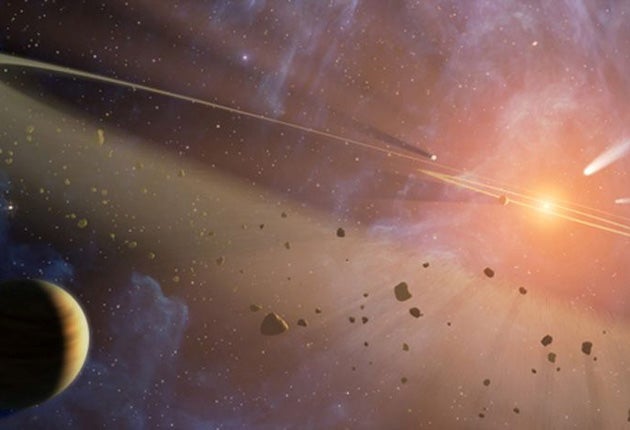
In trying to answer the problem, scientists have turned to the stars, or at least the "builders' rubble" of meteorites and comets left over from the formation of our solar system some five billion years ago. These space rocks, they believe, could help to explain why life began here on Earth.
In fact, a growing body of evidence is now pointing to deep space as the possible source of the raw materials that formed the building blocks of life. The latest study, which focused on a class of meteorites that fell on to the Antarctic ice sheet, also suggests that life's origins may have been extraterrestrial.
An analysis of the meteorites has revealed that these rocks can be induced, under high pressures and temperatures, to emit nitrogen-containing ammonia, a vital ingredient for the first self-replicating molecules that eventually led to DNA, the molecule at the heart of all life.
"These particular meteorites have been preserved in the ice and are found pristine – that is, they show less terrestrial contamination," said Professor Sandra Pizzarello of Arizona State University, who led the meteorite study published in the Proceedings of the National Academy of Sciences.
"What is important is the finding of abundant ammonia. Nitrogen is an indispensable ingredient for the formation of the biopolymers, such as DNA, RNA and proteins, on which life depends, and any theory that tries to explain life's origin has to account for a supply of 'usable' nitrogen," Professor Pizzarello said. "Therefore, its direct delivery as ammonia and in relatively large amounts from the nearby asteroids could have found a 'prebiotic venue' on the early Earth."
Tests have also shown that the nitrogen in the ammonia released by the meteorite is composed of unusual isotopes, indicating an extraterrestial origin rather than contamination from a terrestrial source.
Professor Pizzarello and her colleagues believe that similar meteorites falling to Earth about 4 billion years ago could have produced a constant and replenishable supply of ammonia, and hence nitrogen, which was so necessary for the formation of the first self-replicating molecules.
Previous studies of fossilised microbes in ancient rocks have shown that primitive life must have existed at least 3.5 billion years ago. Yet little is known of the time before that when life originated, except that it must have been very inhospitable.
The planet was bathed in intense ultraviolet light which quickly destroys organic molecules, and was pummelled with meteorites during the "heavy bombardment period" from 4.5 billion to 3.8 billion years ago. However, this bombardment of meteorites may have actually come with a silver lining, given that many of these space rocks would have carried the relatively delicate organic molecules necessary for life to get started.
Earlier studies have already confirmed that meteorites contain many different kinds of organic molecules, such as the amino acids that make up proteins to the nucleobases that form the building blocks of DNA, the molecule of inheritance. But this is the first time that a meteorite has been shown to be capable of providing a plentiful supply of nitrogen-containing ammonia, said Caroline Smith, the curator of meteorites at the Natural History Museum in London.
"The early Earth was a very violent place. It was hot and did not have the oxygen we have now so it was not conducive for the presence of molecules needed for life," Dr Smith said.
"Obviously ammonia is an important constituent for the idea that meteorites and other cometary material helped to seed the Earth with the buildings blocks needed for life. It adds a further piece to the jigsaw puzzle."
Making an impact
* Scientists estimate between 40,000 and 60,000 tonnes of meteorites and other cosmic debris land on Earth each year. About four billion years ago, during the period of the "heavy bombardment" of the early Earth, the amount would have been much higher. Scientists study meteorites to understand the evolution of the solar system, but these lumps of space rock may also tell them something about the origin of life here on Earth, and possibly on other planets.
The Murchison meteorite
This large meteorite fell to Earth on 28 September 1969 near the town of Murchison in Victoria, Australia. It is one of the most studied meteorites and its value lies in the fact that it was found immediately after it landed, thus limiting the risks of terrestrial contamination that could confuse any chemical analysis. Exhaustive tests on the rock have revealed that it contains a rich variety of organic molecules, such as amino acids, which are the building blocks of proteins, and nucleobases, found in DNA, the vital molecule of inheritance. Many scientists believe that the meteorite provides strong evidence of an extraterrestrial origin of life's building blocks.
The ALH 84001 meteorite
This meteorite was found in 1984 in a region of Antarctica called Allan Hills. There is no dispute that it came from Mars and that it landed on Earth many thousands of years ago, but there is great controversy over claims made in 1996 by Nasa scientists that the meterorite shows evidence of fossilised life forms that may have originated on the Red Planet. The potato-sized rock contains traces of "microfossils" that could have come from extraterrestrial microbes, the Nasa scientists claimed. Others, however, question whether these traces of life exist.
Join our commenting forum
Join thought-provoking conversations, follow other Independent readers and see their replies
Comments
Bookmark popover
Removed from bookmarks