14,000 knife victims a year
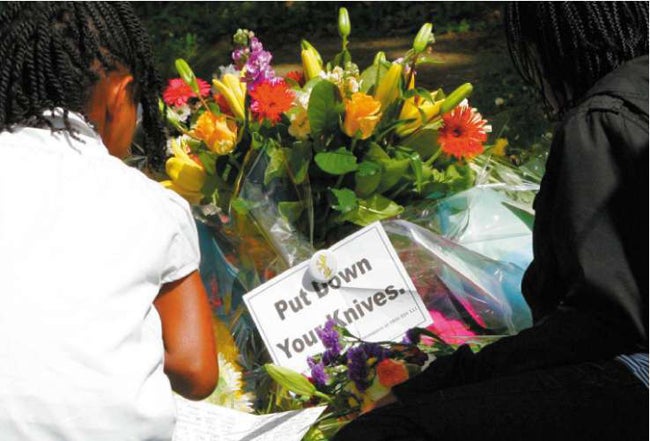
Knife violence in Britain is far worse than official statistics suggest, with almost 14,000 people taken to hospital for injuries caused by knives and other sharp weapons last year.
According to the latest Department of Health statistics, an average of 38 victims of knife wounds are admitted to accident and emergency departments across the country every day.
An analysis of hospital admissions data for England and Wales by the IoS revealed that assaults and injuries from knives and sharp implements, together with sword and dagger injuries, resulted in 12,340 people being admitted last year – 446 of whom were no older than 14. This is an increase of 19 per cent on the 10,372 admissions five years ago. The latest figures from Northern Ireland and Scotland bring the total number of victims in Britain to 13,795 each year.
Dr Tunji Lasoye, A&E consultant at King's College Hospital, London said: "In a nutshell the numbers of stab victims coming into A&E have gone up. It used to be that we would see isolated cases at weekends, but now it is nearly every day of the week. And the age of the victims has gone down. We used to see people in their early 20s; now they are in their mid-teens. And 10 per cent of the victims we see now are girls, which wasn't the case four or five years ago."
The latest statistics from hospitals in England alone highlight an 88 per cent jump in the number of children suffering stab wounds – from 95 in 2002-03 to 179 in 2006-07. And among 16- to 18-year-olds, there has been a 75 per cent rise from 429 to 752.
New figures provided to the IoS under the Freedom of Information Act highlight how the number of people being prosecuted by magistrates for possessing knives has rocketed up from the 4,489 in 1997, the year Labour came to power. By 2006, that figure had jumped to 7,699.
Most were not jailed, with just 14 per cent ending up in prison for little more than three months on average. Suspended sentences leapt from nine in 1997 to 552 in 2006.
The revelations undermine claims by the Home Secretary, Jacqui Smith, last week that knife crime "is not more serious than it has been previously".
Government assurances are based on results from the British Crime Survey, which has recorded "knife-enabled crime" as remaining stable at between 5-8 per cent of all violent crimes in the past decade.
But a report by the Centre for Crime and Justice Studies at King's College appears to confirm the IoS findings, noting that knife crime "suffers from a lack of research on the nature, extent, cause, motivation, frequency and possible growth of knife carrying".
London remains the centre of what is increasingly viewed as a nationwide epidemic. Fatal stabbings of teenagers in London total 14 since the start of the year. In total, 18 have been murdered, compared with 27 for the whole of last year.
The capital accounted for more than a third of all under-16s taken to hospital with stab wounds last year, and has seen numbers of teenagers needing treatment rise from 139 in 2002-03 to 324 in 2006-07.
Hundreds of people were due to attend a rally held early this morning in Islington, north London, where one of the most recent victims, 16-year-old Ben Kinsella, was stabbed to death last Sunday. Yesterday it emerged that the youngster had written a letter to Gordon Brown as part of his schoolwork, warning that knife violence was becoming "part of our culture".
Detectives continue their investigation into the knife murder of 16-year-old Shakilus Townsend in south London last Thursday.
In response to growing public concern about knife crime, the Association of Chief Police Officers (Acpo) will issue new guidance tomorrow, calling on all forces and crown prosecutors to charge anyone over 16 caught in illegal possession of a knife. This will extend to under-16s already "known" to the police.
Acpo wants hospitals to notify police of all patients with stab wounds, in the same way that they do with gunshot victims. The police now want to use hospital records to identify knife-crime hotspots.
Campaigners calling for tough action were not impressed by the Met's announcement on Friday that just 75 officers – a fraction of its 30,000 strength – will run a new taskforce against knife crime across London's 32 boroughs.
Lynn Costello, co-founder of Mothers Against Murder and Aggression, said: "We have to get tough. We've let our kids get away with murder for years and now they are literally getting away with murder – or think they can."
Additional reporting by Brian Brady and Andrew Johnson
Bookmark popover
Removed from bookmarks