Action on scandal of women in jail
For years, the female prison population has been rising as more and more are locked up – often for minor offences. But Maria Eagle, the Justice minister, has decided that enough is enough
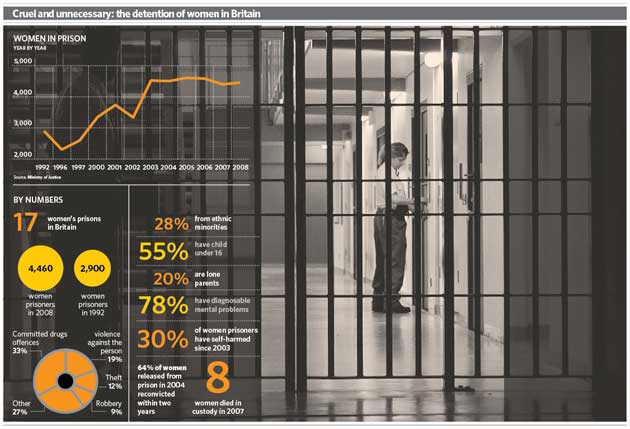
Too many women are being jailed for petty crimes and the Government must cut the number of female prison inmates, the Justice minister has told The Independent.
The total of imprisoned women in England and Wales doubled in the past decade to 4,460. Maria Eagle, the Justice minister, said too many vulnerable and mentally-ill female offenders are being locked up, and that the Government could achieve a "significant" cut of hundreds, to the point where some women's prisons could be closed.
The Justice Ministry will promise extra money to community programmes aimed at rehabilitating repeat petty criminals, such as shoplifters, who would otherwise be jailed. Ms Eagle will ask magistrates to look at alternatives to jail for female offenders, many of whom have young children.
Ministers are also optimistic about removing many of the 900 foreigners in women's prisons, particularly the Jamaican and Nigerian "drug mules" caught by immigration officers.
"We are working hard to try and get proper prisoner transfer arrangements in place," said Ms Eagle. "If we can get those sorted out, women drug mules will be the type of person you would want to send back."
The ministry hopes to see the first falls within six months – it will have to reverse a trend that has already seen the number of female inmates rise by 139 in seven months – and to achieve reductions of "hundreds" within two years.
"For those who are dangerous and serious offenders, prison is the right place and we need to make sure that our custodial estate is available to hold those who really ought to be there," Ms Eagle said.
But she added that "an awful lot of the rest" could be better supervised and rehabilitated in the community: "Clearly there is big scope here for diverting a significant proportion."
She pointed to the one-third of female inmates who had never been in prison before and to the high numbers who were remanded in custody awaiting trial but not subsequently jailed – with obvious implications for childcare in some cases. She added that 80 per cent of women prisoners had mental health problems and that many were multiple drug users.
Aides confirmed later that the ministry's aim was to reverse the increase in women prisoners, starting to reduce numbers within 12 months. They believe hundreds can be taken off the total as beefed-up community sentences that force women to tackle deep-seated problems are encouraged around the country.
Ms Eagle said she would be pushing for cash spent on locking women up to be channelled into developing programmes that keep women out of jail in the first place. "This can be a virtuous circle," she said. "We spend about £35,000 a year keeping a woman in prison – you could achieve a lot in the community using that kind of money. There's a big prize here if we can keep the focus and the forward momentum."
She said the department intended to "engage more" with magistrates to convince them to jail fewer women.
"We need to give them confidence in community sentencing at a local level by having provision that is suitable for women and by having arrangements... that can tackle the revolving door that can be women's offending."
She admitted that the Government had until recently failed to face up to the problems faced by female offenders, which include histories of domestic abuse and inmate suicide. Routine strip-searching of prisoners – attacked by critics as degrading, particularly as many female offenders have suffered abuse – is due to be banned by the end of the year.
"It is almost inevitable that when women are only 5 per cent of the jail population that this has not been at the top of the list of things to do," she said.
The drive to divert female offenders from jail would enable the prison service to make conditions more suitable for women who cannot be released and eventually close some of England's 14 women's prisons, she added.
Ministers have been impressed with the Yorkshire-based Together Women programme and the Women's Turnaround Project, based in Cardiff, which advise offenders on training, housing, drug abuse and looking after their children.
A recent report by Baroness Corston, a former Labour MP, called for an overhaul of the Government's approach to women's offending. She suggested that female offenders could be held in a network of small jails, holding just 20 to 30 women each.
But Ms Eagle said the idea had been ruled out, amid fears that such small units could be "claustrophobic" and prone to bullying. She added: "The size is just not sufficient to enable us economically to provide the sorts of services in each of these places that you would want to provide."
Cruel and unnecessary: the detention of women in Britain
Prisoners' stories...
* Lesley Butt was on the streets at the age of 12 after her parents broke up, and was arrested at 14. Her third prison sentence was six years for drug dealing. She kicked her habit and since her release has been reunited with her sons, and gives talks at schools.
* Aimee and her husband had been together since she was 16, but after 10 years he left her and their nine-year-old son. Desperate for money, she dealt cocaine. She was sentenced to eight years in prison. "Every time I saw my boy, I could feel him slipping away," she said. "I was transferred to three different prisons, which made visiting difficult. So instead, I'd write to him and send pictures."
* Petra Blanksby was abused from the age of five, and was raped in a children's home aged 14. After several breakdowns, she was charged with arson and remanded in New Hall prison, Wakefield, where staff recorded at least 90 attempts at self-harm. Eventually, she hanged herself with a shoelace and died aged 19.
* Cheryl spent two and a half years in prison for a "white collar" crime connected with her husband's business. "I was not someone with mental health problems, but I developed them. My pain was caused mainly by the separation from my daughter."