Army of mavericks lays down its arms
A small band of vicious terrorists killed some 150 people, many of them in internal feuds.
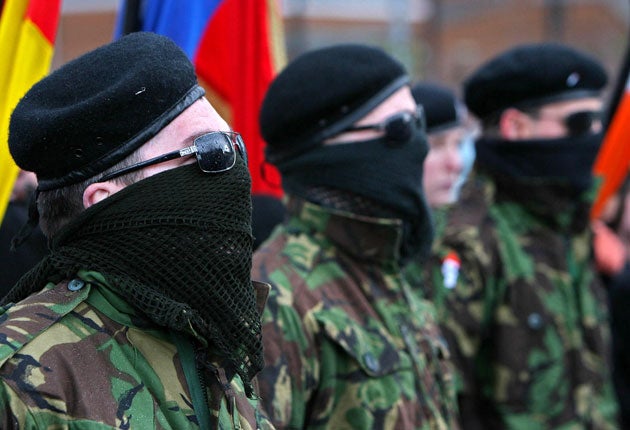
It was an organisation that blew up a crowded disco and machine-gunned the congregation of a Protestant gospel hall, and had in its ranks fearsome gunmen with nicknames such "Mad Dog" and "Doctor Death".
So when the Irish National Liberation Army yesterday signalled that its decades of violence are behind it, and that it intends to decommission its weaponry, the news was greeted with widespread relief.
In the past few years the organisation's murders have been sporadic rather than on a large scale, the group claiming that its victims have been involved in drug-dealing. But it possesses a significant number of guns, and it has been active in extortion, protection rackets and other types of criminality.
If it sticks to its promises, its disappearance will therefore be a major step towards a more peaceful and stable Northern Ireland.
Although it was always much smaller than the IRA, it killed more than 150 people during the Troubles. Among these was Airey Neave, the Tory MP and close ally of Margaret Thatcher, killed by an INLA booby-trap bomb within the precincts of the House of Commons.
Its assassinations also included that of the loyalist paramilitary leader Billy Wright, whose death inside the Maze prison sparked a wave of retaliatory attacks.
But in the republican backstreets of Belfast it will also be remembered for the large number of fatalities generated by internal feuding. Dozens died in disputes between the INLA and other minor republican groupings, while more were killed during faction-fighting inside the organisation.
It began life as a left-wing breakaway in the 1970s, killing Airey Neave in 1979. Although its ideological content eventually disappeared, its members originally displayed republican dedication: three of them were among the 10 hunger strikers who in 1981 starved themselves to death in the Maze.
With many in republican areas regarding this as self-sacrifice of the highest order, hundreds flocked to its ranks in the years that followed, some of them disillusioned former members of the IRA. The result was a wave of violence which in a three-year period brought more than 50 deaths.
Seventeen lives were lost when the INLA set off a bomb at a disco at the Droppin Well public house in Ballykelly, Co Londonderry, in 1982. Over 150 people were crowded into the bar when the bomb exploded, bringing down the roof.
An Army officer who rushed to the scene spoke of finding bodies "like dominos, one on top of the other". Eleven of the dead were soldiers, mainly from the Cheshire Regiment, which was based in the garrison town. The others killed were civilians, four of them women.
A year later came a purely sectarian attack when INLA gunmen opened fire on worshippers at a Sunday evening service at Darkley Pentecostal Church in Armagh. The 60-strong congregation, made up mainly of farming families, was singing "Are you washed in the blood of the lamb?" when gunmen fired up to 40 shots, killing three of the church elders.
One of the injured sustained five bullet wounds to the stomach, a woman was hit in the spine, and a female organist had her elbow smashed by a bullet. Twenty-six children present took cover under their seats.
The leader of the INLA at the time was Dominic "Mad Dog" McGlinchey, who later said there was no justification for killing "entirely innocent hill-billy folk who had done no harm to anyone". He admitted, however, providing a rifle used in the attack.
McGlinchey, one of the most notorious of republican gunmen, was believed to have ordered the Droppin Well attack. As INLA "chief of staff" he shot dead a number of its members, sometimes claiming they were security force informers.
In a newspaper interview he said he himself had killed around 30 people. He declared: "I like to get in close to minimise the risk for myself. I will probably get shot eventually. There is a good possibility of my not seeing the end of the struggle, but I don't really give it a lot of thought.
"I always try to avoid being shot. I will be remembered for nothing. I have no illusions about myself. The only people who will remember me will be my family and particularly my children."
That was in 1983. Four years later McGlinchey's wife, Mary, who was also active in the INLA, was shot dead, hit by nine bullets as she washed her two young sons in her bathroom. Those who shot her were said to be exacting revenge for previous feud killings.
McGlinchey himself was in prison at the time, but after his release he too was shot dead in 1994, attacked as he left a video store by three men who knocked him to the ground and pumped 14 bullets into him.
The McGlincheys were regarded as among the most dangerous members of the INLA, but others were equally fearsome. One of these, Gerard "Doctor Death" Steenson, was said to have carried out dozens of murders.
Steenson was jailed for life after being convicted of 67 terrorist offences, including seven murders. The judge described him as "a most dangerous and sinister terrorist – a ruthless and highly dedicated, resourceful and indefatigable planner of criminal exploits who did not hesitate to take a leading part in assassinations".
He was jailed on the evidence of one of the "supergrasses", INLA members who testified in court against former associates. But most of these cases collapsed on appeal, and Steenson and many others were released.
The irony was that, once freed, many of them died in further feuding. He himself was driving in a car, apparently looking for old associates, when he was spotted by one of them and shot dead.
By that stage the INLA was regarded, by both the security forces and other republicans, as an unstable and unpredictable group which was susceptible to security force penetration and a magnet for mavericks.
One of its last major operations took place in 1997 when imprisoned INLA men in the Maze smuggled in a gun which they used to kill Billy "King Rat" Wright, a notorious loyalist assassin. After shooting Wright they threw down the gun used to kill him and surrendered to the authorities. They received additional sentences but were later released.
In the last decade the INLA has rarely sought publicity and although it has carried out some recruiting and training it was regarded more as a potential menace than an actual threat.
Various ex-members have been active in the Irish Republic, however, taking part in criminal activities such as kidnappings and extortion.
While other dissident republican groups have launched attacks on the security forces in Northern Ireland, it has not done so. It made a few small efforts to develop a significant political wing, but these were not a success, and it has no obvious political presence.
Its ranks today are said to include veteran members who believe that the time has come to give up the gun, but also some younger hot-heads. The hope is now that the organisation will fade away completely, and not generate splinters which might continue to be involved in illegality.
INLA's reign of terror Victims ranged from leading Tory MP to dancers in a disco
Airey Neave, March 1979
Margaret Thatcher's shadow Northern Ireland Secretary, 63, was assassinated by an INLA booby-trap bomb beneath his Vauxhall Cavalier at the House of Commons. The attack came just after the campaign for the 1979 general election had opened. He was expected to become Northern Ireland Secretary in the event of a Tory victory.
Darkley Pentecostal Church, November 1983
The 60-strong congregation, made up mainly of farming families, was singing "Are you washed in the blood of the lamb?" as the opening hymn of their Sunday evening service when INLA gunmen arrived and shot dead three of the church elders.
The Dropping Well Public House, December 1982
The INLA bomb attack on a disco at this Ballykelly pub at 11.15pm resulted in one of the highest death tolls of the Troubles. Eleven of the dead were soldiers, mainly from the Cheshire Regiment, which was based in the garrison town. The other six killed were civilians, four of them women.
Around 150 people were inside and 30 were injured. The bomb used in the incident was comparatively small, containing only 5lb of commercial explosives, and it had been placed under an unoccupied bench seat.
Billy Wright, December 1997
Nicknamed "King Rat", Wright founded the Loyalist Volunteer Force and was widely considered the most terrifying loyalist paramilitary to emerge during the Troubles. He instilled fear among Catholics, especially near Portadown, Co Armagh, where he lived. He was involved in more than a dozen killings. He died, aged 38, inside the Maze prison, where he was shot seven times by INLA inmates in an ambush of the van taking him to the prison's visitor centre. Wright's high profile made him a marked man. He said in one interview: "I'm a dead man. It would be morally wrong to back off. I have kids, but ... if I was shot dead in the morning, I would laugh in my grave."
Bookmark popover
Removed from bookmarks