Failed by her keepers: Ana Attia's story
An investigation has found Britain's Prison Service seriously lacking in its mental health provision for inmates
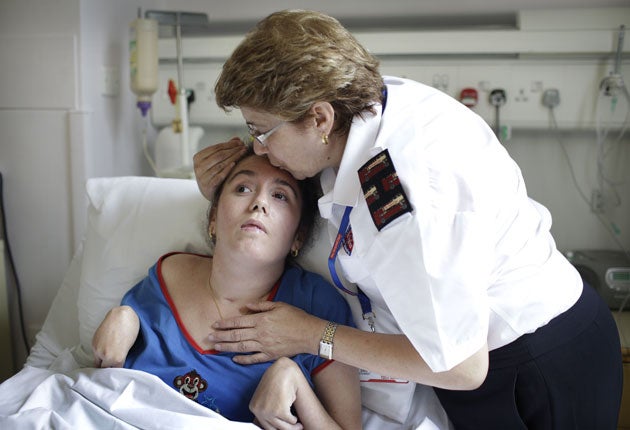
Prison authorities missed a series of opportunities to help a 21-year-old former British gymnast who was left permanently brain damaged after attempting suicide at Holloway Prison, according to an independent investigation.
Ana Attia, now 28, has been in a persistent vegetative state since she was found hanging in a single cell at the London prison more than six years ago. The incident occurred days after she had been found with a ligature around her neck.
Ms Attia, a first-time prisoner, had been extremely distressed in the days and hours leading up to the near-fatal incident, following the break-up of her long-term relationship. Prison officers were unable to spend time consoling her due to endemic staff shortages; and an officer, unaware of the recent ligature episode, allowed her unsupervised access to bed sheets which she used to hang herself.
Remanded in Holloway in June 2003 under a false name, Ms Attia was charged with offences relating to the supply of drugs and wounding with intent. The hanging deprived her brain of oxygen for so long, it left the promising athlete confined to a wheelchair, her hands and feet contorted. Now at London's Royal Hospital for Neuro-Disability, she groans in pain but otherwise cannot communicate. She will never recover.
The investigation, commissioned by the Ministry of Justice (MoJ) in 2009 after delays and repeated threats of legal action by Ms Attia's lawyers, is highly critical of the poor care she received throughout her stay, and the failure of the prison mental health team to ensure her welfare. Poor communication meant officers had no idea that Ms Attia had a history of paranoid psychosis and deliberate self-harm.
The report by Rob Allen, director of the International Centre for Prison Studies at King's College London, also condemns the lack of mental health and suicide prevention training at the prison, which holds large numbers of women with mental health issues, drug addictions, and many who self-harm. Worryingly, it questions whether the prison has improved its assessment and care of women such as Ms Attia.
Her case is only the third "near death" in custody to be independently investigated since a landmark ruling in 2006 related to the attempted suicide of a prisoner from Pentonville Prison. Then, the Court of Appeal ruled the government had a duty to conduct inquiries into near deaths in order to comply with Article 2 of the European Convention of Human Rights. Previously, attempted suicides were subject to private, internal prison investigations, whereas suicides trigger an automatic jury inquest.
But the government refused to hold Ms Attia's inquiry in public, citing a 2007 House of Lord's ruling which said public inquiries were only necessary in "exceptional circumstances". This, in essence, gave the MoJ much more leeway to refuse.
The Howard League for Penal Reform is currently bringing legal challenges against several such refusals, amid accusations that the Government is hiding the true extent of "inadequate, incompetent and abusive" treatment suffered by hundreds of mentally ill prisoners every year.
There were 27 suicides in UK prisons in 2009 and 1,844 reported incidents of self-harm at Holloway alone – an 86 per cent increase since 2004.
Anne-Marie Jolly, a Howard League solicitor, said yesterday: "The scale of potentially life-threatening incidents in custody calls for a greater degree of investigation. The cost of imprisoning vulnerable and emotionally distressed people far outweighs the cost of near-death inquiries. The MoJ should follow the spirit of the Convention and see the duty as an opportunity to create change."
Born in west London in 1982, Ms Attia was bright, popular and a keen athlete, representing Great Britain in tumbling while at school. According to her mother, Olga Rodriguez, Ana's life began to unravel after meeting her boyfriend when she was 15. She left college, stopped sports, started getting in trouble and, records show, was treated by psychiatrists for addiction and psychoses. Her true identity was not established until after the attempted suicide, but Holloway should have done more to find out about her situation, according to the report.
Ms Attia's mother said: "My daughter cried for help but they left her alone in a cell and didn't give it to her. They were supposed to look after her. But there was no communication and they made a big mistake. What they don't realise is that, because of this, I lost my daughter. She'll never come home and give me a kiss, never get married. The most hurtful thing is that they won't admit it. I need them to answer my questions. I hope one day they will say 'sorry, we made mistakes'."
Anna Mazzola, a lawyer from Hickman and Rose, said: "We are disappointed there will be no public hearing, or opportunity for Ana's family to put questions to the witnesses. The investigation has been limited by the fact so much time has passed; records have been lost, people have moved on and memories have faded... The MoJ has given Ana the minimum she is entitled to under Article 2, and only provided that after years of wrangling. I understand the Government is concerned about spiralling costs, but it should not be left to the grieving family to battle for a proper investigation into how their loved one nearly died."
A spokesman for the National Offender Management Service said: "Since Ana's attempted suicide there have been significant developments in prisoner suicide prevention policies and practices. We will carefully consider the investigation's recommendations so that lessons can be learned. We decided to publish the report as Article 2 requires the investigation to be subject to sufficient public scrutiny."
Legal challenges: Justice Ministry in the dock over refusal to act
"P" The European Court of Human Rights will hear how the Ministry of Justice (MoJ) rejected calls to investigate the treatment of the 19-year-old boy admitted to hospital 84 times with life-threatening self-inflicted injuries while he was held at Feltham Young Offenders Institute. "P" had no mental health care and spent long periods in segregation.
"G" The mental illness of 14-year-old "G" went undiagnosed despite nearly three years in custody. Instead, her persistent self-harming, including swallowing broken glass and an attempted hanging that burst blood vessels in her eyes and required her resuscitation, were seen as disruptive. The MoJ's refusal to investigate now faces a High Court challenge.
"SP" A teenage female prisoner needed repeated blood transfusions and nearly died from blood loss after self-harming. The MoJ agreed to a partial public inquiry; this will hear from "SP" herself – a legal first. The Prison Service faces questions on whether its treatment of her, including segregation, made things worse.
Nina Lakhani