Former police informants were behind 'stop snitching' campaign
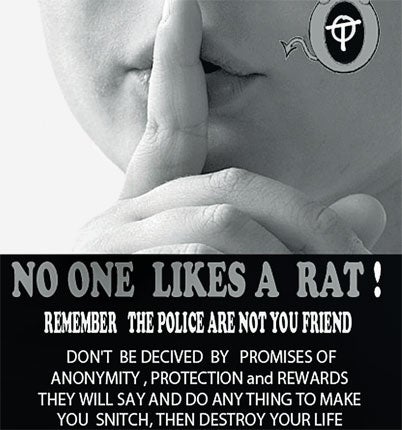
The authors of a campaign encouraging people not to "snitch" in murder cases and serious shootings are today revealed as former police informants desperate to use their experiences to force reform of witness protection schemes.
The "stop snitching" campaign caused outrage after leaflets were distributed warning witnesses to the shooting of five-year-old Thusha Kamaleswaran in south London not to give information to police.
In another leaflet, the footballer Rio Ferdinand was depicted as "a rat" for fronting a campaign to find the killers of a childhood friend.
The campaign was widely reported to be the work of gangsters scaring communities into silence, but The Independent can reveal the leaflets were in fact created as a subversive reaction to the perceived "abandonment and isolation" of a group of police informants.
On condition of anonymity, the group spoke about the motivation, legality and morality of the campaign. They said they understood why "stop snitching" was described as "sick" by some media and "irresponsible" by police. Thusha, who was shot in the chest in a shop in Stockwell in March, may never walk again.
But they said their motivation was to expose failings with witness protection – which they said was like being in "a mini Guantanamo" – and argued that only a shock campaign would lead to proper exposure and reform.
They claimed that their collective experiences, which cover four police forces across England over several years, proved the system was failing to protect victims, witnesses or the public, or to help police obtain convictions.
"In the end I didn't testify and people got off with murder," said John, who went straight to police after witnessing the aftermath of a murder. He entered the witness protection programme after signing a statement saying that a youth, whom he saw stashing a gun, admitted to him he was involved in the killing.
He said he refused to testify after police told him he did not qualify for the programme because he was a foreign national. By this time, his signed statement and real name had been revealed to the defendants, who were part of a well-known criminal gang. He also claimed police failed to honour an agreement by denying him access to his son.
The force involved said the Crown Prosecution Service had deemed him to be an unreliable witness and denied all his claims, particularly that John's nationality had anything to do with the decision to exclude him from the witness protection programme. John has lodged a civil action.
John now lives on benefits in a new town under a false name. He has not seen his son for two-and-a-half years. "I came forward and protected my community for it no longer to be my community. What did I protect? I lost my family, everything," he said.
Another member of the group, Gavin, worked at an import company and tipped off police that a customer was smuggling drugs. When officers were caught trying to break into the customer's building, things unravelled rapidly.
Gavin, who now has a new family that knows nothing of his past, said: "I was told by the police a mole in their own department had fingered me to the gang as the snitch and told I should leave as soon as possible. I had to go into hiding. I lost everything – my life was ruined."
John said there was not any way to complain. "I couldn't talk to anyone, I was completely isolated and abandoned in every sense," he said.
The pair met three others and together agreed to set about exposing their "injustice". They stole the idea for the campaign from a rap video "Stop Snichin", which was made in Baltimore and threatened to harm police informants. They consulted lawyers "not on morality but to comply with the law", set up the website in the US to keep outside UK law.
Claudia Webbe, chairwoman of the Independent Advisory Group for the Metropolitan Police's Operation Trident, which deals with gun crime in London's black community, said the campaign was "misguided and wrong".
She said: "I can't condone or support [the campaign] because it hurts vulnerable communities who are most at risk from violence."
A spokesman for the Metropolitan Police said the witness protection programme was "absolutely vital in helping make a stand against criminals" and "had a successful record that has resulted in many witnesses agreeing to give evidence". There are about 1,000 people in the UK in the programme but each police force has a separate budget.
A review of the scheme, conducted by the Ministry of Justice and the Association of Chief Police Officers, has been under way since May last year, but has no date for completion.
John's lawyer, who was present when he gave his police statement, described his client's evidence as "very strong".
He said: "Somebody independent has to be there [at the interview]. I don't want to criticise the police, because they have a tough job, but if there were more guidance maybe more people would come forward."
The names of several people in this article have been changed to protect their identites
How the campaign began
* The group took the "Stop Snitching" idea from a Baltimore-based rap video warning people who had evidence about crimes against going to the police. After consulting lawyers and taking steps to mask their identity, they began their campaign in south London in January.
* The first leaflet appeared days after the killing of Sylvester Akapalara in Peckham, south London, on 29 December last year. The 17-year-old was shot in the head and chest on the fourth floor of Heron House on the Pelican Estate. The leaflet referred people to a website which said: "Don't be decived (sic) by promises of anonymity, protection, and rewards they will say and do anything to make you snitch, then destroy your life." The group included spelling mistakes to make it seem more realistic.
* The group also dropped leaflets in the area of London where Thusha Kamaleswaran was shot in the chest. The five-year-old and 35-year-old Roshan Selvakumar were both innocent bystanders when gunfire broke out in a Stockwell shop on 29 March.
* In April, they posted leaflets in the Peckham street where Rio McFarlane, a schoolboy friend of Rio Ferdinand, had been killed in September 2010 in a drive-by shooting.
Bookmark popover
Removed from bookmarks