Mother 'helped daughter to die with lethal drugs cocktail'
Woman stricken with ME for 17 years was handed morphine and syringes
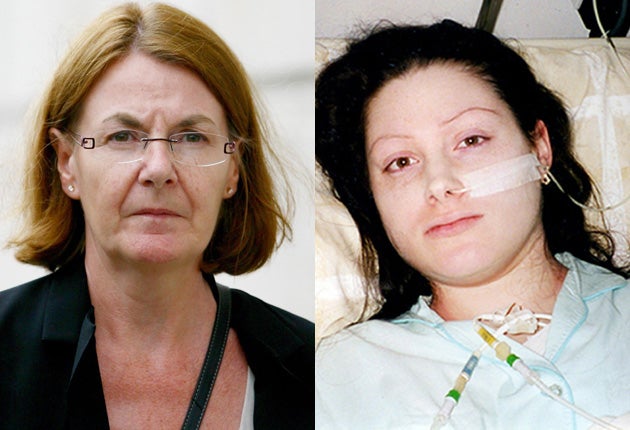
A "devoted" mother helped her suffering daughter die by handing her a lethal dose of morphine and then administering a lethal cocktail of drugs, a court heard yesterday.
Bridget Kathleen Gilderdale, known as Kay, gave two syringes filled with large doses of morphine to her 31-year-old daughter Lynn Gilderdale, who injected the medicine herself in a suicide attempt at the family home in Heathfield, East Sussex.
But when she realised the morphine dosage had not been enough to kill her daughter, she then administered more drugs, Lewes Crown Court was told.
Over the next 30 hours she gave her daughter tablets, further doses of morphine and finally syringes of air. Miss Gilderdale, who had suffered from the debilitating illness ME for 17 years, finally died on the morning of 4 December 2008. Her mother denies attempted murder, but has admitted aiding and abetting suicide.
The case comes to court just three months after the Crown Prosecution Service clarified the law on assisted suicide, outlining cases where there could be a public interest to prosecute. The Director of Public Prosecutions listed 15 factors which should be considered. Opening the case yesterday, Sally Howes QC, for the prosecution, told jurors it was not their task to judge the "motive or morals" of Mrs Gilderdale or "to choose where your sympathies lie". "It is your job to decide whether the actions of Kay Gilderdale fell outside the law," she said.
The court was told that Miss Gilderdale had been struck down with ME at the age of 14. She became bedridden and lost the ability to swallow, which meant she had to be fed through a nasogastric tube. As her condition worsened, she was said to have become distrustful of the medical profession and became dependent on her mother and other carers.
The court was told that a "turning point" came in October 2005 when Miss Gilderdale was admitted to hospital to have her catheter changed under local anaesthetic.
During the procedure her lung was punctured and filled with blood. She was placed on life support and was unconscious for three weeks, but survived.
Ms Howes said: "This traumatic experience and her lengthy hospital stay was a turning point, and she had a subsequent wish not to be resuscitated if she was in that position again."
The court heard that, in the early hours of 3 December, Miss Gilderdale called out to her mother, saying she had not administered enough morphine. Her mother spoke with her for about an hour, telling her it was "not the right time", but Miss Gilderdale insisted it was time for her "to go".
At about 3am, Kay Gilderdale gave her two syringes of morphine, which her daughter administered herself. But Ms Howes told the jury: "Kay felt this had not achieved Lynn's aim of killing herself". At about 6am, Kay Gilderdale crushed tablets using a pestle and mortar and inserted them into her daughter's nasogastric tube. The next day, at 2am on 4 December, she gave her daughter two or three doses of morphine and later injected her with three syringes of air.
Ms Howes said Mrs Gilderdale then telephoned the assisted suicide organisation, Exit, in the hope of gaining further advice, and then gave her daughter a further eight tablets. She died at 7.10am that morning and left no suicide note. The jury was told that when she was arrested on suspicion of murder, Kay Gilderdale gave no response.
Ms Howes told the jury: "We don't doubt that Lynn Gilderdale suffered from a profound illness, with a quality of life which was unimaginably wretched, and we do not dispute that Lynn had expressed a clear desire to end her life.
"The question for you to consider is what the defendant intended by her actions during those 30 fateful hours – the last hours of her daughter's life.
"It is the prosecution's case that when Mrs Gilderdale realised that the two large doses of morphine that she provided to Lynn, that Lynn self-administered to try to end her life ... instead of then realising that her daughter's suicide had gone horribly wrong, she then set about, over the next 30 hours, in performing actions which were designed with no other intention than terminating her daughter's life.
"The further morphine, further cocktail of drugs, the injecting of air – all were designed to terminate her daughter's life. It wasn't done to make her better, it was done to make sure she died."
The court heard that Miss Gilderdale had accessed the website of Dignitas, the Swiss assisted suicide clinic, more than a year before her death. She had also instructed a solicitor to draft a "living will" in which she stated she did not wish to be resuscitated or subjected to any medical intervention if her quality of life was too poor.
The case continues.