The Big Question: At what age should children be held responsible for their criminal acts?
Why are we asking this now?
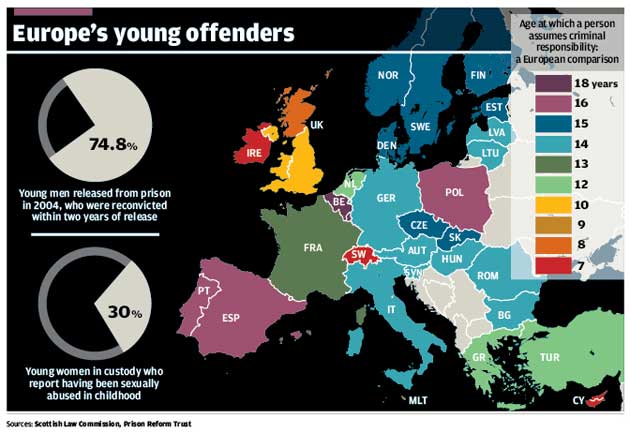
Because the former head of the Youth Justice Board, Professor Rod Morgan, has called for the age at which children can be locked up –the so-called age of criminal responsibility – to be raised. The minimum age is currently 10 years in England, Wales and Northern Ireland and eight in Scotland. Professor Morgan spoke for many criminologists and penal reformers when he argued that the age should be raised, and voiced concern that nothing would be done.
"I don't think that's a political option at the moment," he said yesterday, before explaining that too many youngsters were dragged into courts and detained at too early an age. He believes a less punitive approach would ultimately benefit society by steering them from away from crime. "If we were to use our few state boarding schools and intensive fostering," he added, "it would cost less and would be much more effective."
Why is there an age of criminal responsibility?
It is self-evident that toddlers cannot break the criminal law because they lack the maturity to understand the concept. Equally, adults cannot evade their obligation to act within the law (unless they can demonstrate that their responsibility was diminished by mental illness). Lawyers and politicians have agonised about where this line is drawn for almost as long as courts have sat in judgment over the public. Until 1998, prosecutors had to demonstrate that defendants aged between 10 and 13 knew the difference between right and wrong. That stipulation was swept away by the then Home Secretary, Jack Straw, who argued that such a requirement flew in the face of common sense because modern children developed faster, both mentally and physically, than their forebears.
How does British policy compare with that of the rest of the world?
The age at which children can be prosecuted is far lower in Britain than it is in our nearest European neighbours. The minimum age is 12 in the Netherlands, 13 in France, 14 in Germany, 15 in Sweden and Italy, 16 in Spain and 18 in Belgium. Most US states do not stipulate when children can be prosecuted, but in those that do the age varies between six and 12. Australia followed the English lead and set a minimum of 10, while it is 12 in Canada, 14 in New Zealand and 15 in Japan. Fixing an age of criminal responsibility does not necessarily mean children are jailed. Instead, it leads to young law-breakers being treated as a welfare problem.
How much serious crime is committed by very young children?
Very little, but the rare instances become notorious. Most infamous were Jon Venables and Robert Thomson, who ignited a national wave of revulsion in 1993 after they abducted and murdered two-year-old James Bulger in Liverpool. Danny Preddie and his brother, Rickie, were 12 and 13 when they stabbed to death Damilola Taylor, 10, in Peckham, south-east London, in 2000. The low age took a farcical turn in 2007 when a boy of 10 found himself in court in Salford for racially abusing an 11-year-old classmate. The judge protested: "This is nonsense... there must be other ways of dealing with this apart from criminal prosecution."
What happens to young offenders?
In Britain, children who break the law or repeatedly act in an antisocial way are first dealt with by youth offending teams, which comprise police, probation officers and social workers. Persistent offenders who ignore reprimands and warnings are sent to a youth court, which has the power to imprison offenders for up to two years or, for the most serious crimes, to a crown court. Most of those who are found guilty are given community sentences, but a small minority end up in custody, such as secure training centres or young offenders' institutions.
How many are locked up?
About 2,900 under-18s were in custody in England and Wales in November, more than 90 per cent of them boys. The figure has been stable for a few years but is twice the number locked up in the early 1990s and higher than in Europe. Finland, for example, has just three children behind bars.
How young are the youngest in custody?
In November, 37 children under 14 had lost their freedom. It is thought no 10- or 11-year-olds are currently detained in England, Wales or Northern Ireland, and only a handful of 12-year-olds, who are most likely to be held in secure children's homes.
What are the arguments for a higher age?
In no other sphere of life are 10-year-olds forced to take complete responsibility for their actions. They have to wait six years before they can leave school or marry (and only then with parental approval) and eight years to vote or see some films. So why should they be branded criminal while still at primary school? Many criminologists also argue that sweeping up children in the court system – with the ultimate sanction of custody – is more likely to lead to a life of crime, and there is some evidence to support this. A recent report by the Centre for Crime and Justice Studies at King's College, London, warned: "A court appearance can, in certain cases, confirm an adolescent's deviant identity both in their own eyes and those of others, thereby extending rather than curbing a delinquent career."
Meanwhile, a study of young offenders in Northamptonshire concluded: "Prosecution only seems to increase the likelihood of re-offending."
Are there good reasons to support the law as it stands?
Ministers believe the Bulger case is an powerful example of why the age of criminal responsibility should be retained in the most extreme circumstances. They argue that the public would not have understood if Venables and Thomson were allowed to walk free following such a brutal killing. One Cabinet member defended the law yesterday, telling The Independent: "This is not about locking them up at that age; it's about providing them with help."
So will the age of criminal responsibility be raised?
Scottish ministers look set to increase the age that children can be prosecuted from eight years to 12, following a call by the UN Committee on the Rights of the Child for it to be "raised considerably". Elish Angiolini, Scotland's most senior lawyer, has agreed that the age of criminality north of the border is "extremely low". Although the subject is occasionally discussed in Whitehall, there is little sign of a similar move in Westminster. The Ministry of Justice says it believes 10-year-olds are old enough to differentiate between right and wrong. The Conservatives agree, making clear there is no prospect of an incoming Cameron administration altering the age limit. Michael Howard, who was Home Secretary when the Bulger killers were sentenced, said, "It has been 10 for a while and I think that's quite reasonable." He also stressed that children were put in custody only "when almost everything else has been tried and has failed... before a case gets to court he's likely to be reprimanded first by the police."
Should the age of criminal responsibility be raised from 10?
Yes...
* Evidence suggests that dragging such young children into the criminal justice system backfires because it criminalises them.
* Almost every other western nation has set a higher age limit.
* It would be much better to treat the mental illness suffered by more than half of young offenders.
No...
* Children who have been in school from the age of five should know what is right and wrong.
* There has to be a way of dealing with offenders like James Bulger's killers – and they have to take responsibility for their actions.
* Raising the age limit could mean troubled youngsters getting no help.