The man who tried to sell the Ritz
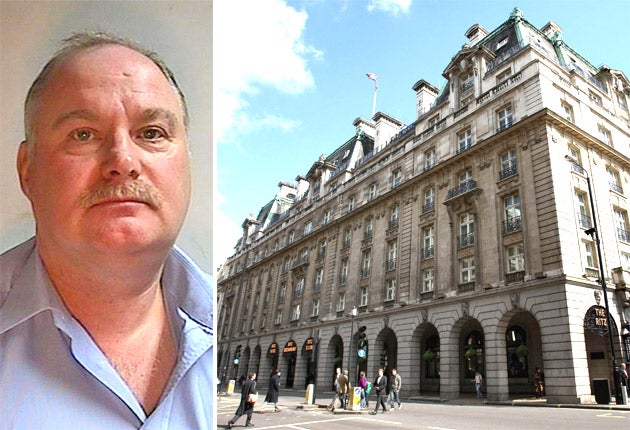
When Anthony Lee offered buyers the hotel on the cheap, the deal looked to good to be true. It was – he didn't own it

For free real time breaking news alerts sent straight to your inbox sign up to our breaking news emails
Sign up to our free breaking news emails
If a penniless lorry driver from Yorkshire, whose property portfolio doesn't even include a house, offers to sell one of London's most luxurious hotels for £350m less than its value, the deal might sound too good to be true. And so it proved for the wealthy developers hoodwinked by Anthony Lee, who was jailed yesterday for five years for what a judge described as an "elaborate and outrageous scam".
That was, if anything, an understatement. Lee had never completed a property sale in his life but his audacious attempt to "sell" the Ritz hotel got so far he was able to extract a £1m deposit from the buyers he had lined up for the London landmark.
Lee's plan, which he codenamed Project Notting Hill, began in 2006 when he contacted Karen Maguire, a director of Property-Source.com, a company specialising in finding properties for private clients.
Lee claimed he was a "close friend and associate" of the reclusive billionaire brothers, Sir Frederick and Sir David Barclay, the owners of the prestigious hotel in London's Piccadily district, and that he planned to buy the Ritz for £200m.
The self-proclaimed "straight-talking Yorkshireman" said he wanted to then sell the hotel for, in the words of the prosecuting barrister, Anuja Dhir QC, "the bargain price of £250m". The lorry driver told Ms Maguire he would split the £50m profit with her if she found a buyer.
But the Barclays had never heard of Lee and were unaware he was claiming to be able to sell the hotel, which they had bought for £80m in 1995 and was, at the time, valued at between £450m and £600m.
Unaware of this, Ms Maguire put Lee in contact with Terence Collins, a London-based property developer. Mr Collins agreed to buy the hotel for £250m and planned to sell it to Marcel Boekhoorn, a property magnate.
With a chain of investors in place, Lee demanded a £1m deposit. When the money was paid into an Irish bank account in Lee's name the deal, perhaps unsurprisingly, hit a snag.
Lee, who was on trial alongside Patrick Dolan and Conn Farrell, claimed he had accepted a better offer – of £470m – for the hotel. But, as the deposit was non-returnable, he kept the £1m and claimed it was money that Mr Collins owed him for unrelated property deals.
Ms Dhir told the court: "In that competitive world of secret multimillion-pound deals, some people are prepared to take risks that might seem breathtaking to most of us. Millions of pounds can be made and lost on transactions for trophy properties like the Ritz. What sets this transaction apart from most is that it was all based on one great big lie."
Last month, Lee, an undischarged bankrupt who had a police caution for theft and was behind with his rent at the time of the scam, was found guilty of obtaining the £1m by deception.
Judge Stephen Robbins said yesterday: "You were found guilty by a jury of this elaborate and outrageous scam. This con or scam or sting, whatever term is used, was probably motivated by y our mistaken belief that Terry Collins had deprived you of another potentially lucrative property deal and it may be that this offence was done out of revenge."
Lee was acquitted, alongside Mr Dolan and Mr Farrell, of conspiracy to defraud. Mr Dolan was alleged to have been Lee's partner in the scam and Mr Farrell their solicitor. But the latter two were acquitted, claiming that they thought they were working on a legitimate deal.
Mr Dolan, 68, a former construction manager, admitted he had received £435,000 of the £1m deposit. But he explained that he had spent it on gambling, horses and paying off his mortgage. "I had a good time," he told the jury. "A wise man told me there's no shops in the graveyard."
Despite his deception, Lee might never have come before the criminals courts had it not been for a High Court judge and a particularly determined detective. After being stung by Lee, Mr Collins sued him and won. The High Court judge said the case amounted to fraud and should be criminally investigated.
It was referred to North Yorkshire Police where Detective Sergeant Garry Ridler worked on the case alone. Yesterday he was at Southwark Crown Court to see Lee sentenced.
Afterwards he described the result as "highly satisfying" and added: "The sheer size and scale of the deception was truly unbelievable, and the fact it related to such a world-renowned business such as the Ritz made the investigation that bit more challenging.
"Lee also claimed to be an affluent businessmen when in reality he was a bankrupt. He had started numerous property deals, however he had never successfully closed a single deal apart from the £1m, subject of this case, that he obtained through lies and cheating. To put it bluntly, Anthony Lee had never made a single penny from his dealings in property."
Other landmark scams
While Anthony Lee's scam was outrageous, it was by no means original. Selling famous landmarks to gullible businessmen is nothing new.
* In 1925 after reading about the great expense involved in the upkeep of the Eiffel Tower, Victor Lustig saw his opportunity. He "sold" it to Andre Poisson for 250,000 francs. Poisson was too embarrassed to go to the police so Lustig "sold" it again, to a scrap metal dealer. This time the man did go to the police.
* In 1947 George C Parker made a living selling New York landmarks to tourists. He sold the Brooklyn Bridge twice a week for years, telling people they could charge people to cross the bridge. Police often had to remove people setting up their own toll booths.
* Arthur Ferguson traded in British landmarks after the First World War. He sold several landmarks many times, charging $5,000 for Big Ben, $30,000 for Nelson's Column and took $10,000 for Buckingham Palace.
Subscribe to Independent Premium to bookmark this article
Want to bookmark your favourite articles and stories to read or reference later? Start your Independent Premium subscription today.