The week four people vanished – and only one made the news
Joanna Yeates disappeared one month ago today. But what of the similar cases at the time that the public never heard about?
When Joanna Yeates disappeared from her Bristol home on 17 December, her parents suffered the anguish of not knowing what had happened to her, but fearing the worst. This explains why they described the news of the discovery of Ms Yeates's body eight days later as "a relief".
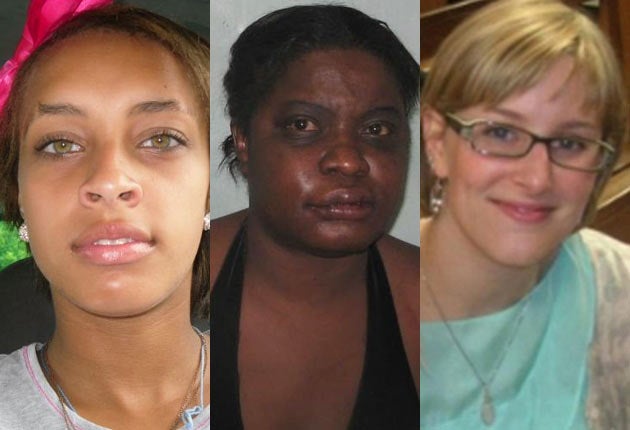
For the families of Nathan Tomlinson, Ciara Richards and Natalie Bailey, there is no such "relief". All three went missing on or around the date that Ms Yeates disappeared, exactly one month ago today. But, unlike Ms Yeates, their cases have attracted little or no publicity, and what has happened to them is still unknown.
Mr Tomlinson, 21, was last seen in the Mitre Bar, Manchester, at around 10.15pm on 17 December – the same night Ms Yeates went missing. He was later filmed on CCTV walking towards Salford but has not been seen since. Ciara Richards is 14 and has run away from home five times before. She has not been seen since 11 December after leaving her home in Hounslow, Middlesex.
Natalie Bailey, a 34-year-old paranoid schizophrenic from Jamaica, has been missing from Dartford in Kent since 13 December. She escaped from the care of a nurse while on day release from a mental health unit. The question of why the majority of missing persons cases fail to merit mention but that of Ms Yeates dominated the news became particularly pertinent earlier this month when celebrities used their Twitter accounts to highlight the case of Serena Beakhurst, a 14-year-old girl who had been missing since 15 December but attracted no media attention. Miss Beakhurst was later found.
While cynics suggest that Ms Yeates's case has attracted publicity because she was a middle-class, photogenic young woman from a wealthy area of Bristol, there are several other reasons her case has received widespread coverage. Firstly, it is now a murder enquiry. But, even before her body was found on Christmas Day, Ms Yeates had been missing for eight days – which was widely reported.
The police don't always alert the media to missing people. Detectives categorise missing people into three categories – low, medium and high risk, and only those in the high-risk category are generally selected for publicity.
The Yeates case was immediately categorised as high risk because the police believed that Ms Yeates had come to harm because she had told nobody of having any plans that evening and had left her mobile phone and personal belongings at home. Assistant Chief Constable Philip Thompson, the spokesman on missing persons for the Association of Chief Police Officers, said: "We ask ourselves what the specific risks are around each individual. In the Joanna Yeates case, an investigator identified at a very early stage that it was an unusual disappearance. She was missing for the first time. That was a high-risk case.
"Someone would also be high risk if they had mental health issues or if they had a medical problem, or if they were particularly young or if they disappeared in an emotional state. Similarly, we look at other issues – has the person gone missing before? Where were they found? And sometimes people are reported missing when they are technically not missing.
He continued: "If someone is staying in local authority care, for example, and they fail to return on time, the person responsible for their care has a duty to report them missing. We often have calls during which someone will say 'I know exactly where he is, but I have to report him missing.' That is obviously not going to be a high-risk case.
"That said, we have to take every call seriously. But we also need a ranking scale. We cannot treat everything as high risk because we would paralyse ourselves. Similarly, if everything was low risk we would be neglecting our responsibility."
Approximately 200,000 people are reported missing every year in the UK. In the Metropolitan Police district 40,525 people were reported missing last year alone.
In Ciara's case, this is the sixth time she has gone missing since last year. The last time she was not seen for eight weeks before returning. Her mother Kerry Richards said: "I can't describe how I feel. It is like I have been ripped apart. The police are so limited in what they can do because kids nowadays have so many rights. Some people know where Ciara is, but they don't have to tell me."
Mr Tomlinson's brother, Paul, 26, said: "This is so out of character. Obviously we are worried and we have heard absolutely nothing. If he was somewhere now we would get a phone call, so we have got to think something has happened."
Natalie Bailey has no family in the UK, which is hindering the search for her. Sergeant Joseph McDonald explained: "We have tried to contact the press quite a lot: local press, internet appeals, and we have distributed her poster to women's refugee centres, in hospitals and in council buildings. There has not been one recorded sighting."
However, very few cases are publicised by the police, let alone appear in the pages of national newspapers or on television, and this lack of coverage is difficult for family members. Martin Houghton-Brown, chief executive of Missing People, said: "It is really challenging to provide coverage for every family of a missing person.
"Even if we wanted to, we cannot control what the media writes, which is why social media is becoming so important for us. We try to emphasise to families how they can harness the power of websites like Facebook and Twitter to search for their loved ones. But I know many families get frustrated by the lack of publicity and they ask us why there isn't more."
Sometimes it is an operational decision by police to keep the media appeals small, as Mr Thompson explained: "If we take an appeal national, with the best will in the world someone in Aberdeen will swear blind that they have seen someone who went missing in London – and we know from experience that it is unlikely, because most people who go missing tend to be found in that same area."
Some families simply do not want media coverage. Joe Apps, the manager of the National Policing Improvement Authority's Missing Persons Bureau, explained: "There are a number of families who think it is a private event or that the person will turn up. They might also worry about the potential embarrassment it brings for the family.
"People don't generally go missing for nothing. There is always a reason behind it. It depends how much they [families] want what happens in their family life to be pried into by the police and the media."
Missing: Three cases that failed to attract publicity
Ciara Richards
The 14-year-old schoolgirl has been missing from Hounslow, Middlesex since 11 December. It is the sixth time since July that she has gone missing – the last time she was not found for eight weeks. Three days later she had disappeared again, and is still gone. Her mother, Kerry Richards, 33, said: "We are all baffled by it. Ciara is extremely intelligent, doing brilliantly at school and has lots of friends. When she came home last time, I was just relieved that she was still alive."
Nathan Tomlinson
The 21-year-old was last seen just after 10pm on Friday 17 December by a friend at a work Christmas party in the Mitre Bar in Manchester city centre. He was spotted on CCTV walking past Manchester Cathedral and heading towards Salford, but has not been seen since.
His brother Paul Tomlinson, 26, said: "This is so out of character. Obviously we are worried. If he was somewhere now we would get a phone call so we have got to think something has happened."
Natalie Bailey
The 34-year-old has been missing from Dartford, Kent, since 13 December. She suffers from paranoid schizophrenia and has been in a secure mental health unit since 2009. She had been visiting a man she said was her uncle in Lewisham when she escaped from the nurse accompanying her. Sergeant Joseph McDonald, from Lewisham police, said: "She has no family in this country we can get hold of, she is originally from Jamaica. We are very worried about her safety."