British floods 'were the result of climate change'
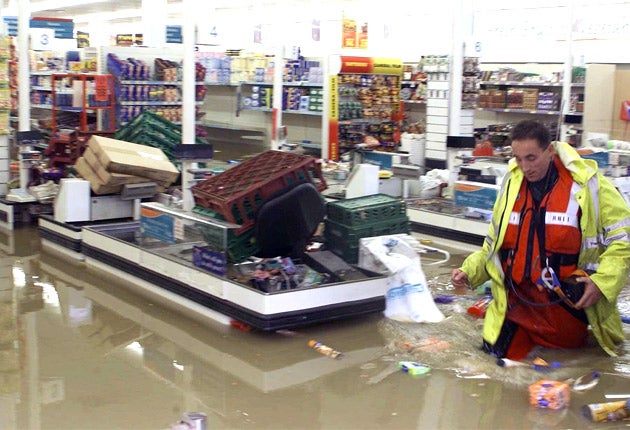
The catastrophic floods of autumn 2000, which saw river levels reach 400-year highs and left 10,000 homes underwater across England and Wales, were most likely the result of global warming.
It is the first time scientists have been able to plot with any confidence the link between the extreme weather with man-made greenhouse gases. Researchers from Oxford University and the Met Office aided by thousands of volunteers online believe 20th-century industrial emissions made the natural disaster almost twice as likely.
While environmentalists have long pointed to the floods as early evidence of the impact man is having on the environment, concrete proof has been harder to find.
But Dr Pardeep Pall, who began the research while a doctoral student at Oxford University's Department of Physics, said this has now changed. "This study is the first of its kind to model explicitly how such rising greenhouse gas concentrations increase the odds of a particular type of flood event in the UK, and is the first to use publicly volunteered computer time to do so," he said.
In mid-October 2000, parts of Kent and Sussex were under water when the Ouse at Lewes burst its banks, along with the Uck at Uckfield and the Medway at Tonbridge in Kent. A few weeks later it was Yorkshire's turn with the Ouse in York reaching its highest level since 1600 while the Severn at Worcester and Shrewsbury recorded its biggest flood since 1947.
The Thames, Trent, Wharfe and Dee also flowed after much of the country suffered its wettest autumn since records began. The final insurance bill for the damage was £1.3bn with motorways closed, train services cancelled and power supplies disrupted.
The research, published in Nature, reveals there was a two-in-three chance that the odds of flooding that year were increased by global warming by a factor of two or more. While unable to rule out the possibility that the floods could have happened even if the atmosphere had been unpolluted by greenhouse gases in preceding decades, scientists believe the study brings them closer to being able to work out the real-time impact of climate change rather than the long-term predictions which are normally used. Experts could soon be able to tell almost immediately whether an event was caused by the effects of man or not.
Researchers used a Met Office computer climate model to simulate the weather of autumn 2000 both as it was and how it might have been without the presence of man-made CO2. Volunteers around the world then repeated the experiment thousands of times by logging on to the website ClimatePrediction.net. The data was then fed into a flood model by Risk Management Solutions, which develops risk models for the insurance industry.
It was concluded that the chances of floods occurring in autumn 2000 had increased by more than 20 per cent; and perhaps as much as 90 per cent.
Professor Myles Allen, a co-author of the paper, said while scientists had been more easily able to link climate change to the European heatwave of 2003 – an event which resulted in 40,000 deaths, drought, fires and crop failure – establishing the link to floods had been a longer process. He said: "Whether or not a flood occurs in any given year is still an act of God but with the help of thousands of volunteers we are beginning to see how human influence on climate may be starting to load God's dice."
The research will be cited today by Secretary of State for Energy and Climate Change Chris Huhne in an address at the Royal Geographical Society (with IBG) calling for closer co-operation between governments to reduce emissions and cope with the effects of a changing atmosphere. He will say: "The evidence for human influence on climate is now even more compelling. Climate change is not a distant threat, it is a clear and present danger – and one that we can do something about."
Join our commenting forum
Join thought-provoking conversations, follow other Independent readers and see their replies
Comments