Brown finally axes Snatch Land Rovers linked to 36 Army deaths
As the Prime Minister makes a surprise visit to Afghanistan, news comes of more British casualties
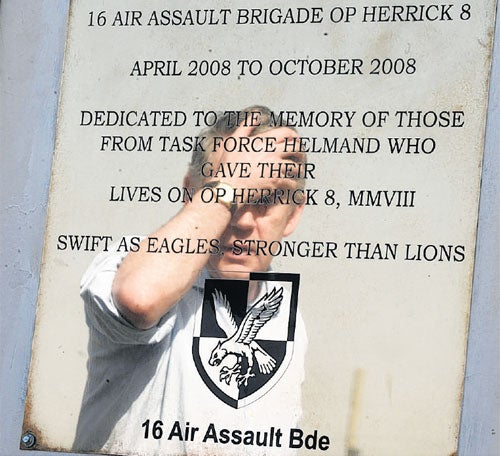
Hundreds of soft-skinned "snatch" Land Rovers of the type implicated in the deaths of at least 36 British troops over the past decade are finally to be phased out after a bitter five-year campaign.
Ministers have agreed to spend more than £100m on a new design of vehicle that will offer British servicemen and women greater protection against the scourge of roadside bombs in Afghanistan. The first of 200 British-built "light protected patrol vehicles" (LPPV) are expected to begin replacing the snatch models by the end of next year.
The LPPV, unlike the snatch, is fitted with armour that can absorb the blast of improvised explosive devices (IEDs), which are responsible for four out of five British deaths in Helmand province.
News of the "imminent announcement" came as Gordon Brown paid a surprise visit to Afghanistan to view progress made by Operation Moshtarak – the latest military "surge" against the Taliban – and efforts to improve the capacity of local police to keep order in their own country.
Mr Brown's visit was overshadowed by the death of two British soldiers from 3rd Battalion the Rifles in Sangin yesterday. One died in an explosion, the second was shot during a firefight. The Ministry of Defence (MoD) said the soldiers' next of kin had been informed.
A day after Mr Brown finally appeared before the Chilcot inquiry amid allegations he had failed to provide the cash to fund vital equipment for British forces in Iraq and Afghanistan, the Prime Minister also pledged millions extra to help to improve protection against the roadside bombs that have taken an increasing toll on British forces – accounting for almost half of the British fatalities last year.
But he came under attack yesterday from Lord Guthrie, a former chief of the defence staff, who said the MoD received the "bare minimum from the Chancellor" at the time of the last strategic defence review in 1998, when Gordon Brown had "wanted to give the military as little as he could get away with". He added: "To say Gordon Brown has given the military all they asked for is simply not true."
The Ministry of Defence will spend £18m on further work to counter IEDs, including providing 2,000 hand-held metal detectors to troops on patrol in some of the most treacherous areas of Afghanistan.
Britain will also provide an extra 150 expert police training staff towards the target of increasing the number of trained Afghan police officers from 98,000 to 134,000 by the end of next year. Establishing an efficient police force has been identified as crucial if Afghanistan is to assume control of its own security. But the campaign to "Afghanise" the police and military has been held back by the poor quality of recruits, corruption and, in some cases, drug abuse.
But Mr Brown's trip sparked a furious political row back home, as the Tories complained that he was using the armed forces as political "props". The Prime Minister has also faced accusations that his forces-friendly announcements were engineered to counter criticisms arising from his appearance before the Iraq inquiry on Friday.
The Tories responded to the latest prime ministerial visit by producing a "charge sheet" which they claimed undermined his attempts to suggest he had consistently backed British forces. The dossier declared that Mr Brown should apologise for a series of actions, including "using the armed forces as political props when politically convenient", "failing to provide the resources and equipment for our troops invading Iraq" and "delaying the delivery of key equipment for our forces in Helmand province".
However, Mr Brown has faced a string of accusations through the Chilcot inquiry that budget cuts he drove through at the Treasury in 2003 cost lives on the front line. The inquiry heard at the time the helicopter capacity was 38 per cent below what was required by the military. The Tory dossier claimed Mr Brown's cuts to the helicopter budget amounted to £1.4bn.
Downing Street furiously rejected the claims, insisting instead that Mr Brown had been planning the trip for a long time, and that he had visited Afghanistan in December 2007, April, August and December 2008, and April, August and December of last year.
A spokesman for the Prime Minister said the Tory attack was "a desperate attempt to divert attention from the mess over Lord Ashcroft's assurances". He added: "This spurious nonsense demeans the Conservative Party. Would the Tories prefer the Prime Minister didn't thank our armed forces for their efforts in Operation Moshtarak?"
Mr Brown praised the bravery of the 4,000 UK troops involved in the 21-day Operation Moshtarak, which aimed to repel the Taliban. On arriving at the huge international base at Camp Bastion, the Prime Minister said: "My visit is to say thank you to the thousands of British, Afghan and international troops involved. Their bravery and professionalism are an example of how the international community can and should intervene to make us all safer."
Later, on a visit to the Helmand police training centre, he underlined the importance of encouraging the Afghans to take control of their own security. Mr Brown added: "The Afghan army is already rapidly expanding, but we also need a strong Afghan police force to create enduring security. Training the Afghan forces to secure their country for themselves is the right approach. It will provide the conditions where the Afghans are able to maintain their own security and our troops can come home."
Join our commenting forum
Join thought-provoking conversations, follow other Independent readers and see their replies
Comments