Casualties of war: how forces children bear scars of conflict
An Armed Forces report reveals bullying, mortal fear, and schools that just do not understand
Bullied, badly behaved, regularly uprooted and moved about the country – the children of British military personnel have become a "ticking time bomb", a major report warns today.
The stark warning paints the children as the forgotten victims of the Afghanistan and Iraq wars, highlighting the traumatic impact that conflicts have on young minds and on families struggling to hold their lives together while a parent is on the front line.
The report by the Royal Navy and Royal Marines Children's Fund, the first in-depth look at the effect of war on forces children, explains in poignant detail how the long-term absence of service personnel can impact on military children's behaviour, at school and at home. There are around 175,000 school-age children of service personnel.
Many young children whose fathers die believe he will still come home even long after they have been told the news.
"A four-year-old may be able to tell others confidently that 'My daddy's dead,' and may even be able to explain how 'a landmine exploded and he died'," the authors write. "However, the next sentence may be, 'I hope he'll be back before my birthday' or 'he's emailing me tonight'.
"Slightly older children may still have this hope and belief that the death will not be permanent ... Children bereaved when they are five to eight may feel that they can in some way reverse what has happened. 'Dad will come back if I'm very good and eat my broccoli.'"
The report, The Overlooked Casualties of Conflict, outlines the effect on them of mass-media coverage, anti-war sentiment, and being moved to new schools at a moment's notice as the parent's unit changes location. Studies are disrupted, exams are missed.
Some face bullying at school, dismissed as "military brats" once it is known they have a parent in the forces. "One of the main problems of being labelled a 'military brat' is the stereotypical image of a child from a military background – one of authoritative parenting, buzz haircuts, withdrawn emotions and relocating frequently," the authors say.
A survey of spouses revealed that 60 per cent said their children had increased levels of fear and anxiety when husbands or wives went to war and 57 per cent reported increased behavioural problems. As seven-year-old Jamie, son of a naval officer in Portsmouth, put it: "It can be quite sad when daddy goes away because I've got a book we are reading and when he goes away I can't really read it. I don't really talk about it. When he goes, I just start cuddling Scruffy, my teddy bear, he's my most-loved teddy."
Further problems occur with the reaction of non-military children when they know a classmate comes from a services family. "The term 'military brat' or 'army brat' is frequently bandied around," said the report.
"Many people, including teachers, parents and children, talked about this reputation of service children existing for two reasons: either the public does not understand them or they think 'they won't be here for long'."
The report tells of how anti-war sentiment can "bubble over" into hostility towards those employed in the armed forces and their families and make their children "prime targets" for bullying. One mother told how her son was attacked with a knife by an older child with anti-war parents.
"It was like this kid was insinuating that his father was personally responsible for the war and that he shouldn't be in the war," she said.
"For the rest of the time that we lived in that neighbourhood, we were terrified for our safety. My daughter didn't eat for weeks and she was just so afraid."
While many are taught in schools with a large service intake through being sited near Army estates, some can be isolated in schools where teaching staff have no training to cope with the peculiar demands of looking after service children.
Teachers may be unaware their new arrival is the child of a service family.
"Some schools were appreciative of the lifestyle of service children, whilst others just saw the children as a temporary annoyance which would impact upon their attainment and attendance figures," the authors found.
The consequent effects can be disruption to the curriculum with the new school possibly unable to match the timetable children had in their previous school. They may not be able to take the exam they had been planning to take.
The impact of media coverage of the war can also exacerbate traumas – sometimes tragically.
"Many children were continually distressed, anxious and upset by the images they'd see of black body bags being flown home and were fearful their dad might be in one," the report explains.
"For one little boy, aged eight, called Fred, the images on the news were too much. One morning, Fred's mum entered his bedroom to find he had hung himself, unable to cope with the emotional distress of the situation."
The report urges a greater understanding by authorities of the impact a service lifestyle can have on a child's behaviour, emotional well-being and educational attainment. It concludes: "Service children cannot remain the overlooked casualties of conflict any longer."
Case Study: 'His classmates just didn't understand'
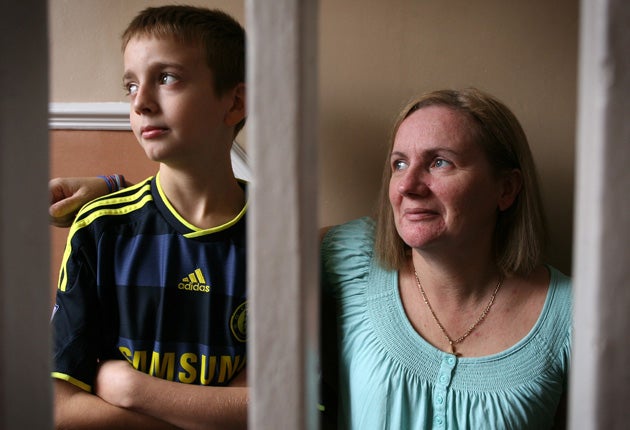
For nine-year-old Chris Shine, his brother's horrific injury in Iraq was traumatic enough to cope with. Stephen, 25, the older brother he always used to play football with, lost a leg in a terrorist blast while on active service in the war.
Unlike many service families, Chris was at a school where he was the only pupil to have family in the armed forces. "I think at first they were sympathetic," said his mother Frances, who lives in Paddington, west London. "I don't think they really understood."
Problems were exacerbated by the fact that the primary school had a number of children from Iraq on its roll. "Chris was very upset by Stephen's injury," said Mrs Shine. "I think his first thought was, 'Will he ever play football with me again?'
"Chris started to play up. He had nobody to talk to amongst his classmates. My son was injured in Iraq and a lot of boys in his class were from Iraq. I think he felt a pressure to hide the fact that he was from a service background. I actually did speak to somebody from the school and they said it was probably best for him not to talk about it."
Mrs Shine did not see why she or Chris should have to hide the fact that his brother was serving his country.
Chris, now 12, has transferred to secondary school – and things seem better. "Chris is wearing a poppy at the new school," said Mrs Shine. "I don't think he would have been able to do it in his primary school."
Join our commenting forum
Join thought-provoking conversations, follow other Independent readers and see their replies
Comments