Fear of Mumbai-style attack prompts UK security review
Britain needs 500-strong rapid response force, chairman of Commons committee says
MPs are to carry out a review of national security policy amid fears that Britain is exposed to a Mumbai-style attack, The Independent has learnt.
Security agencies are aware that home-grown Muslim extremists may attempt to carry out copycat assaults on "soft targets" in the UK, modelled on what took place in India.
Patrick Mercer, the chairman of the Commons Counter-Terrorism Sub- committee, said: "What can happen in Mumbai can happen in Manchester or Birmingham. Events in Mumbai demonstrate the great urgency of such a review. There is little doubt that we need to examine whether our counter-terrorist forces are capable of dealing with this kind of attack. This is a style of attack which is very difficult to cope with and, with the Olympics coming up, we need a thorough review."
Mr Mercer, the former Tory security spokesman and an ex-Army officer, held that while the UK had "excellent" forces to deal with terrorist emergencies, they were too few in numbers and the Government should consider setting up a "battalion strength" of about 500 military and police as a quick reaction force in the event of an attack.
At present, one squadron of the SAS, about 80 men, known as the Special Projects Team, is on standby in Hereford. This squadron, however, is believed to be below full strength because of commitments in Iraq and Afghanistan. Police armed response units also carry out continuous mobile patrols to deploy during an emergency. Additional forces would be called in during a prolonged operation or those which turn into a siege situation.
Security experts backed Mr Mercer's call for a re-evaluation of current security policy. Peter Clarke, who recently retired as head of Scotland Yard's Counter-Terrorism Command, described how there has already been a plot to carry out the type of attack experienced in Mumbai. He said: "Is it possible that Britain could suffer carnage on the scale of what happened in Mumbai? Could hotels, restaurants, railway stations and community centres be raked with machine-gun fire? It's more than likely that is what one terrorist wanted to do."
The case he referred to, that of Kazi Nurur Rahman, received little publicity because it was the subject of reporting restrictions on legal grounds for a prolonged period. Mr Clarke said: "In the Summer of 2005, even as London was still reeling from the July bombings, Rahman, the leader of an east London terrorist cell, was trying to buy machine-guns, rocket-propelled grenades and missiles. He was neither fantasist nor daydreamer, he had been to a terrorist training camp in Pakistan. He had a long history of involvement in violent extremism." Rahman was arrested in 2005 and sentenced to nine years in jail.
Tobias Feakin, the director of the Royal United Services Institute's homeland security and resilience department, had spent time in India compiling a report on Indian special forces. He said: "The problem in Mumbai was that there were just too many different law enforcement agencies involved and there was a lack of co-ordination. The command and control would be much more structured here. But the sensible thing to do would be to look at what is going on abroad and see what lessons can be learned. We need to stay one step ahead of the terrorists to maintain safety for citizens."
Robert Emerson, a security analyst, warned: "There is a lot of talk about 'dirty bombs' being used by terrorists, but what Mumbai showed was you don't need that kind of technology to have a lethal impact. All you have to do is look at underworld shootings to see how plentiful guns are in this country. I don't think we have a system in place at the moment to cope with such multiple attacks in this country."
Although hotels and shopping centres are among the most vulnerable targets for a Mumbai-style attack, security experts maintained that people in this country are still not ready for stringent security measures. "This is a psychological thing as much as anything else but I do not think the civilian population in this country would like to see Baghdad-type security," Mr Emerson said.
Israel buries Mumbai dead
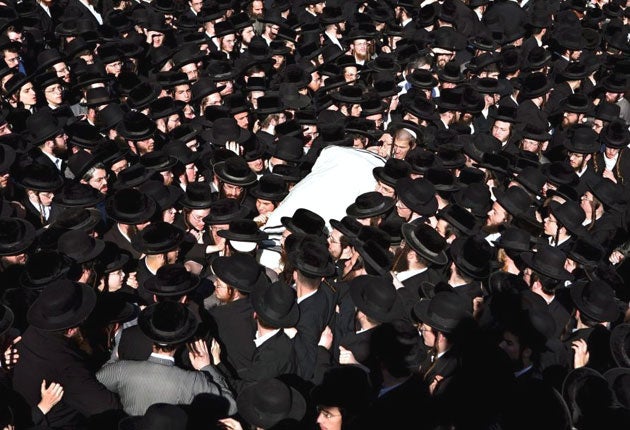
Six Jewish victims killed in last week's attacks in Mumbai – including the parents of a two-year-old boy – were buried in Israel yesterday in funerals attended by thousands of mourners. The six people were found dead after security forces ended a standoff that followed the attack on Chabad House, the Mumbai headquarters of one of the largest international movements of Hasidic Jews. Israel's President Shimon Peres attended a service in Kfar Chabad, a village near Tel Aviv, for Gavriel Noach Holtzberg, 29, and his 28-year-old wife, Rivka. Their son, Moishe, was found and taken to safety by his Indian nanny. Moshe Kotlarsky, a Chabad rabbi, said the community would look after the boy. "You don't have a mother who will hug you and kiss you," he said, "You are the child of all of Israel."
Join our commenting forum
Join thought-provoking conversations, follow other Independent readers and see their replies
Comments