Gordon Brown makes surprise visit to rally forces in Helmand
As the premier hints more troops may be sent to support a new surge, a Royal Marine is killed
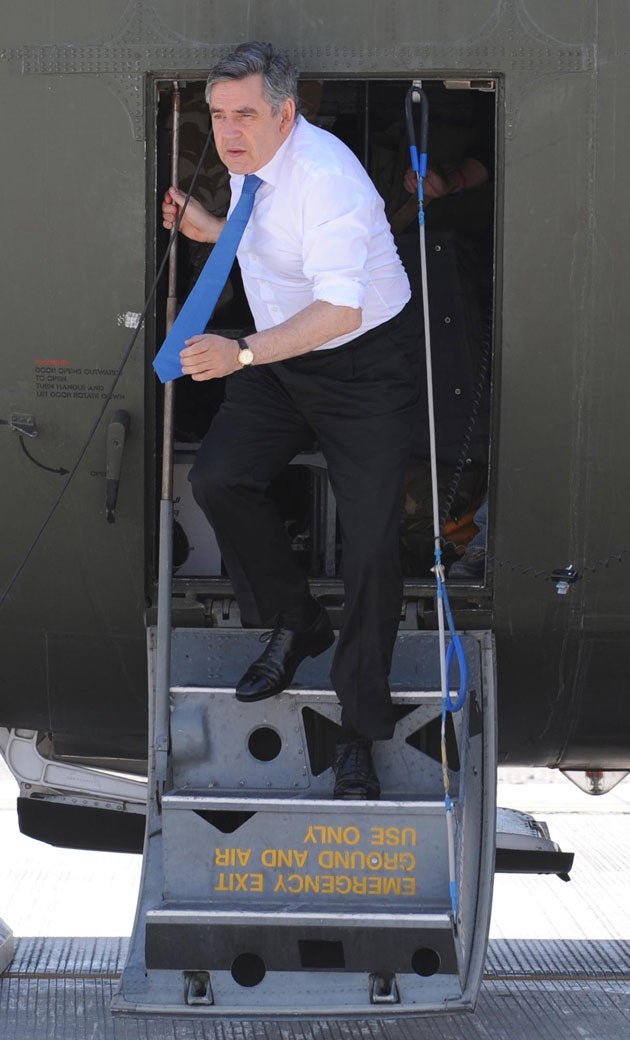
Gordon Brown made a surprise visit to the front line in Afghanistan yesterday as part of a concerted effort to tackle criticisms that the battle against the Taliban was being undermined by troop and equipment shortages.
Amid spiralling concerns over the human cost of the campaign, the Prime Minister arrived in Helmand province to pledge further protection against the lethal roadside bombs that have helped push the British death toll beyond 200 in recent months. But the trip was overshadowed when the Ministry of Defence announced, soon after he left the country, that a Royal Marine had been killed in an explosion during a foot patrol in the area, bringing total British losses to 208.
Reports from Afghanistan last night suggested that Mr Brown had hinted that he could send more troops to back up another "surge" against the Taliban in the coming months. However, neither officials in London nor those travelling with the Prime Minister could substantiate the claims.
In a calculated response to rumours of an increase in the international presence in Afghanistan, Mr Brown highlighted the Afghans' responsibility for helping to restore order themselves. He said local forces should accelerate their training as part of a strategy to increase Afghan control over the country. The Prime Minister said the target of training 134,000 Afghan soldiers by the end of 2011 should be brought forward to November 2010. He also pledged British help to double the number of recruits – to 4,000 a month – to an army currently just under 90,000 strong.
"We can get another 50,000 Afghan armed personnel trained in the next year," Mr Brown said, during a two-hour visit to Camp Bastion in Lashkar Gah. "Stepping that up means Afghans take more responsibility for their own affairs, backed up by partnering and mentoring by British forces."
The decision to concentrate on the Afghans' role in rebuilding their own country comes as Britain is expected to come under US pressure to increase its troop presence beyond its present level of around 9,000. The Independent yesterday revealed that, once the Afghan election result is clear, General Stanley McChrystal, the top US commander in Afghanistan, will ask for 20,000 more international troops. Mr Brown held talks with General McChrystal as part of his visit.
But the question of sending more troops to Afghanistan presents critical problems for Mr Brown, as support for the conflict has plummeted and the number of British casualties has soared during recent months.
Mr Brown spoke by phone to the incumbent Afghan president, Hamid Karzai, and his challenger Abdullah Abdullah. He said he made it "absolutely clear" to both that the UK expects Afghanistan to train more soldiers.
The latest polling released yesterday showed President Karzai extending his lead in last week's vote, but still falling short of the 50 per cent needed to avoid a run-off. The Independent Election Commission of Afghanistan said he had 46 per cent of the vote and Mr Abdullah 31 per cent, with barely a third of the votes counted. The country will be plunged into a run-off if no candidate gets more than 50 per cent of the first-round vote, and final results of the election are not expected until the middle of next month.
During his visit, Mr Brown discussed improved techniques for detecting and disabling improvised explosive devices (IEDs), which have killed three-quarters of the soldiers who have died in Afghanistan. He said Britain would double the number of specialist troops it has in the country for dealing with the bombs, from 200 to 400, by the end of the year and increase flights by unmanned surveillance aircraft that provide intelligence to track and target bomb makers.
Mr Brown said: "This has been a most difficult summer in Afghanistan, because the Taliban have tried to prevent elections taking place. I think our forces have shown extraordinary courage during this period.
"They know the reason why we are here and that our security at home depends on a stable Afghanistan – no return of the Taliban and no role for al-Qa'ida in the running of Afghanistan."
The Prime Minister flew into Lashkar Gah, where he was joined by Air Chief Marshal Sir Jock Stirrup, Chief of the Defence Staff, and General McChrystal.
The shadow Defence Secretary, Liam Fox, said Mr Brown had been "woefully slow" to provide British troops with the equipment and claimed that his visit had failed to answer a number of significant questions about the British mission in Afghanistan, including the supply of Ridgeback armoured vehicles.
Join our commenting forum
Join thought-provoking conversations, follow other Independent readers and see their replies
Comments