Historians furious as Kew archives are 'dumbed down'
As opening hours and expert jobs are cut, is public access under threat in the name of saving money?
david sandison
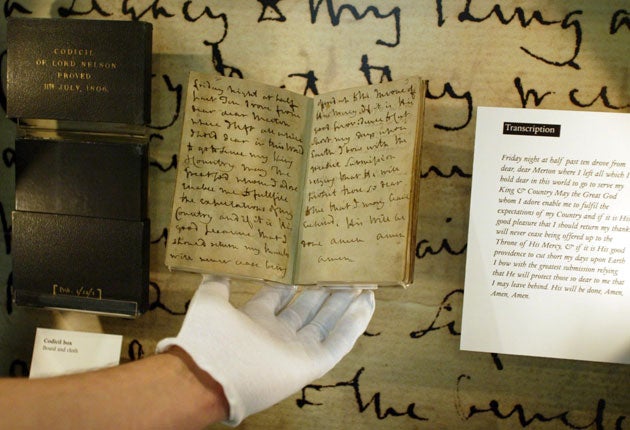
A codicil belonging to Admiral Nelson, one of many old documents held at the National Archives
As the home of unique documents ranging from the Titanic passenger list to top-secret cabinet papers, the National Archives is Britain's single most valuable source of primary materials for social historians. But concern is growing that public access is under threat after an announcement that it is to reduce opening hours, limit access to original documents and lay off a number of specialist archivists.
Leading historians, including Antony Beevor and Saul David, have this weekend expressed anger and dismay at the proposed cuts. Professor David told The Independent on Sunday: "The future history of our country is at stake."
Housed in a vast complex in Kew, south-west London, the National Archives (TNA) is the repository for the country's main public records, including birth, marriage and death lists, national censuses, wills and military records. In recent years, with interest in genealogy growing, the archive has seen a surge in demand for access from members of the public. It is also a vital resource for professional historians, biographers and writers.
The changes come as part of an ongoing drive to digitalise records so that they can be accessed directly online, thereby reducing visitor numbers to Kew. Once records are scanned, the original document is put into deep storage away from Kew. But historians argue there is a case for the originals to remain accessible. "The possibility of seeing the originals should always be available," said Antony Beevor, author of D-Day: The Battle for Normandy, which was researched, in part, at the National Archives.
Managers closed the facility on 30 June for a special meeting in which they informed staff of the proposed changes. These include reducing opening hours from six days per week to five from March 2010 – the chosen extra day of closure, apart from Sunday, being Monday – and getting rid of 35 of 105 specialist posts to shave £4.2m from the budget. But job cuts will not affect those at management level or in the press or marketing departments. The closure represents a 16 per cent reduction in public opening hours. Yet according to sources at TNA, that will make savings of only around 3 per cent in terms of recruitment because staff will still have to come in on that day to fulfil other functions.
Natalie Ceeney, TNA's chief executive, a former management consultant who joined from the British Library in 2005, said in an interview soon after her appointment: "The public wants information and they don't care if that information is in a book or online." Dr Nick Barratt, a historian and lead researcher for the BBC's genealogy programme Who Do You Think You Are?, believes the ultimate goal is to reduce visitors to Kew. "The end-line message is that they want to stop people coming to Kew and they want to restrict access to public records," he said. "Cutting into specialists and specialist knowledge is one part of that. It's dumbing down, effectively. The general move is to a mass market."
Professor Jane Ridley, prize-winning biographer of Edwin Lutyens, said: "I am shocked and saddened by this. We live in an old country, and one of the UK's great unsung assets is its huge and accessible public archives. Britain is a world leader here, compared with France or Russia. If digitalisation is to be made a pretext for reducing access to historical records, we are in serious trouble. In the case of some records, such as census reports, it is an incredibly useful tool. But historians need to see sensitive, rare documents which are not suitable for digitalisation, and I worry that these will be much harder to see."
Others concerned at the proposals include the cultural historian Jonathan Foyle, the biographer AN Wilson, and military historian and broadcaster Saul David. "From a historian's point of view, to be able to see the actual documents is absolutely crucial," Professor David said. One source said that the current management team were pushing the cuts through with a degree of "ruthlessness".
But a spokesperson for the archives said the changes were necessary for the organisation – which is funded by the Government – to keep within its budget. "We have looked at ways in which we can make savings across the organisation, and reducing opening hours will enable us to continue to invest in our online services," said Mel Hide. "We have a budget allocation which has been set for three years, but we need to make savings of 10 per cent to enable us to continue investing in digitalisation."
One problem that will never go away is the question of space, as documents are continually added to the archives.
"We do only have a finite amount of space," said Ms Hide, "and at some point you do need to think about where you put the records that are coming in. I think it's a very sensible decision to digitalise as much as possible."
View all comments that have been posted about this article.
Offensive or abusive comments will be removed and your IP logged and may be used to prevent further submission. In submitting a comment to the site, you agree to be bound by the Independent Minds Terms of Service.
- Print Article
- Email Article
-
Click here for copyright permissions
Copyright 2009 Independent News and Media Limited


Comments
The skilled archivists aren't objecting to everything being online, they are objecting to that being the ONLY access to the records, which is what is apparently being proposed. Professional historians and others need access to the original source material, and some material isn't suitable for digitalisation anyway. Apart from anything else, it's too easy to doctor digitised records and change history....
As usual it isn't the marketing or management levels (arguably the ones least useful) it's the skilled men and women at the front line, who are responsible for conserving the material so it's available in the first place. Shame on those making those types of cuts, you don't want so many people visiting? Cut out the marketeers; geneologists and others wanting information will find you via Google without you having to do any marketing at all. Take out management levels, and you will probably need to lose a lot less people (and less useful people to the core functions) to save the money. Skilled people know their jobs, and don't need "managing" anyway, in my experience all managers do is add an unnecessary layer of bureaucracy and interfere with getting the job done.
But back to the story - What I understand from the article is that academics might no longer have access to the original documents on a Monday, only Tues-Sat. "The future history of our country is at stake" Yeah right...
Layers of management that spend all their time navel gazing and generating extra paperwork, policies and procedures (that aren't usually practical anyway because they don't really understand how to do the job, having never done it), aren't very useful, whereas the people at the sharp end who actually do the work and are responsible for the productivity normally cost a fraction of the management. Who does it make more sense to cut if you're really trying to save money, management who have a net cost, or revenue generators who have a net income, to the business?
As for the marketers, why do you need marketers if you're trying to prevent people coming along to visit in person, and there are search engines available to find you online?
I accept that "real" historians needs to see original documents.
I don't. Except for sentimental reasons, perhaps.
The thoroughness of a massive operation- usually incomplete.
Whilst a visit to the NA is paid for from your taxes, use of digitised images is usually charged extra, as for the online census records. And if there's a data error that costs you money, reporting it doesn't result in a refund, in my experience.
There's also the issue of the clarity of images which can never match the originals to adequately reveal marks, erasure, binding and inclusions (ever printed off C19 census records?)
Database subject searches and transcripts are fine as a starting point- but that's all they are for.
So, be prepared to pay and to be kept at arm's length.
Some states put records on line for free. I am very grateful for instance to the Missouri State Archives who have death certificates on line for 1910 to 1958. This is only done, of course, at a cost to the taxpayer and I am not entirely comfortable with the concept of blanket subsidy of my hobby.
However, the exchange of access to original documents with online access to digital facsimiles in no way justifies the loss of professional archivists. If anything, the increased demand for access that will be brought about by increasing availablility to the historic resources of TNA will bring a need for even more specialists to interpret, describe and manage the collections.
Digitisation is an expensive process. It is something that has to be added to the functions of a modern archive and funding should be provided above the existing budgets - not paid for from the salaries of highly trained specialist archivists.
I believe part of the point is being trivialised here. The digitisation programme conducted by TNA is poor, and populist, in terms of their scanning and conversion. Some good steps such as Wills and military records - but don't forget the needs of researchers and familys to want to be able to touch and 'connect' with the (or their past).
There are many millions of people who's cultural past is Britain, if even 200 years ago in my case. I suspect that research tourism may be a more significant part of your economy than is realised.
My suggestion is that until such time as the National Archives can provide a comparable level of access online to what the Spanish have done (30 million documents online - for free) then your archives authorities should maintain the status quo. Digitisation is an investment in the future, it is not a cost saving measure, where you rob Peter to pay Paul.
Shame Ms Ceeney, shame.