Libel court 'is not the right place for faith disputes'
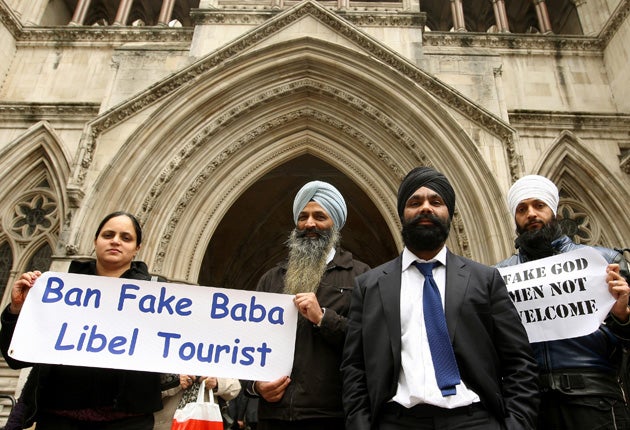
One of Britain's most senior judges said yesterday that libel courts must not become places where religious and doctrinal differences are hammered out.
Mr Justice Eady made his comments while summing up his reasons for suspending a defamation case brought by an Indian "holy man" against a British journalist.
The dispute centred around an article published by Hardeep Singh in the Sikh Times in August 2007 entitled: "Cult divides Sikh congregation in High Wycombe". Mr Singh, a freelance journalist and a practicing Sikh, was investigating the links between a North Indian religious organisation and three gurdwaras (Sikh temples) in Britain.
At the time the article was published, followers of the Nirmala Kutia Johal, a Sikh sect based in the Punjab, were divided over the accession of Sant Baba Jeet Singh, who had become their leader in 2002 following the death of the group's previous guru.
Mr Singh's article described Nirmala Kutia Johal as a "cult" and said that disagreements over the accession of the group's new guru had spilled out into the open among supporters in High Wycombe. Baba Jeet Singh, an Indian national who has never travelled to the UK, issued libel proceedings in the British courts against both Mr Singh and the Sikh Times, which later went bust.
Baba Jeet Singh claimed that Hardeep Singh's article defamed his character by describing him as a leader of a cult and an impostor who had disturbed the peace in the Sikh community of High Wycombe, and had promoted blasphemy and the sexual exploitation and abuse of women.
Mr Singh, who lives in Slough, Berkshire, denied libel, pleading justification, fair comment and qualified privilege. His counsel, Mark Hill QC, asked Mr Justice Eady to suspend – or "stay" – the case because the allegations centred around the "doctrine, tradition and practice of the Sikh religion" which were a subject, he argued, that Britain's secular courts could not rule with authority on.
Mr Justice Eady agreed and decided to stay the case with no right of appeal. His decision is significant because it reinforces the notion that Britain's courts are primarily secular and therefore cannot get involved in complicated theological or doctrinal libel arguments which rely on faith – rather than fact.
Citing an example of where the libel courts could intervene, Mr Justice Eady said that if someone accused a religious leader of having "their hands in a till", judges could decide whether that accusation was correct and whether defamation had taken place. But, in this case, he said "The issue of whether this claimant is fairly described as an impostor cannot be decided without examining the doctrines of the Sikh faith."
Dan Tench, a litigation partner at the firm Olswang, said the judgement revealed how libel courts try to avoid certain issues. "Courts are not always fearful of treading on issues surrounding doctrinal or religious belief," Mr Tench said. "But libel courts often act differently. When it comes to accusations of defamation, the courts have become increasingly reluctant to get involved in matters of legitimate and expert debate."
Speaking outside the High Court yesterday, Hardeep Singh said he was "delighted and relieved" with the verdict. But he also called for a reform of Britain's libel laws. "This exhausting battle to clear my name has cost me in excess of £90,000 and yet it took Justice Eady only three hours to throw out the case," he said.
"It seems [Baba] Jeet Singh hoped I would be forced to back out of the case as the costs mounted, which begs the question: should freedom of speech in this country only be available to the rich who have means to defend themselves in court? Ultimately, our libel laws need urgent reform, not only to protect British journalists but also to prevent our laws being abused by foreign nationals."
Court battles
Daily Mail v The Unification Church
The Moonies' took the paper to court in 1981 over a two-page spread the paper ran under the headline: "The Church That Breaks Up Families". The paper interviewed two former members of the Unification Church who accused it of brainwashing them. The case continued for five months. The Unification Church were eventually ordered to pay £1m in costs and the Inland Revenue was advised to investigate its tax free status.
Daily Mail v Jonathan Blakely
A self-styled bishop who runs his own church, Blakely took the Mail to court in 2003 over a comment piece following his appearance on the TV show This Morning, where he presided over the wedding of a gay couple. The Mail attacked the ceremony and questioned Rev Blakeley's right to call himself a bishop. The case was stayed for the same reason as yesterday's case.
Join our commenting forum
Join thought-provoking conversations, follow other Independent readers and see their replies
Comments