Merchant ships could be armed to tackle pirate threat
Special report: MPs to consider allowing commercial vessels to carry weapons, as attacks off the Horn of Africa increase. Kunal Dutta, Jonathan Owen and Brian Brady report
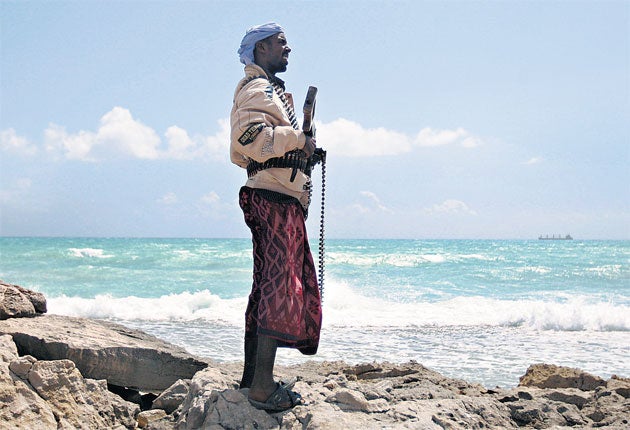
Britain is poised to allow merchant ships formally to carry arms for the first time since the Second World War in a dramatic effort to tackle the escalating threat of international piracy.
Click HERE to view piracy facts graphic (142 KB)
The move is designed to protect British ships and curtail the growing unregulated market of private contractors offering armed protection.
Details of the proposal, now being considered by a number of government departments, will be submitted to MPs on the parliamentary Foreign Affairs Committee, which on Wednesday begins an inquiry into piracy off the coast of Somalia. MPs will also hear demands that pirates should be brought to the UK and other nations to face justice.
Yesterday Mike Penning, the shipping minister, said: "Recognising the specific issue of increasing piracy attacks off the coast of Somalia, the Department for Transport is considering amending the current policy to recognise that engaging armed personnel is an option for UK-flagged ship owners to combat piracy."
MPs have ordered an investigation into efforts to tackle pirates amid growing concerns over the failure of naval forces to act as a deterrent and a lack of action in bringing the guilty to justice when they are caught. Though there have been a few cases in Europe, the judicial burden has been largely carried by Kenya and the Seychelles, as well as a high-profile case in Yemen where six Somali pirates were sentenced to death.
Growing industry disquiet comes at a time when 117 ships have been attacked by pirates in Somalia with at least seven crew members killed and 338 seafarers held hostage in the first quarter of this year, according to one estimate. More than 700 seafarers are being held hostage by Somali pirates at any one time according to the Greenwich Maritime Institute. "If two jumbo jet loads of Westerners were being held by hostage takers, the international community would do something about it very quickly," said its director, Professor Christopher Bellamy. "But because many of the seafarers themselves are from Third World countries, the same sense of urgency is lacking."
That frustration is echoed by the British Chamber of Shipping (BCS), which will call for tougher sanctions. "The industry is fed up with pirates committing international crimes only to be subject to the 'soft-glove' treatment," said Gavin Simmonds of the BCS. "There needs to be a more robust and ambitious international programme that will see pirates shackled and brought to the UK for prosecution rather than remaining under the comfortable jurisdiction of their respective nation states."
Underlying the urgent need for a united response, other countries are now considering taking the fight to the pirates on land as well as sea – with options such as sending special forces into Somalia and bombing pirate bases in the Horn of Africa.
MPs will also examine whether international law is adequate to deal with the piracy threat, and British involvement in relation to ransoms and insurance. London, as the centre of the world maritime insurance industry, is estimated to have paid out more than $300m (£185m) in ransoms and other costs since 2009.
The inquiry comes as a senior US military official admitted the country was struggling to protect ships from attack. There are not enough ships in the world to defeat piracy at sea, William Wechsler, the deputy assistant secretary of defence for counternarcotics and global threats, told US lawmakers investigating piracy: "Somali pirates operate in an area covering approximately 2.9 million square nautical miles. If you took all of the navies of all the countries in all of the world, and put them against this area, they still wouldn't be able to cover this amount of nautical space."
As a result, the US would pursue pirates on land as well as sea. "Our intention is to pursue innovative measures to maximise all the tools at our disposal in order to disrupt the activities of the financiers, organisers and logistics suppliers of piracy," Andrew Shapiro, assistant secretary of state for political-military affairs, told the congressional hearing. "We will focus in the coming months on identifying and apprehending the criminal conspirators who provide the leadership and financial management of the pirate enterprise, with the objective of bringing them to trial and interrupting pirate business processes."
An official Danish government anti-piracy strategy, published this month, has suggested tougher measures, including the use of special forces and bombing of pirate bases. The report also advocates relaxing the rules under which ships can have armed guards. "A more robust mandate for the international effort could be considered ... including the possibility of targeting piracy equipment and installations on land close to the Somali coastline. Should that be the case, piracy equipment and installations could be destroyed with ... precision-guided bombs. Where this is not possible – and in very special cases – the deployment of special forces could be considered."
US Congressman Ed Royce claimed many Somali pirates are in league with the terror group al-Shabaab, which has spoken of a "sea jihad" and has opened a marine office to co-ordinate with pirates. The Kenyan government estimates 30 per cent of the ransoms are channelled to al-Shabaab.
During the congressional hearing, Mr Wechsler admitted the US needed more intelligence on the links. "[Intelligence] on this issue is much less than any of us would like. As we see it now, we believe the terrorists and the pirates are not operationally or organisationally aligned, though there is an element of coercion that results in pirate revenues going to al-Shabaab."
There are fears that many hostages are suffering sadistic abuse at the hands of their captors. According to a report, The Human Cost of Somali Piracy, published this month, hostages were severely beaten, dragged underwater and forced to undergo elaborate mock executions.
"There is a genuine fear that abuse and even torture will be used with increasing frequency to provide additional leverage during ransom negotiations," the report says. "It appears almost certain that piracy attacks will increase, numbers of hostages will increase, and the violence will increase as a result of the growing danger and complexity of Somali piracy."
Attempts to increase security on ships will also increase risks to crews, the report says. "A development that may increase the risk to seafarers is that increasing numbers of vessels are now carrying private armed security guards to counter pirate attacks. While this tactic is largely successful and increasingly supported by ship owners and flag states, pirates are returning fire and engaging in shootouts with armed personnel."
Jon Whitlow of the International Transport Workers' Federation said: "We would prefer military personnel but there aren't enough available. We recognise that some ship owners, to protect the seafarers, have put on private armed guards ... It is regrettable the industry has felt the need to respond in this way. It is because the international community, the governments, especially the flag states, have done nothing to address the situation and provide protection to people on vessels flying their flag."
Ministers hope that allowing commercial ships to arm themselves will undermine the growing numbers of unregulated private security firms offering protection. Critics say this has led to the waters around the Horn of Africa turning into the "Wild West on Sea". "There are hundreds of people setting up shop, some never having been aboard a ship before, much less knowing how to defend it," said John Dalby of the security company Marine Risk Management.
But private security firms argue they are merely meeting a much-needed industry demand. They point out that it is the failure of individual countries – including Britain, which has three Royal Navy ships stationed in the region – together with Nato to provide appropriate protection that has led to the rapidly expanding industry.
Join our commenting forum
Join thought-provoking conversations, follow other Independent readers and see their replies
Comments