One in five troops unfit to fight on the front line
Injured, ill, or overweight from lack of training, 16,000 soldiers are unable to go to war, which increases the pressure on Britain's battle with the Taliban
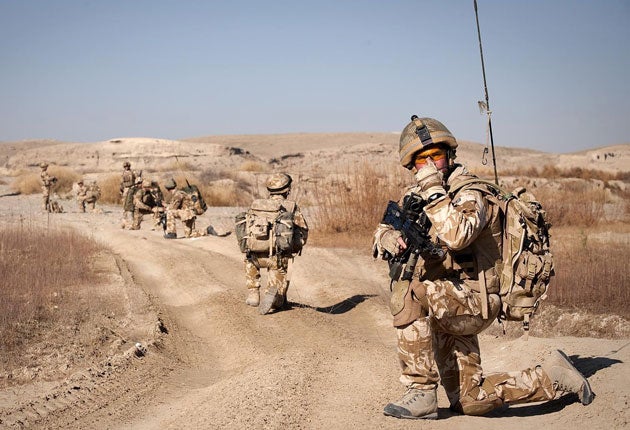
Britain's ability to wage an effective military campaign in Afghanistan is under growing pressure as the number of soldiers unfit for battle has risen to one in five.
As UK forces prepare to begin yet another year embroiled in a gruelling struggle against the Taliban, defence chiefs have confirmed that more than 16,000 troops are not fit enough to fight.
As many as 22 per cent of the 73,000 Army personnel who should be available for combat operations are either classed as "non-deployable" or are only able to be sent to military bases with medical facilities to care for them.
The figure has risen sharply in recent years as the Army has sustained growing casualties, and as more service personnel are downgraded due to illness or poor physical fitness. Details of the attrition rate – the highest since the start of the Iraq war in 2003 – come barely a month after the Ministry of Defence (MoD) admitted that more than one in 10 of the Army's 22,677 infantry soldiers was not considered "fit for task". The figures are endorsed by anecdotal evidence from senior soldiers recently returned from Afghanistan.
Major General Patrick Cordingley, who commanded the Desert Rats in the first Gulf war, said the "remarkably high" figure was the worst attrition rate he had ever heard of. He also warned that the rate would increase if the Government did not provide enough money to train replacements.
The shortfall has become so severe that defence chiefs are considering a dramatic plan to medically discharge more "unfit" personnel, to make way for recruits who would be able to fill in on the front line.
The disclosures paint a dismal picture of the state of British forces at the end of a troubled year, in which more than 100 troops have died in Afghanistan – 10 of them in the past month alone.
Colonel Bob Stewart, former commander of United Nations forces in Bosnia, said the fall in the number of personnel available to fight was "an inevitable consequence of having a small pool of military personnel". He also warned that the number of personnel who were "too fat" was becoming more and more of an issue.
The forces have enjoyed a surge in recruitment in recent months, with ministers announcing that the Army is now "fully manned" to a level of 102,000 personnel. But around a third of these are non-deployable because of the nature of their jobs – and thousands more have been ruled unfit to fight.
Patrick Mercer, Tory MP for Newark and a former Army officer, also warned that the forces were now stuck in a vicious circle where they could not properly train the extra recruits who were coming forward to join up.
"We have seen a disgraceful failure on the part of the MoD to take advantage of the recruitment bulge," he said. "At the moment you can only recruit, train and deploy enough men to keep the battalions at their current under-strength state."
Maj-Gen Cordingley said that, under normal circumstances: "In any unit, I would expect the figure to be closer to 1 per cent, because you will always have someone who has a problem that has to be sorted out. It's going to be impossible to sustain if you are losing the ability to send soldiers back as we are at the moment."
Since the invasion in late 2001, 246 British troops have been killed in Afghanistan. Some 1,018 have been admitted to field hospitals suffering from combat wounds, and 2,190 more admissions have been attributed to diseases or "non-battle injuries".
Details of the high number of soldiers out of reach for front-line commanders emerged in a memo sent to members of the Defence Committee by the MoD last month, after they quizzed the MoD's senior civil servant. Sir Bill Jeffrey, permanent under-secretary at the MoD, said: "Partly as a consequence of serious regard for those who have suffered injuries, the Army have been trying to find useful employment for those who have been injured. As we get closer to full manning they have been thinking about the implications of that and whether to reissue the guidance about the circumstances in which people's service can be ended on medical grounds, but it is a very sensitive issue."
The MoD's memo to the committee revealed that 56,677 of the Army's battlefield strength, including infantry, artillery, engineers and other units, are classed as "fully deployable". A further 9,037 [up from 7,390 in March 2007] are "limited deployable" for medical reasons and can be sent to combat zones, but not into action – and 7,220 more are "non deployable" – half of them for medical reasons.
Col Stewart said soldiers were downgraded due of a range of factors, including injuries, diseases, and "ongoing problems" such as dental work. But he added: "The final reason, which is more and more of a problem, is that they are unfit; they are too fat. This is because of cut-backs on training, meaning that when not on active service, soldiers spend a lot of time doing sedentary jobs, meaning that all they have to look forward to is eating."
In a statement, an MoD spokesperson said: "The majority of those classed as Medically Non Deployable are fit enough to work in some capacity and continue to make a contribution to the effectiveness of the armed forces."
Out of action: The statistics that spell danger for British soldiers
22% of combat soldiers are unfit to be sent into battle.
16,000 troops classed as "non" or "limited deployable".
246 soldiers have died in Afghanistan since 2001.
1,018 soldiers have been admitted to field hospitals suffering combat wounds.
2,190 soldiers have been taken to hospitals with disease or "non-battle injuries".
58% of army units have "critical or serious weaknesses".
Join our commenting forum
Join thought-provoking conversations, follow other Independent readers and see their replies
Comments