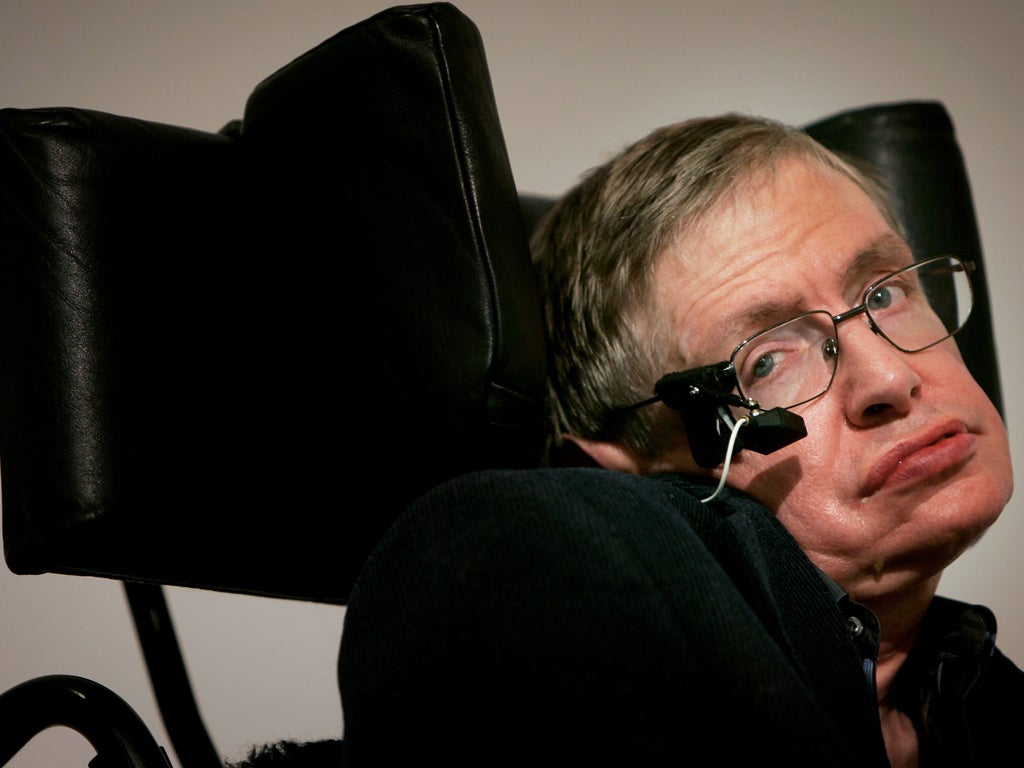
He may be one of the world's most eminent scientists but one thing remains a mystery to Professor Stephen Hawking - women.
When asked what he thinks most about during the day the physicist, who turns 70 on Sunday, said: "Women. They are a complete mystery."
Prof Hawking was diagnosed with amyotrophic lateral sclerosis (ALS), a form of motor neurone disease, when he was 22 and was not expected to live for more than a few years.
But he went on to become one of the world's most renowned physicists, publishing three best-selling books, including the well-known A Brief History Of Time, and has been awarded with a number of honorary degrees, medals, and a CBE in 1982. He has also been married twice and has three children.
Prof Hawking made his comment about women in an interview with New Scientist ahead of his birthday on Sunday.
He also told the magazine his "biggest blunder" was thinking that information was destroyed in black holes.
"This was my biggest blunder, or at least my biggest blunder in science," he said.
He was also asked what he would study if he were a young physicist starting out today, to which he replied: "I would have a new idea that would open up a new field."
The interview comes a week after Prof Hawking's technician Sam Blackburn, responsible for the past five years for the technology that allows him to communicate, told New Scientist the physicist's facial muscles that control his voice synthesiser are fading and new technology will be needed.
"Stephen's rate of speech is down to about one word per minute, and while I am making slight advances in the technology he is using, the nerve decay has now reached the point where we need to move to some new technology."
Prof Hawking will mark his 70th birthday with a speech at a public symposium at the University of Cambridge on Sunday.
Currently director of research at the Department of Applied Mathematics and Theoretical Physics at the university, where he also founded the Centre for Theoretical Cosmology (CTC), he previously held the Lucasian Professorship of Mathematics at Cambridge, a post once held by Isaac Newton.
The symposium, organised by the CTC in conjunction with technology company Intel, is called The State of the Universe.
Speakers will include the Astronomer Royal Lord Martin Rees; Professor Saul Perlmutter, winner of the 2011 Nobel Prize in Physics; and theoretical physicist Professor Kip Thorne, from the California Institute of Technology - a long-term collaborator with Prof Hawking.
Justin Rattner, chief technology officer at Intel, who will introduce Prof Hawking's speech on Sunday, said: "With more than half a century of remarkable research Professor Hawking has continually pushed the boundaries of humankind's understanding of the cosmos.
"More than any other scientist in recent history, his ability to engage people in the process of scientific discovery through his books, lectures and television programmes has opened countless inquisitive minds to a universe full of possibilities. Thank you, Stephen, and the best of wishes on your 70th birthday."
Prof Thorne said: "When Stephen lost the use of his hands and could no longer manipulate equations on paper, he compensated by training himself to manipulate complex shapes and topologies in his mind at great speed.
"That ability has enabled him to see the solutions to deep physics problems that nobody else could solve, and that he probably would not have been able to solve himself without his new-found skill."
Professor Sir Leszek Borysiewicz, vice-chancellor of the University of Cambridge, added: "I am proud that the world's best-known scientist is a Cambridge colleague.
"It would always be appropriate for Cambridge to celebrate such a person, and in Stephen's case there is even more reason to mark a long life that has transformed our perception of the universe."
PA
Join our commenting forum
Join thought-provoking conversations, follow other Independent readers and see their replies
Comments