Pressure grows to ban kettling as police face triple legal challenge
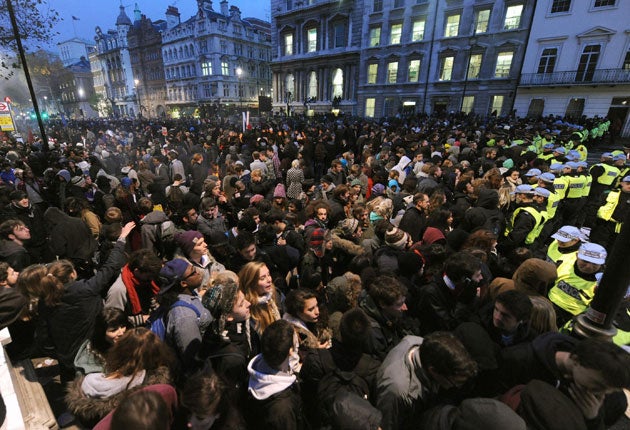
The contentious police tactic of "kettling" demonstrators is to face a series of legal challenges that could result in it being outlawed – starting with a case tomorrow brought by three teenagers.
Civil liberties groups are backing attempts by students and schoolchildren to ban the practice of holding large numbers of protesters in confined spaces for several hours.
The Metropolitan Police has repeatedly resorted to kettling as a crowd-control measure – mostly recently in marches against plans to increase university tuition fees. Critics condemn the practice as depriving law-abiding protesters both of their liberty and of their freedom of expression.
Challenges are being mounted both in this country and at the European Court of Human Rights, The Independent can disclose. The first will come when three teenagers from London go to the High Court tomorrow to press for a judicial review of the use of kettling.
Adam Castle, 16, his sister Rosie, 15, and Sam Eaton, 16, were among 10 friends caught in a "kettle" in Whitehall for eight hours when they joined a tuition fees march on 24 November.
They joined thousands of students, lecturers and teachers who gathered in Trafalgar Square to march towards the Houses of Parliament. As young demonstrators, many still in school uniforms, moved down Whitehall, they were corralled by police. They claimed they had no access to food or water and that two portable toilets were provided only five hours after they were penned in.
In an effort to keep warm in the freezing temperatures, the young marchers broke up placards and set fire to them.
Adam said: "The 'kettle' felt like a punishment for protesting – there didn't seem any logic for the police doing it. They were bringing in reinforcements against a shivering army of schoolchildren. I came away from the day angry that the police could do this. I didn't go to other protests because I didn't want to be kettled."
The teenagers' solicitor, Michael Oswald, is challenging the use of kettling under provisions in the European Convention on Human Rights guaranteeing personal liberty and security.
Mr Oswald, from the law firm Bhatt Murphy, said: "It's very encouraging that thousands of schoolchildren were politically engaged enough to turn up on 24 November and we should be proud of them for doing so. However, they were met by oppressive tactics on the part of the police, with the sad result that many of those young people won't be doing anything similar in the future."
Liberty is also preparing a legal challenge to the tactic following the tuition fee protests. The civil liberties organisation believes the use of kettling has changed the atmosphere on legitimate protests, stoking up tensions between protesters and police officers.
It acted as the official observer on the TUC anti-cuts rally in March and, although police stopped short of deploying the tactic, the organisation said it was an ever-present threat and had a "chilling" effect on the demonstration. Liberty is pursuing the case of two girls – aged 15 and 17 – who were caught up in the turbulent events of 24 November. The younger girl broke her foot when she attempted to leave the kettle to go home. She claims she was accused by police of fabricating the injury; after she finally persuaded an officer to let her out she was taken straight to hospital.
Emma Norton, a solicitor at Liberty, said: "These were children and they did not receive any special treatment. They are particularly vulnerable and there's no evidence the police factored that into their planning. Our concern is that kettling is used as a default mechanism. The courts need to look at it properly – it's only going to get worse with the demonstrations planned over the next few months."
Meanwhile, an eight-year battle over a previous instance of kettling will come to a head in the European Court of Human Rights in Strasbourg in September. It centres on the case of Lois Austin, who took part in an anti-globalisation demonstration in Oxford Circus, central London, in 2001. She was among 3,000 people, including passers-by who were not part of the protest, to be held in a police cordon for more than seven hours. They were held until 9.30pm and, despite repeated pleas, Ms Austin was not allowed to leave to collect her baby from nursery.
The House of Lords ruled six months ago that the tactic was lawful because of the conditions on the day. But Ms Austin has appealed to the Strasbourg court also arguing that the police tactic deprived her of her liberty.
The Metropolitan Police said it welcomed the court action as a chance to clarify the law over the containment of protesters. Assistant Commissioner Lynne Owens said: "Our use of containment has developed over the years. It now incorporates a containment manager who is responsible for setting the release strategy and putting this into action as soon as possible."
Join our commenting forum
Join thought-provoking conversations, follow other Independent readers and see their replies
Comments