Queen's cash crisis proves we <u>are</u> all in it together...
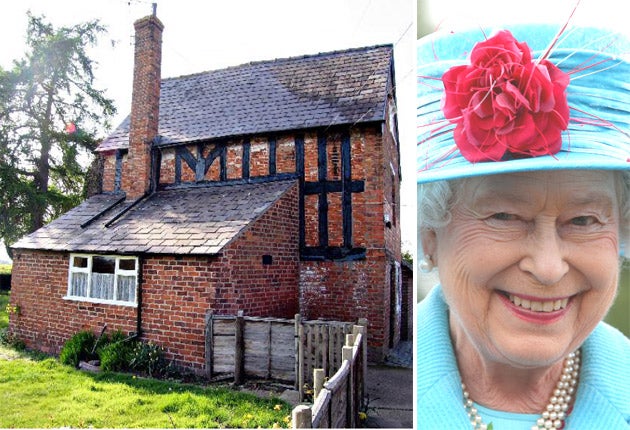
The Queen has been forced to sell one of her country estates, raising almost £1m in cash and heightening concerns over the scale of the financial crisis sweeping her investments and crumbling palaces.
Hadley Hall, a 16th-century listed farmhouse set in 50 acres of Cheshire countryside, was last night auctioned off by the Duchy of Lancaster; the Queen's national property portfolio which provides the monarch with a private income.
The royal sale comes on the eve of the publication of the Duchy's accounts which next week will reveal the extent of the damage done to her private wealth by combined effects of the recession and the credit crunch.
Separate accounts published by the Palace this month showed how the Queen's reserve of public cash, saved to pay her rising staff bills and fund her role as head of state, had fallen from £35m to £1m in the past 10 years, forcing her to go cap in hand to the Treasury for an increase to the Civil List.
Money raised by the Duchy of Lancaster is mostly used to finance her private affairs and businesses. The Civil List and parliamentary grants pay for her role as head of state.
But critics say it is time the Queen used her vast private wealth to pay off her public debts, including a £40m bill for the maintenance of Buckingham Palace and her other occupied palaces.
Last year the value of the Duchy of Lancaster, comprising 46,000 acres across England and Wales, fell by a fifth, or £75m, to £322m.
Lord Shuttleworth, the chairman of the Duchy's council, said in the Duchy report that the Queen's private estates had "suffered a substantial fall in the capital value" and he warned that the Queen's income would not be immune from the recession. "In the year ahead, it will be hard to maintain, let alone grow, the income with slow take-up for empty commercial space and a heightened risk of tenant business failure."
The Duchy invests its funds in agricultural, residential, commercial and financial portfolios.
Last year almost £15m was taken out of the financial portfolio in a defensive move and to pay for property refurbishments and new buildings.
The four-bedroom Hadley Hall near the Shropshire border with Cheshire needs renovating but retains period features such as a sweeping oak staircase, inglenook fireplace and oak-panelled wall on the first floor.
There are also two outbuildings next to the main house with scope for conversion. These include a Dutch barn and traditional brick building that could be turned into a detached house or used for office space, stables or storage.
In addition, the Duchy is selling two lots of agricultural land covering a further 16 and 33 acres, with guide prices of £90,000 and £150,000 respectively, which would be suitable for farming or horses.
Ahead of the auction last night, Ben Legget, of auctioneers Denton Clark, said there had been huge interest in the sale of the "very unusual property" which had been previously let to one of the Queen's tenant farmers.
"It needs a great deal of modernisation and possible alteration," he said. "It needs new wiring, central heating, plumbing and a new bathroom. It will probably have to be a cash buyer who has somewhere else to live while the work is being carried out."
A spokeswoman for the Duchy of Lancaster said the Duchy had a policy of consolidating its estates and disposing of peripheral assets. "Hadley Hall is located on a peripheral estate and is therefore designated for future sale," said the spokeswoman.
"The sale will provide further capital for re-investment into the Duchy portfolio. The Queen does not have any right to either the capital or the capital gains deriving from The Duchy of Lancaster, which is in effect a private portfolio of land and property assets held in trust and providing a private income for the reigning Sovereign."
Her Majesty's finances: The mystery of the sovereign's wealth funds
A recent analysis of the Queen's wealth showed that she holds assets worth £17bn in trust for the nation.
But access to these treasures is restricted by hundreds of years of obfuscation over what the Queen owns as sovereign and what she, as Elizabeth Windsor, owns personally .
While her private income is derived from a mixture of a portfolio of stocks and shares invested by the Bank of England Nominees and the drawings from the ancient estate of the Duchy of Lancaster, her public income is provided by the Government under the terms of the Civil List and parliamentary grants for travel, communications and the upkeep of the royal palaces.
The main areas of confusion focus on her "grey wealth": ambiguities surrounding the ownership of large parts of her estates which she holds in name alone, such as the Duchy of Lancaster and the Crown Estates. Constitutional experts argue that hundreds of years of history have helped to muddle the issue of royal title. But ultimately, such questions may have to be settled in the courts.
Only by dividing the Queen's property and income into properly defined categories – private wealth, sovereign wealth and grey wealth – would it be possible to finally work out what she is actually worth and what parts of her property the nation can claim as its own.
This would give Parliament a firm basis from which to debate the issue of the funding of the Royal Family and the many treasures it owns on the people's behalf.
This would appear particularly relevant today as the Queen's annual earnings, public subsidies and the cashflow of the Royal Family business have come under increasing strain over the past decade.
So what else could she sell?
The Royal Train
It costs the public on average £52,000 every time the train leaves the sidings. Could fetch a few million if a railway buff or museum took an interest.
Collections
The Queen has in her personal possession a wine portfolio worth £2m, 800 medals (including the first Victoria Cross, which was never issued) worth £2m, cars (including a 1900 Daimler Mail Phaeton) worth £7m and an inherited stamp collection believed to be worth up to £100m and including a £2m Mauritian twopenny. (Values from 2002).
Private homes
When Edward VIII abdicated, George VI had to buy both Balmoral in Scotland and Sandringham House in Norfolk, so that they would remain retreats for the Royal Family. These are the Queen's private homes and unlike Buckingham Palace, which is held in trust for the nation, could be put up for public sale. In 2002 they were estimated to have a combined value of £60m.
Gifts
The Queen has accumulated some 1,600 gifts during her 58 years on the throne. Some of the more unusual were put on display in a special exhibition at Buckingham Palace in 2002 to celebrate her Golden Jubilee. Among the exhibits was a tin model of a bus, presented in 1997 by the High Commission drivers in Pakistan, a ceremonial sword of sharks' teeth from the Pacific island of Kiribati, and a scene depicting a Bedouin oasis, crafted from gold, from the Emir of Qatar. The piece de resistance of the show was a 6ft-long wine cooler in the shape of a grasshopper given to the Duke of Edinburgh by then French President Georges Pompidou in 1972.
Join our commenting forum
Join thought-provoking conversations, follow other Independent readers and see their replies
Comments