Refugees in Calais 'Jungle' barred from crossing UK shores
Britain will not take any of the 2,000 asylum-seekers to be evicted, among them Afghans and Iraqis

Get the free Morning Headlines email for news from our reporters across the world
Sign up to our free Morning Headlines email
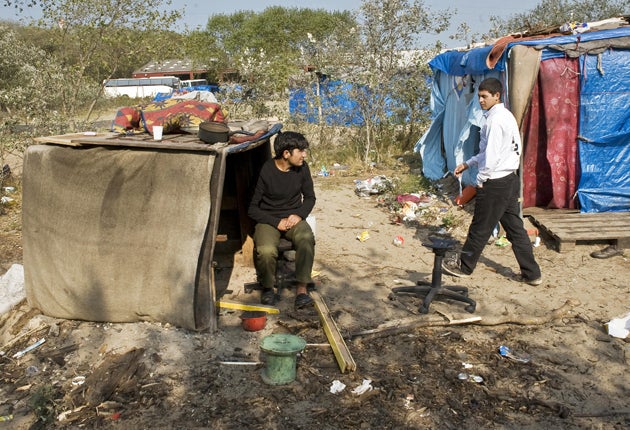
French police are expected to move this week to shut down the squalid refugee camp known as "the Jungle", where around 2,000 asylum-seekers, many from Afghanistan and Iraq, have gathered in an effort to reach Britain.
The Government yesterday shrugged off calls from Antonio Guterres, head of the UNHCR, the UN refugee agency, to take some of the refugees before they are evicted. The Refugee Council also called yesterday for a small proportion of the refugees to be granted asylum, arguing that it could be the "right solution".
Speaking from the camp, at the southern mouth of the Channel Tunnel, Saeed Khan, 25, described the horror and terror of life in the Jungle.
"I've been living in the Jungle for two and a half months," he said. "I travelled straight from Afghanistan to France and I was planning to apply for asylum, but the system they have here made me think about it twice. They just don't care.
"In France, if you apply for asylum, you sometimes have to wait for three to five weeks before you even get somewhere to live. They need to change the law here; it's very harsh and designed for dogs, not people."
Conditions inside the camp are also harsh, Mr Khan said, with little in the way of hygiene and medical facilities.
"The Jungle is cold and there are a lot of infections and skin diseases like scabies. There are two NGOs working here who bring food and without them we wouldn't survive. We are living in plastic tents and the water is not clean. There are only three showers, but there are more than 400 of us, and there's just one doctor. All he can do is give out paracetamol.
"In two and a half months I've only seen the UNHCR come here twice. They're not doing enough. We all want to go to England."
The dream of all the refugees in the camp is a new life in Britain. The difficulty lies in crossing the Channel. Mr Khan described the desperate attempts the asylum-seekers make.
"Getting into a lorry is the only way of getting across the Channel," he said. "I've tried it eight times now, but every time the French authorities have found me. Once, they held me in prison for 24 hours, but all the other times they just said to 'go back to the Jungle'. That's the only words they know. They don't explain what to do next or how to claim asylum.
"Why do people want to go to England? They want to live peacefully and have a human quality of life. I left Afghanistan because it was dangerous, but it's scary here, too. People are putting their lives at risk again just to get to England and find peace. I fled because my life was in danger. I was an interpreter for Isaf [the International Security Assistance Force] for two years and then I was working in a unit that investigated inside the government. We looked at who was taking bribes. I didn't get problems working as an interpreter, but I did when I was making investigations into my superiors; they didn't like it."
He added that even in France he doesn't feel safe. "It's unacceptable for me to stay in Calais, even if the Jungle stayed on. I'm always living in fear because I don't know who's living with me there. The Taliban killed a guy in Calais, so I never say who I was.
"My mother, father, brothers and sisters are all in Afghanistan. They're safe because no one knows where they are. I have a house in Kabul and in my village, but it's not safe. I can't live in my own country or in my own house, Instead, I'm stuck in something that's not even a tent. Nobody's listening as we have no voice. Nobody cares."
Subscribe to Independent Premium to bookmark this article
Want to bookmark your favourite articles and stories to read or reference later? Start your Independent Premium subscription today.
Join our commenting forum
Join thought-provoking conversations, follow other Independent readers and see their replies