Six years in jail, no charge: the war on terror's forgotten victim speaks
Babar Ahmad, 35, is the longest-serving prisoner held without charge or trial in the UK. In his first media interview since his arrest on a US extradition warrant in 2004, Mr Ahmad tells Robert Verkaik that he is the forgotten victim of the 'war on terror'. In March 2009, he was awarded £60,000 in compensation after an admission by the UK's anti-terrorist police that they subjected him to 'grave abuse, tantamount to torture' during his first arrest in December 2003. Corresponding via email from a secure isolation unit at Long Lartin prison, he calls on the Government to charge him or release him. Today, the European Court of Human Rights rules on his case
Can you describe your life in the UK before your arrest?
I was born in the UK and have spent all my life living in south London in the Balham/Tooting area. At the time of my first arrest in December 2003, I was employed full-time as an ICT Support Analystat Imperial College London. My job entailed supporting the software needs of undergraduate academic teaching and postgraduate research. I have always been a devout Muslim and others would describe me as adhering to mainstream Islamic teachings. I have never been charged with or convicted of any criminal offence.
Describe the conditions of your detention.
I have been held in a number of prisons throughout the high-security estate since my arrest in 2004. I have been designated a category A prisoner. Initially, I was held on normal wings in prisons, alongside prisoners of all different categories. I was then moved to a small unit in HMP Long Lartin and held with other men fighting extradition or deportation. Over the last year and a half, the conditions of my detention have deteriorated. I spend all day, every day on a small unit with seven other prisoners. We are isolated from all other prisoners and all our time is spent in the claustrophobic atmosphere of a small unit. If I am extradited to the US, my conditions will deteriorate further. I face the possibility of life without parole in solitary confinement under the harshest of prison regimes in a Supermax prison, far from home, family and friends.
What is the case against you?
The central US allegations against me revolve around a family of websites that provided news in nearly 20 languages on Chechen resistance fighters who were defending their land against the Russian Army's invasion of Chechnya in the 1990s. According to the US, this was terrorism [The Home Office says Mr Ahmad is accused of providing material support to terrorists]. But according to UK this was, and still is, legal as Chechen resistance fighters have never been proscribed as a terrorist organisation, unlike al-Qa'ida. In fact, the leader of the Chechen resistance has been living in the UK for several years, having been granted asylum.
The US claims jurisdiction because it is alleged that one of the several dozen computer servers on which the websites were hosted was located in the US for approximately 18 months from early 2000. The US accepts that the websites were also hosted on computer servers around the world and that "at all times material to the indictment" I was living in the UK. Other peripheral allegations against me are that a US naval battleship plan document was allegedly seized from me in December 2003. The media raised uproar about this document when I was arrested on the extradition warrant. However, in a letter to Sadiq Khan MP, the former Attorney-General Lord Goldsmith wrote that it could not even be proven that it was in my possession. Another document seized from my parents' house was a tourist brochure (belonging to my father) of the Empire State Building in New York, which prompted the media to report "al-Qa'ida planned to attack Empire State Building". That brochure is dated 1973, which is when my father visited New York. What is more incredible is that UK police returned this brochure to my father after I was arrested on the extradition warrant, yet it still forms part of the evidence against me.
How were you tortured in the UK?
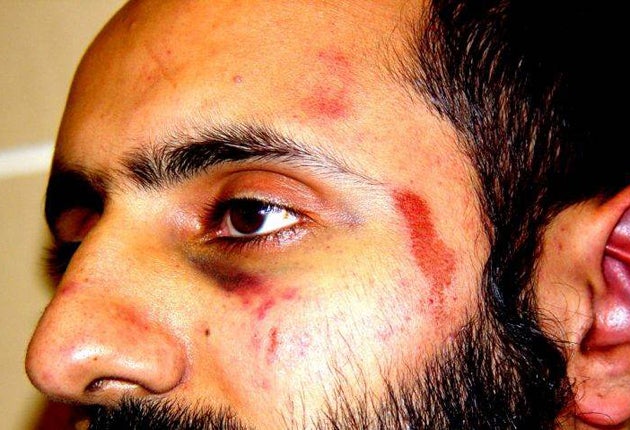
On 2 December 2003, I was arrested in a pre-dawn raid by anti-terrorist police officers at my home in Tooting. During my arrest and subsequent journey to the police station, the officers subjected me to a "serious, prolonged and gratuitous attack" and "grave abuse tantamount to torture", which left me with at least 73 physical injuries including bleeding in my ears and urine. I was held in custody for six days during which my home and office were searched, computers seized and analysed and I was questioned. On 8 December 2003 I was released without charge, after the CPS determined that there was no evidence to charge me with any criminal offence whatsoever. I believe that part of this decision was based on the fact that any future criminal trial would air embarrassing details of the abuse inflicted on me at my arrest.
Following my release I filed a formal complaint against the police and I gave several interviews describing my treatment. My case began to prove highly embarrassing to the Blair government.
When were you re-arrested?
After two months recovering from my injuries, I returned to work in February 2004 and tried to rebuild my life following my ordeal. On 5 August 2004, on my way home from work, I was re-arrested pursuant to an extradition warrant from the US under the controversial, no-evidence-required US-UK Extradition Treaty and taken to a high-security prison where I have remained ever since. To this day I have not even been questioned about the allegations against me.
Why is the US Government so determined to see you face trial there?
The question to ask is why has the Blair/Brown Government been so determined to extradite me? In my case there is documentary evidence to suggest that it is not the US that is really interested in me, but the Blair/Brown Government that has been determined to send me there at any cost. One only has to read the ferocious, lengthy representations that the Foreign Office has made to the European Court of Human Rights urging, almost begging, the Court to extradite me to the US. Their Herculean efforts eclipse those made by the US government itself.
What message do you have for the Coalition Government in respect of your extradition?
I have now been in prison fighting extradition for six years, which is the equivalent of a 12-year sentence. Whilst in prison I have outlived the the Blair/Brown Labour Government. To their credit, both the Liberal Democrats and the Conservatives have steadfastly opposed this controversial UK-US Extradition Treaty and they have pledged, in their published Coalition Agreement, to modify it.
Join our commenting forum
Join thought-provoking conversations, follow other Independent readers and see their replies
Comments