St Therese of Lisieux: Bigger than the Pope
Jonathan Brown: In the latest stage of a world tour, her remains are coming to Britain
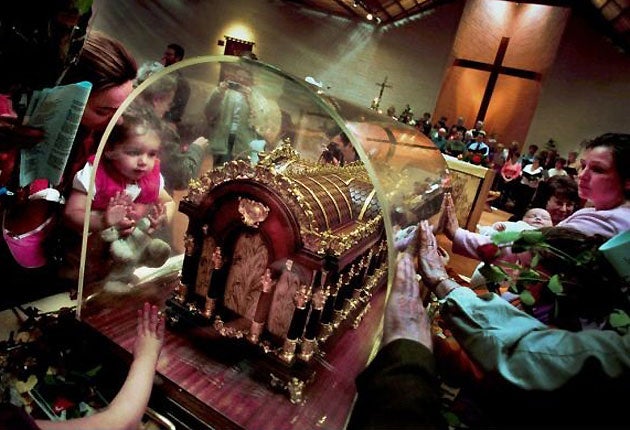
She died more than a century ago aged just 24, having spent the last decade of her life confined within the cloisters of a Carmelite convent in small town in France. Yet the writings and example of Marie-Francoise-Thérèse Martin have elevated her to the status of global Catholic superstar - an inspiration to millions of devotees from Edith Piaf to Jack Kerouac.
This autumn, the remains of the nun who went to become Saint Thérèse of Lisieux, will arrive in Britain for the first time where it is anticipated they could produce an outpouring of public veneration unseen in this country since the death of Diana, Princess of Wales. The relics will be continuing a world tour which has been ongoing for 12 years and has drawn tens of millions of Christians and other religions to pray and kiss the Perspex box, home to the wood and gilt reliquary in which her remains are kept.
In all 40 countries visited so far, from war-torn Iraq to Australia, the display has been accompanied by extraordinary scenes with a piece of her clothing recently taken into space.
In Ireland in 2001, a 14-day tour attracted 75 per cent of the population – more than turned out to see Pope John Paul II during his landmark visit in 1979. A farewell rally in a Wexford football stadium drew 20,000 people. The previous year a four-month tour of the United States saw 1.1m faithful turn out from La Plata to Honolulu. In New York 15,000 crowded outside New York's St Patrick's Cathedral forcing police to close Fifth Avenue.
Arriving at Portsmouth Cathedral in September the relics will be transported by a specially adapted hearse already being dubbed the Thérèse-mobile. They will visit 22 different locations, accompanied at all times by a priest, culminating in an appearance at Westminster Cathedral. The bones will be displayed at the chapel at Wormwood Scrubs and a hospice. In a symbolic show of ecumenicalism the relics will also be taken to York's Anglican Minster where they will be available for veneration through the night.
Organised by the Catholic Church of England and Wales which represents a faith community of 4.5m, the tour is being paid for by public donation. Canon John Udris of Northampton Cathedral, a member of the organising committee, said it was hard to know exactly what to expect. "I will be intrigued myself to see what kind of response we will get. My hunch is that with the English temperament we might be more reticent and we might find that our immigrant communities from Africa and India take the lead." Canon Udris, who visited the relics last month, said people were profoundly affected by their encounter with the relics. "One of her characteristics was her childlikeness, simplicity and straightforwardness. Being in her presence seems to bring out those qualities in us," he said. Canon Michael Ryan who has worked with the Dean of York to bring the relics to the magnificent surroundings of the Gothic minister said Thérèse ranked alongside St Augustine or Thomas Aquinas. "Ordinary Catholics and others are moved by her because she is so relevant to them. She was a person who struggled with life and with depression," said Canon Ryan. "She gave her life totally to God and a lot of people identify with her. Most people are suffering in one way or another. Christ helped her carry that cross and she got over her problems joyfully."
Born in Alençon in 1873, Thérèse was one of nine children born into a deeply religious family. Her mother died of breast cancer when Thérèse was aged four, a tragedy which left an indelible mark for the remainder of her life. Having moved to Lisiuex, the departure of her sister and substitute mother Pauline to a Carmelite convent struck a terrible second blow. The twin losses were the cause of her depression and made her volatile. But her personality was transformed in Christmas 1884 when she underwent a religious experience that persuaded her to devote her life to God. But the Carmelite convent, where two sisters were already residing, refused her entry and she was forced to appeal directly to the Bishop and Pope Leo XIII. As a novice nun her problems continued. Her father suffered a series of strokes which left him with hallucinations and resulted in his incarceration in an asylum. In the last 18 months before she succumbed to tuberculosis Thérèse endured terrible physical pain and deep depression. Yet such was her inner sense of peace few realised she was ill.
Her celebrity has helped turn her home town in the Calvados region of Normandy into France's second most visited shrine after Lourdes attracting more than two million visitors per year. Her life is charted in her slender autobiography Story of a Soul, published after her death, describes her belief in the Little Way – the realisation of sanctity through small acts. She was eventually canonised by Pope Pius XI in 1925.
Catherine Pepinster, editor of the Catholic weekly The Tablet said the veneration of saints' bones was common in Britain before the Reformation. She said the cult of Thérèse was fuelled in part through the fact she was one of the first saints to be photographed. "There is a curiosity factor about this. People in this country are probably the most sceptical in Europe," she said. "There are some who will be made uncomfortable by it. But what we forget in this day and age is that in terms of English history there would have been more people who thought it was a perfectly normal thing than who thought it peculiar. We are really just returning to an English tradition that has been lost."
Join our commenting forum
Join thought-provoking conversations, follow other Independent readers and see their replies
Comments