Stonehenge builders had geometry skills to rival Pythagoras
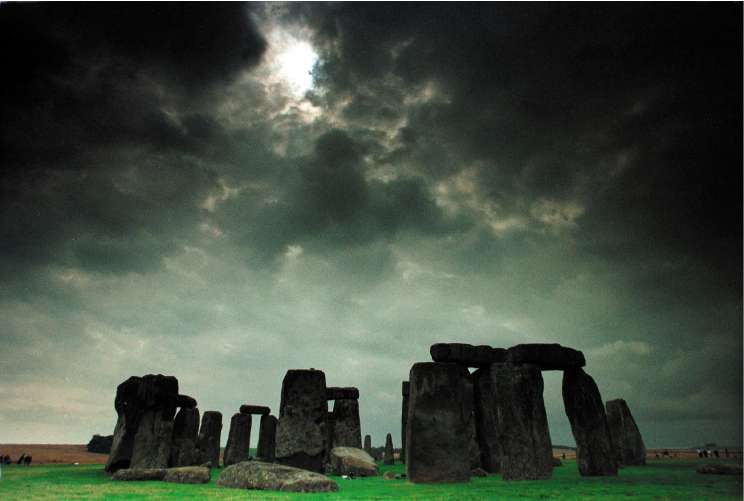
Stone Age Britons had a sophisticated knowledge of geometry to rival Pythagoras – 2,000 years before the Greek "father of numbers" was born, according to a new study of Stonehenge.
Five years of detailed research, carried out by the Oxford University landscape archaeologist Anthony Johnson, claims that Stonehenge was designed and built using advanced geometry.
The discovery has immense implications for understanding the monument – and the people who built it. It also suggests it is more rooted in the study of geometry than early astronomy – as is often speculated.
Mr Johnson believes the geometrical knowledge eventually used to plan, pre-fabricate and erect Stonehenge was learnt empirically hundreds of years earlier through the construction of much simpler monuments.
He also argues that this knowledge was regarded as a form of arcane wisdom or magic that conferred a privileged status on the elite who possessed it, as it also featured on gold artefacts found in prehistoric graves.
The most complex geometrical achievement at Stonehenge is an 87-metre diameter circle of chalk-cut pits which mark the points of a 56-sided polygon, created immediately within themonument's perimeter earthwork.
Mr Johnson used computer analysis and experimental archaeology to demonstrate that this outer polygon was laid out using square and circle geometry. He believes the surveyors started by using a rope to create a circle, then laid out the four corners of a square on its circumference, before laying out a second similar square, thus creating an inner octagon. The points of the octagon were then utilised as anchors for a surveyor's rope which was used to "draw" arcs which intersected the circumference so as to progressively create the sides of a vast polygon.
Indeed, his work has demonstrated that a 56-sided polygon is the most complex that can easily be created purely through square and circle geometry using a single piece of rope.
It is likely that this basic limitation determined the number of sides of Stonehenge's outer polygon – and may also have led to the 56-sided polygon concept becoming important within wider European religious belief. Ancient Greek classical mythology associated just such a 56-sided polygon with Zeus's great rival for divine supremacy, the weather god Typhon.
Johnson's research, published as a book this week, shows that Stonehenge derived its design from geometrical knowledge and features no less than six concentric polygons – a 56-sided outer one built around 2950BC; a regular octagon built around 2500BC) inside that; two concentric (though partly inaccurate) 30-sided polygons built around 1650BC, which were based on a series of hexagons; a 30-sided inner polygon (the sarsen stone ring which was built around 2500BC) also based on hexagonal geometry; and two probable 40-sided concentric polygons (probable former blue stone positions built around 2600BC) that were later modified to 30-sided ones. They also created the famous central stone "horseshoe" utilising the survey markers used to create the thirty-sided sarsen polygon.
The experimental archaeology demonstrates that most of the monument was pre-planned and that the great stones were pre-fabricated off-site and then installed by surveyor-engineers.
"For years people have speculated that Stonehenge was built as a complex astronomical observatory. My research suggests that, apart from mid-summer and mid-winter solar alignments, this was not the case," said Mr Johnson. "It strongly suggests that it was the knowledge of geometry and symmetry which was an important component of the Neolithic belief system."
"It shows the builders of Stonehenge had a sophisticated yet empirically derived knowledge of Pythagorean geometry 2000 years before Pythagoras," he said.
A leading British prehistorian, Sir Barry Cunliffe, from Oxford University, believes that Anthony Johnson's research is "a major step forward in solving the puzzle of Stonehenge".
Details of Anthony Johnson's research can be found in his book 'Solving Stonehenge' published by Thames and Hudson. Further information can be found at solvingstonehenge.co.uk/
Join our commenting forum
Join thought-provoking conversations, follow other Independent readers and see their replies
Comments