Success of Retirement Show confirms power of the grey pound
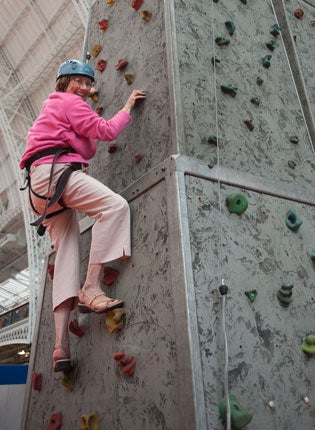
The climbing wall may be more than 40 feet high but Jan Prince is undeterred. With an excited giggle she drops her handbag, slips into a safety harness, adjusts the straps on her helmet and puts her left foot on the first available foothold.
Down below, friends and onlookers cheer as the 72-year-old effortlessly shins up the wall. She pauses briefly to survey the view, turns and then flawlessly abseils back down.
"That was rather fun," she says as she's met by her friends. "I'd never gone climbing before. I've been running for 10 years and my joints are a lot more flexible than they used to be. I think that probably helped."
If anyone wanted confirmation that retirement really is the start of a new life, this weekend at Kensington Olympia's exhibition centre would have been a good place to start. For two days thousands of SKIers (Spending the Kids Inheritance) flocked to the annual Retirement Show to be courted by a host of companies all in pursuit of one thing: the grey pound.
And what a lot of pounds there are to spend. Despite current concerns over pension cuts, which will inevitably force people to watch their wallets in their later years, it is estimated that Britain's army of retirees still spend up to £100bn a year. We are living longer and healthier lives, and we are filling them with activities that would have been unthinkable three decades ago.
Next up the wall is Jan's 62-year-old friend Susan Beckett. The pair have travelled together from Epsom, Surrey, where they keep up a fitness regimen that would put the average person half their age to shame. Susan, who read about the climbing wall on the internet and made sure it was her first stop of the day, reels off the activities that she's currently signed up to.
"I do line dancing, I go to the gym three times a week, as well as swimming and Tai Chi," she says. "Oh, and I nearly forgot, I've just taken up hula hooping. I used to be excellent at that but the hips aren't quite what they used to be."
Tony Clack, a 62-year-old retired businessmen from Berkshire, now runs LaterLife.com, an online magazine for the elderly which also provides courses for people who are about to go into retirement. He says the options for the over-60s are astonishing compared with two decades ago, but many retirees simply aren't aware of the sheer variety.
"The challenge these days is that retirement now often lasts 20 or 30 physically healthy years," he says. "When you say goodbye to your job you've suddenly got to find 40 or 50 hours a week worth of activities to keep you occupied and happy on top of what you already had as leisure time. Most people can't wait for that sort of freedom; they have it all planned out and know exactly what they want to do. [But] for others it can be a very terrifying prospect."
Further inside the exhibition centre, past the exercise class doing balance exercises in time with the pop punk single "Teenage Dirtbag", Keith Watts, 62, is handing out flyers for the University of the Third Age.
U3A, as it likes to be known, is a nationwide organisation of almost 250,000 retirees which encourages older people to share the expertise they have gained in their working lives in informal meetings and social gatherings. For Mr Watts, a former mechanical engineer from Abbots Langley, the need to find some sort of adrenaline-soaked physical adventure was less important than keeping his grey cells ticking over.
"I've been a member of our local group for the past 18 months and we've done so many different things," he says. "I'm in a group that studies genealogy, one that helps people understand computers, and another that deals with science and technology." The last lecture he attended was on the physics behind rainbows. Next time he will be giving the lecture. "I haven't decided what I'm going to do yet but I was involved in brain scan technology a while back so I might talk on that," he says.
For politicians and companies alike, those who choose to ignore our pensioners do so at their own peril. Two years ago Britain passed a remarkable milestone. For the first time in its history there were officially more pensioners than children living in the UK – 11.58 million men over 65 and women over 60, compared to 11.52 million under-16s.
According to the Office of National Statisitics, the percentage of the population aged 65 and over has grown from 15 per cent in 1984 to 16 per cent in 2009, an increase of 1.7 million people. The median age of people in Britain, meanwhile, has risen from 35 years to 39 years over the same period.
By 2034, if current trends continue, an estimated 22 per cent of the population will be over 65 and the median age will be 42. In business terms it's a large and lucrative market to corner, but some believe companies still do not do enough to appeal directly to older consumers.
"There's still an enormous amount of stereotyping going on," says Julian Healey, former head of marketing at Saga, who now runs his own company, Springtide Marketing. "Adverts are overwhelmingly aimed at younger audiences and there is very little recognition of the variation among older people. Someone in their 60s is going to think, behave and spend very differently from someone in their 80s."
A recent study on older people's likely spending habits in the future concluded that the 65 to 74 age range would see the largest increase in annual spending. The amount spent by this group on consumer goods is projected to rise from an average of £4,379 a year now to £6,055 by 2017– an increase of nearly 40 per cent.
But while most visitors to the Retirement Show are looking for ways to spend their hard-earned pensions, others are looking for more work. Rowland Gee, a 64-year-old businessman and former chief executive of Moss Bros, has just launched Grey4Gold, a non-profit site for the over-60s which will match retirees with small businesses looking for employees.
Gee came up with the idea when a friend of his was made redundant by Marks and Spencer two years ago. "The site's only a couple of weeks old but we've already got 300 people registered." he said.
Back at the climbing wall, Maureen Sommerville, a 62-year-old yoga fanatic from Dudley who survived cancer in her early 50s, says: "Cancer left me with such low energy levels that I swore to myself that if I got better, I would stay healthy.
"We're probably the luckiest generation. We've been luckier than our parents were and we've probably got it better than our children."
And with that she starts scampering up the wall.
Join our commenting forum
Join thought-provoking conversations, follow other Independent readers and see their replies
Comments