Suicide is legal, helping someone to die is not. Must the law be changed?
Debbie Purdy and Michael Wenham, both living with terminal illnesses, put their opposing views ahead of this week's Lords debate
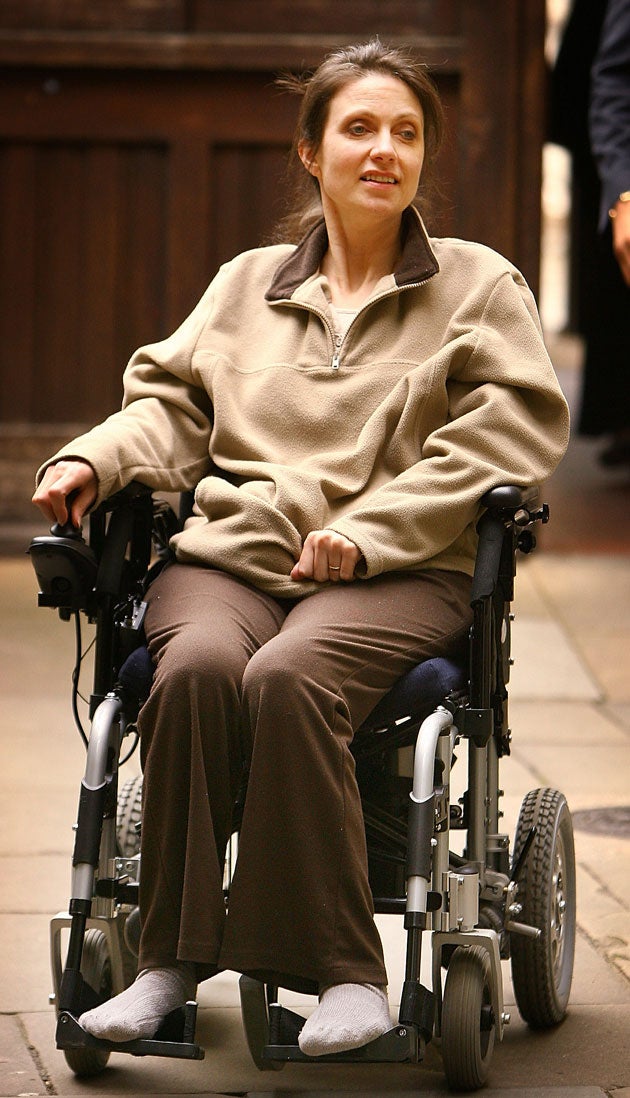
To be or not to be? More pertinently: is it a decision for the individual or the state? While suicide is legal in Britain, helping someone to die is not. In the past seven years, 115 Britons have travelled with the help of relatives and friends to the Swiss euthanasia clinic Dignitas to end their lives. Most were suffering from terminal conditions such as cancer and motor neurone disease, but last week it was revealed a small number had chronic but non-life-threatening conditions, including rheumatoid arthritis. Yet no one has ever been prosecuted.
The House of Lords debates an amendment to the Coroners and Justice Bill this week which seeks to set out the circumstances in which it would be legal to help someone to end their lives.
Debbie Purdy supports the amendment. A multiple sclerosis sufferer, she wants clarification of the circumstances under which her husband, and others like him, would be prosecuted if he helps her to end her life. Michael Wenham, who suffers from motor neurone disease, opposes it. The Independent on Sunday asked them to debate the issue via email.
Debbie Purdy (DP) Thousands of people have told me they wish me success because they need to know their decisions will be respected, so it's about more than just the man I love. A recent BBC poll showed that 4 per cent of the public think assisting should be an offence. I read that as 96 per cent of people think there are circumstances that should not result in prosecution, so we need to be clear what these circumstances are. Don't you agree that legal clarity is a minimum requirement?
Michael Wenham (MW) I read the poll differently but agree with you that the law and the way it's enforced needs to be clearly understood. But if you mean "clarified" as another word for changed, I don't agree. Assisting or encouraging someone to take their own life should not be enshrined in law. I understand you want the exceptions to the rule spelled out in black and white, so that people like yourselves know where you stand. My view is that you can't make hard and fast rules to cover every circumstance. Life, and death, is not like that. The clarity needed is a clear explanation of the present law and its application.
DP The current law says to counsel, procure, aid or abet suicide is unlawful, but suicide itself is OK. This means pushing my wheelchair, making travel arrangements or collecting medical data is illegal; even talking about it with my husband may be.
The law should specify a patient can apply to get medical or legal confirmation that it is their own choice to end their life with medical help. Without that prior application for help, the Director of Public Prosecutions (DPP) would be free to consider a prosecution. This is what I mean by "clarity". The amendment would not make it "easier" to go to Switzerland or commit suicide; that's already legal. What it would do is establish a framework for advance confirmation that this is the patient's decision and set out the help they can expect.
MW I don't see how it would prevent pressure from being applied to someone struggling with illness. Imagine a frail old lady, in a home, who has cancer, feels she's a burden to her family and says so. "It would be easier for everyone if I ended it all," she says. "Well, we wouldn't want to put pressure on you, but if you wanted we could arrange for you to see some doctors..." No obvious pressure from interested parties, just the subtle implication of not being wanted. This amendment would protect them when they took her to Switzerland, because the documents would all be in order. The present law is a strong deterrent to any such abuse of the vulnerable.
That leaves your dilemma. I know that to say "Trust the DPP to get it right" is not good enough for you. You don't. I'm not sure there is an answer with the guarantee you want, but then I'm not sure there are any guarantees in life, anyway.
The major flaw in the amendment is that it says assisting suicide for the terminally ill is allowed if a person travels abroad. Why on earth should it be considered differently in the UK? In effect it introduces into British law an entirely new principle.
That's the point, isn't it? As well as providing you with some reassurance, it's also a step towards legalising assisted suicide.
DP Common law in this country is not to prosecute people who assist loved ones going abroad to die, so "Granny" isn't protected now. The law needs to be framed in a way that is appropriate in 21st-century Britain with the safeguards that are needed here, not Switzerland. Many campaigners, including Dignity in Dying, want the law to apply only to those who have begun the process of dying, that is, who are terminally ill. I personally would argue for a law that provided assistance to the incurable/chronically ill who suffer unbearably and have reached the end of their tether. We need open public discussion and a law that says what it means and means what it says.
MW I wouldn't want to ask Jane [his wife] or any of my family to help me kill myself because I know they'd just absolutely hate it. I've written in My Donkey Body about how hard it is for them to watch me deteriorate and become completely dependent. I know it's purgatory for them but if I chose to end it all that would be worse, and worst of all would be if I asked them to have a part in that. It says that I was no longer of value to them, that they were no longer of value to me, that the pain and suffering outweighed their love. I know they don't think I've lost my dignity even when I'm incontinent, dribbling and incoherent. I don't believe they will when I'm much worse. But some are not so "lucky" – people suffering alone. What or who have they got to live for? That seems to me to be a failure of our society.
DP You have made a choice how you live your life and how you will face death. You find dignity in fighting motor neurone disease to your last breath. But someone else may find dignity in taking control of the time and manner of their death. I don't believe anyone else has the right to pass judgement on an individual's decision, which the law does.
"Assisted suicide" suggests someone giving up. It is always heartbreaking when a person loses faith in her/himself, and family and friends are consumed with regret at not having done "something". What we are talking about is "assisted dying", when someone facing the certainty of death or pain they cannot bear chooses to take control.
MW I often hear people arguing: "They're religious and trying to impose their views on the rest of us." That ducks the issue, which is: what is best for society? Everyone has beliefs. You believe God doesn't exist; I believe He does! The fact that the majority of the population say they believe in God isn't the point. The question is: does the law work at present in its purpose, or can it be improved? Palliative care has improved immeasurably. It's not perfect or uniformly good, but that's an argument for expanding and improving it, not offering euthanasia as an economical alternative.
Email debate moderated by Nina Lakhani
Join our commenting forum
Join thought-provoking conversations, follow other Independent readers and see their replies
Comments