Taliban doubles number of bomb attacks on British troops
Cameron pledges UK soldiers won't stay in the country 'a moment longer than necessary'
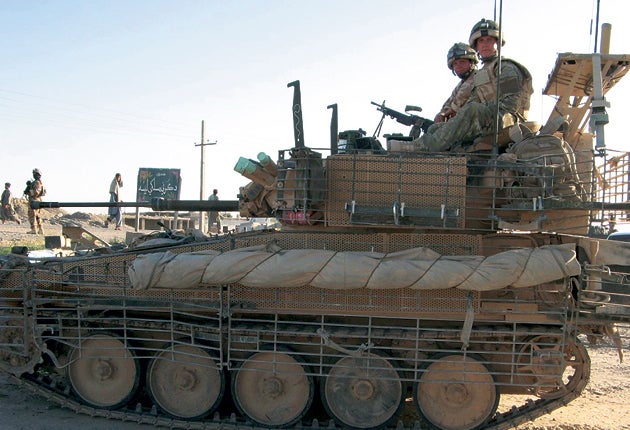
The death of a British soldier from 1st Battalion The Mercian Regiment, who was killed in an explosion in Nahr-e Saraj, Helmand province, yesterday, has taken the death toll to 295 since the start of the conflict nine years ago.
The latest casualty comes as statistics from a secret Nato database reveal the full extent of how British troops are bearing the brunt of bomb and gun attacks in Afghanistan.
Figures obtained by The Independent on Sunday confirm that there were 3,594 improvised explosive device (IED) attacks in southern Afghanistan between October 2009 and March 2010, according to Nato's Combined Information Data Network Exchange. This equates to 21 incidents a day in the part of the country where Britain's 10,000-strong force is based, and is 78 per cent of all IED attacks overall. It represents a 236 per cent increase in attacks compared to the same period last year. Soldiers operating in southern Afghanistan also suffered more direct-fire attacks than forces elsewhere in the country, according to Nato's statistics.
The figures will add to pressure on the Government over Britain's role in Afghanistan. The news comes as David Cameron hinted at a troop withdrawal during a visit to Afghanistan last week. He pledged that he would not keep British service personnel in the country "a moment longer than necessary", and added: "This is the year when we have to make progress." The Prime Minister ruled out sending any more troops, saying it was "not remotely on the UK agenda".
During a joint press conference with the Afghan President, Hamid Karzai, in Kabul last week, Mr Cameron announced that an additional £67m will be made available to help troops deal with IEDs.
The danger being faced by British troops was brought home to the Prime Minister when he had to pull out of a planned trip to a forward patrol base on Thursday amid fears that he had become a target for Taliban assassins.
Tensions in Afghanistan are running high, with the Taliban mounting attacks on the recent "peace jirga" talks held by Mr Karzai with tribal leaders. On the eve of last month's conference, which tried to find a way to persuade insurgents to lay down their arms, the Taliban issued a statement saying that the conference did not represent the Afghan people and was aimed at securing the interest of foreigners.
And the US Defence Secretary, Robert Gates, admitted on Friday that the road ahead would be "long and hard" and warned that gains "will not come quickly or without high cost".
As the death toll continues to climb, concern about Britain's involvement is growing, with more than three-quarters of Britons backing a withdrawal of troops, said a recent poll for The IoS.
A senior commander involved in planning the deployment of British troops to Helmand Province in 2006 admitted yesterday that the MoD's approach to the mission was flawed. Rear Admiral Chris Parry, speaking on the BBC Radio 4's Today programme, said: "At the time, I think we had an immature approach to what is now known as counter-insurgency. We didn't realise the complexity and character of the context in which we were going to fight. In fact, we didn't envisage we were going to fight." His view was echoed by Tory backbencher Adam Holloway, a member of the Commons Defence Committee, who described Britain's strategy in Helmand as having been "fatally flawed".
A coalition troop "surge" in recent months has resulted in soaring levels of violence and has seen Taliban commanders switch their strategy to avoid large-scale confrontation and increase the use of IEDs.
The coming months could see the death toll rise still further, as coalition forces prepare to move on the Taliban stronghold of Kandahar in what commanders are calling the "most difficult and most important" operation since the war began.
The Army's top bomb disposal officer resigned last month after speaking out about the pressures faced by soldiers in Afghanistan. Colonel Bob Seddon, the principal ammunition technical officer of the Royal Logistics Corps, said he was "very concerned" about the toll being taken on his staff. And Christina Schmid, the widow of Staff Sergeant Olaf Schmid, who died in October while trying to defuse a bomb, claimed her husband was a victim of overstretch. "He was flaking at that point, saying 'I need to step back because I need to recharge', and I don't feel he had that time."
The MoD insisted this weekend that countering the threat from IEDs is a priority. Liam Fox, the Defence Secretary, said: "The threat does not stand still and nor does our response. I will make sure everything possible is done to ensure our forces have what they need to deal with this indiscriminate threat. They deserve nothing less."
Join our commenting forum
Join thought-provoking conversations, follow other Independent readers and see their replies
Comments