UK

3° London Hi 4°C / Lo -2°C

The Big Question: Is the writing on the wall for the Government's ID card scheme?

By Ben Chu


independent graphics

Why are we asking this now?

The Government had been due to award a key contract as part of its grand biometric ID card scheme this autumn. Three companies - Thales, Fujitsu and IBM - were bidding for the right to develop the cards' design and handle their production. But this week the Home Office admitted a decision might not be made until the second half of 2010. This is the second delay to have hit the Government's ID card scheme. Under the original plans, the widespread roll-out of the cards would have taken place next year. Now it is not due until 2012.

Why the latest delay?

The Home Office argues that commercial and technical considerations are responsible. But it has been noted that the decision comes at a time when the future of the scheme has never looked more precarious. This week the shadow Home Secretary, Chris Grayling wrote to companies who might be involved in producing the cards to warn them that the scheme would be cancelled if the Conservatives win power at the next election; something the opinion polls suggest is increasingly likely.

Why are the Tories opposed to the scheme?

The Tories and the Liberal Democrats have long maintained that the introduction of ID cards would undermine traditional civil liberties. The Tory leader, David Cameron attacked the scheme as "unBritish" this week. The Liberal Democrat home affairs spokesman, Chris Huhne, has called the cards a "laminated poll tax".

The smaller parties, from the SNP and Plaid Cymru, to the Green Party and UKIP, are also opposed. The Government claims the scheme would be useful in curbing illegal immigration, thwarting organised crime, and would make it easier for people to access public services. Opponents argue that it would be ineffective, intrusive and create new opportunities for fraudsters.

Are those the only objections?

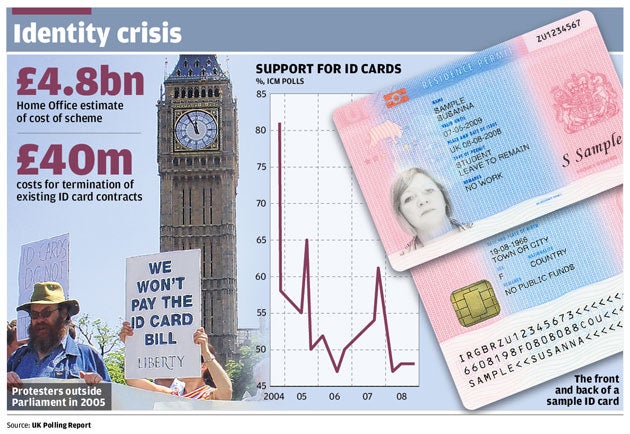
Far from it. The cost of the scheme is another major reason why the scheme attracts opposition. The Government says the cost of producing biometric ID cards and passports over the next 10 years will be £4.8bn. At a time when all parties are looking for ways to reduce public spending, cancelling the scheme is seen as a relatively pain-free way of saving money.

The Home Office argues that 70 per cent of the £4.8bn would be spent on biometric passports, limiting the saving from scrapping the cards to around £1.2bn. But this ignores the fact that this Government has an unfortunate habit of underestimating the cost of large projects, particularly those involving computer databases. Dr Edgar Whitley of the London School of Economics estimates that the true cost of the scheme will end up between £10bn and £20bn. If that is closer to the truth, the potential savings begin to look rather more substantial.

Haven't some contracts already been signed?

Yes. Four contracts have been concluded. Thales is running a pilot scheme. CSC is developing a passport and ID card application system. IBM has a contract to build a database to store fingerprint and facial biometrics. And De La Rue has a contract to produce biometric passports. The former Home Secretary, Jacqui Smith, revealed in March that it would cost £40m for the Government to extricate itself from these contracts.

But much of the technology being developed under these agreements would be needed to develop biometric passports, which the Conservatives support. The key contract with the private sector would be the one to develop and produce the new cards themselves. That is why this latest delay is significant.

Is it wise for the Tories to write to companies threatening to overturn signed contracts?

The Tories say such drastic measures are needed to prevent the Government locking a future government into the scheme. But not everyone is impressed by this argument. Some point out that companies such as Thales are already fully aware that public procurement contracts, especially ones as controversial as ID cards, are at risk of being revisited and that they insert compensation clauses with this risk in mind. This makes the Conservative warnings unnecessary. It is suggested that the opposition would be better off concentrating its criticism on the Government, rather than seeking to put pressure on private firms.

What is the timetable for introducing ID cards?

Some 30,000 cards have already been issued to non-EU nationals living in Britain. Later this year, they will be given to workers at London City and Manchester airports. And this autumn British citizens living in Manchester will be given the chance to participate in a trial scheme.

From 2011/2012 the Identity and Passport Service plans to issue "significant volumes" of ID cards to people when they apply for a British passport, although they will be able to opt out of having a card.

This staged approach is deliberate. The Government hopes that support for the cards will grow when people witness how they can make their life easier. The Government says that if it wins the next general election it will give MPs a free vote on whether to make the cards compulsory for all UK citizens over the age of 16.

What is the view of the public at the moment on ID cards?

Despite the deep concerns of civil libertarians, most people have, in the past, been reasonably well-disposed to the idea of a national ID card scheme. But that has begun to change as the costs have come into focus, particularly the fact that everyone will be required to pay a £30 fee to obtain one.

Over the past five years the NoID pressure group has commissioned regular polls to gauge public support for the Government's proposals. Normally a poll from a pressure group would need to be treated with scepticism. But NoID has asked the same unloaded question on each occasion. It has found that support for the cards has fallen from 55 per cent in June 2005 to 48 per cent in December 2009.

Interestingly, the plans to issue ID cards to pilots and other airport workers - the first British citizens to be forced to hold the cards - are meeting growing resistance.

Is the Government about to perform a U-turn?

There are rumours in Westminster that support in the Cabinet for ID cards is receding. And there were reports at the weekend that the new Home Secretary, Alan Johnson, has ordered a review of the policy.

But Mr Johnson also described ID cards this week as a "manifesto commitment". And while there might be grumblings about the wisdom of ploughing on with the scheme in the Cabinet, it would be a considerable humiliation for the Government to scrap a policy that it has doggedly clung to for some four years.

So ID cards might not be officially binned, but do not be surprised if ministers decide to kick the scheme still further into the long grass before the next general election.

Will ID cards ever see the light of day?

Yes...

* The new Home Secretary, Alan Johnson, has reaffirmed the scheme as a "manifesto commitment"

* It would be expensive to break the contracts that have already been signed

* ID cards are already a reality and they will become increasingly accepted in the years ahead

No...

* The Tories have promised to scrap the scheme and they are likely to win the next general election

* ID cards are an expensive scheme that the country simply cannot afford with the public finances in their present state

* The public mood is shifting against the scheme

Post a Comment

View all comments that have been posted about this article.

Offensive or abusive comments will be removed and your IP logged and may be used to prevent further submission. In submitting a comment to the site, you agree to be bound by the Independent Minds Terms of Service.

Comments

Jings & crivvens! Ye'll dang well hae these cards because
[info]reiksares wrote:
Thursday, 18 June 2009 at 11:17 pm (UTC)
Gordy sez so!!
Future History
[info]austinstraker wrote:
Thursday, 18 June 2009 at 11:57 pm (UTC)
How did they get the result from December 2009?

Thought it was NO2ID...
Re: Future History
[info]b_chu wrote:
Friday, 19 June 2009 at 11:51 am (UTC)
Ben Chu here. Apologies. That polling result was from December 2008, not 2009.
ID cards? -- some hope!
[info]voroddo wrote:
Friday, 19 June 2009 at 12:21 am (UTC)
For a common-law country such as the UK to introduce ID cards would mean a total redefinition of the traditional relationship between the state and citizens. It is one that most of us (pace Ben Chu) will not tolerate. Tell the stste every time we change address? -- it's not going to happen, and any government silly enough to try to make it happen will provoke civil disobedience such as will make the poll tax riots look like a genteel tea-party.
Remember about IBM...
[info]ancientoneuk wrote:
Friday, 19 June 2009 at 01:45 am (UTC)
In 1937 Thomas Watson of IBM signed a deal with a Mr A. Hitler to supply tabulating machines for the Reich's use on its citizenry...

This of course made it very easy for Hitler to bring in his little plans such as Aryan Certificates, identify habitual criminals and those convicted of crimes such as homosexuality, identify non Aryans such as Jews, Romanian Gypsies and the like and we all know what he did with that information from there...

Have the Jews and the Muslims here in Britain not understood a damned thing from Hitler's introduction of the national identity database then? Todays database will have DNA, religious records, biometric records, if someone in Downing St said as Hitler once did, I want the names and addresses of all the Jews here in the UK, it would be fairly instant, now imagine if you will a scenario where a party like the BNP builds on populist support, with support comes the ability to field more candidates, now imagine in 10 or 20 years time that maybe the BNP has grown to a size that is considered strong enough to win an election....

Now imagine that database in the hands of the BNP...
Re: Remember about IBM...
[info]sickofstupidity wrote:
Friday, 19 June 2009 at 11:49 am (UTC)
Exactly. One of the strongest arguments aganst ID cards and the database of personal information that they would support is that, regardless of the current government's - somewhat unconvincing - assurances that the information will never be abused or misused, we simply do not know who might get their hands on that database in the future.

If, god forbid, an illiberal, oppressive totalitarian government comes to power in this country in the future, they will have a ready-made tool for identifying 'undesirable' or potentially subversive elements in society - e.g. religious groups, academic radicals, homosexuals, ethnic groups - and setting about rounding up, imprisoning or otherwise sliencing them. (An ultra-right wing party, such as the BNP, is not the only possibility for such a government; it might be an ultraconservative, Sharia-based Islamic government, if increasing birthrates in the Muslim combine with decreasing birthrates in the non-Muslim community to bring about a demographic inversion of the electorate.)

Do we really want to hand these future governments the instruments of our own oppression on a plate?
After the MPs expenses, who trusts data security in the UK
[info]mannygoldstein wrote:
Friday, 19 June 2009 at 03:04 am (UTC)
The danger of centralising data in a single system with inadequate data protection has been shown by the ease with which a single individual obtained the confidential information related to MPs expenses.

Does anyone remember the CD's that went missing that contained information about Child Benefit, data related to 36 million individuals?

How about the computerisation of patient records for the NHS?

An ID system would allow tens of thousands of individuals access to the system, so data security would not be good.
Happy days
[info]happybabe1987 wrote:
Friday, 19 June 2009 at 06:21 am (UTC)
^^^^^^^^^^^^^^^^^^^^^^^^^^^^^^^^^^^^^^
I am a nice man. In the past I was always seeking my love. A friend told me a platform-========Cougar Circle . com =========where I knew my ideal match, a beautiful and gentle woman. I hope more and more people can get happiness there. I believe "All shall be well, and Jack shall have Jill".
^^^^^^^^^^^^^^^^^^^^^^^^^^^^^^^^^^^^^^
(no subject) - [info]thomas_66 - Friday, 19 June 2009 at 08:23 am (UTC) Expand
Re: I wish it was only ID cards we had to worry about
[info]sickofstupidity wrote:
Friday, 19 June 2009 at 12:25 pm (UTC)
Regarding location tracking via mobile phones, this is actually not some dark Orwellian scheme deliberately intended to monitor our movements for purposes of government and police surveillance.

On the contrary, it is a byproduct of the way in which cellular phone networks are designed to operate; they actually rely upon being able to detect your approximate location, so that they know which local cell to route your calls through. And as you move about, they have to constantly recalculate your location in order to route your calls through the next appropriate cell. If they could not calculate your location in this way, cellular networks simply would not work, and probably would not exist.

Of course, this location data can undoubtedly still be used for purposes of government and police surveillance, should they so wish - and, indeed, it already has been in a number of recently reported criminal investigations (and, in one case, it provided vital information about the movements of terrorist suspects who later committed terrorist acts in London and Glasgow). But this was never the *primary* purpose of this technology, and so mobile phone companies should not be viewed as instruments of government surveillance - it is simply that their technology, by its intrinsic design, *enables* such surveillance.
Re: I wish it was only ID cards we had to worry about
[info]ratcatcher911 wrote:
Friday, 19 June 2009 at 05:47 pm (UTC)
If it provided "vital information" about terrorists, why weren't they stopped?
If we're photographed on an average of 300 times a day (in London) why isn't there any CCTV footage of the July bombers?
I wouldn't have such a problem with ID cards if I thought the people running the law were anything other than a sinister bunch of cowards and liars.
But I don't.
ID Cards - A.K.A. Biometric Passports
[info]briandrury wrote:
Friday, 19 June 2009 at 09:00 am (UTC)
"But much of the technology being developed under these agreements would be needed to develop biometric passports, which the Conservatives support".

The Conservatives should realise that, in maintaining a fingerprint Database that is intended to support the ID Card system, under the guise of a Biometric Passport scheme, very little will have changed.

The dangers inherent in the harvesting of the fingerprints of the entire British population will still remain and the opposition to this fundamentally flawed idea will not go away.

Mr. Cameron should familiarise himself with Paragraph 170 of the Home Affairs Select Committee Report on ID Cards, which stated:

"A National Physical Laboratory's feasibility study showed that good fingerprint systems were able to achieve a false match rate of 1 in 100,000". See:

www.publications.parliament.uk/pa/cm200304/cmselect/cmhaff/130/13007.htm#a28

This means that, with a database of 60 million people, a single fingerprint scan of it will match with those of 600 people - This is the fatally flawed reality of New Labour's "Gold Standard of Identification".

In a breathtaking display of technical ignorance, on the 20th Feb 2007, Tony Blair publicly stated that:

"They will be able, for example, to compare the fingerprints found at the scene of some 900,000 unsolved crimes against the information held on the register." See:

www.telegraph.co.uk/news/main.jhtml?xml=/news/2007/02/20/nidcards20.xml

Which means that, with 600 false matches per scan, everyone on the database will (on average) match with the prints found at 9 of those 900,000 crime scenes.

The biometrics underpinning the system are, quite simply, not fit for purpose and the uses to which they can be put represent a very real danger to the people of this country.
Not just incompetence
[info]rhinocircus wrote:
Friday, 19 June 2009 at 10:02 am (UTC)
Regardless of the incompetence of government personnel to keep personal information confidential, the ID card and biometric and electronic data store, is the worst kind of control over unborn generations, as well as an immediate control over the aspirations and job prospects of people today.

What an indictment on Britain's so called "Democracy" to out-Orwell Orwell and bring in a"Credit Card" of people's personal worth to the State--do you see where this is heading?

The Nazis would have had different races and opponents sorted in a year with this discriminating and dangerous technology. Who will watch the watchers?
[info]bundubasher wrote:
Friday, 19 June 2009 at 10:25 am (UTC)
I lived in South Africa for year where ID Cards are mandatory and you can do nothing without them.First thing they ask for is "ID Book? " even if one pays cash of more than a couple of grand lest it is stolen or drug money.However public pays only for the photos. Taxes pay the rest since it is obligatory.They carry everything in them too age/sex/marital status/drivers license/health history/ nationality..( originally I was an "alien" ,being British.. they changed that to a number denoting Brit later on) it is disgusting.. ooh and shopping habit if they want to look. The concept reeks.

Problem.. one of the biggest organised crime scams in SA is..fraudulent ID Books.!!!

Rubbish idea .Should be binned ,and that has nothing to to with its Big Brother mentality or "cutting crime and /or illegals "

It is a huge invasion of privacy whether one has nothing to hide or not.It is so open to abuse one way and another by criminals and by governments etc.
microchips
[info]jeanshaw wrote:
Friday, 19 June 2009 at 10:54 am (UTC)
My son has just had to get a 3rd passport in 4 years because the microchip inserted in the passport has been faulty and cannot be read by the scanners at immigration control. The officers at airports as varied as gatwick, birmingham ,bristol on both occasions advised him to apply for a refund and get a new passport. New passport were supplied but refunds have there been NONE.Letters, email ,phone calls elicit no action
If this happens with something whhich is general use then you can forget ID cards they will be a complete disaster
IBM supports Oppression
[info]cardrew wrote:
Friday, 19 June 2009 at 03:33 pm (UTC)
The British government cannot be trusted, as demonstrated in WMD lies, dishonesty with expense accounts, curtailment of BAE and Guantanamo Torture trials. Why would we give them private personal information? Have the government been honest about what agreements they have made with USA and other countries about trading our personal data?

The ID card scheme is a financial scam, where certain prominent government individuals have received a backhander to introduce this intrusive system. A Home Secretary that resigned in disgrace, wanted to add contract clauses to protect IBM and Thales, when the Tories abandon the scheme, just who does she represent?

The current government are trying to keep ID cards for certain categories, so that they can force them on us if they ever get re-elected in the future.

Three foreign companies Fujitsu, IBM and Thales are the contenders to hold personal information from all 60M British people. Yes, the same infamous IBM, that facilitated the HOLOCAUST.

ID Cards
[info]simples_1 wrote:
Friday, 19 June 2009 at 03:45 pm (UTC)
Why oh Why does this so called Governement never look out side Britain at these things. Spain has national ID cards for everyone, which includes your name, address, National Insurance number, Date of Birth, Nationality, as well as your photo and fingerprint these cards cost the public under 10 euros. With the cards, a check can be kept on Immigrants and Nationals alike, when it comes to things like getting jobs, opening bank accounts and proving you are legally in the country, so wake up Britain, smell the coffee. The main thing I'd be interested to know, is at what cost does Spain manage to produce these cards and why are they so much cheaper than the UK quotes.
Re: ID Cards
[info]ratcatcher911 wrote:
Friday, 19 June 2009 at 05:51 pm (UTC)
Spain's ID cards are a hangover from the Franco regime and, in my experience, just make it easier for plod to give you a fine and nothing else.
And if the Spanish government really cared about illegal immigration the population of Madrid would be halved.
Manifesto Committment?
[info]rendevou5 wrote:
Friday, 19 June 2009 at 04:43 pm (UTC)
Ask Mr Johnson why being a manifesto committment has anything to do with it.

His government abandons manifesto committments at will.

The abolition of shared sex wards was a manifesto from his government in 1997: we still have them.
I LKE ATM CARDS IT HAS ALL THE CASH NO BLOOD RELATIONS
[info]famulla wrote:
Friday, 19 June 2009 at 05:47 pm (UTC)
Tell me something on banking please, please I beg of you. I have a friend who is the NatWest. He says the USA police took him in the night and no one, not even Tony Blaire did anything. The family moved from one tube to another, plane to plane, ferry to ferry, Air bus, and buses but there was no response. I was told the same. There is no what you term as tiptoe, tripartite regulatory structure agreement. Are they out? HE HAS THE GREEN AND RED CARDS HE SAYS FROM THE FOOTBALL STOLEN CAHIRS. DOSE ID HELP HIM. ID IS IDENTITY PIN IS PERSONAL INFORMATION NUMBER CID IS CRIME IN DEPT... WHAT ELSE DO WE WANT BLOD BROTHERS FROM HIV??
I thank you
Firozali A. Mulla

I thank you
Firozali A. Mulla
support for the cards will grow when people witness how they can make their life easier
[info]kuma2000 wrote:
Friday, 19 June 2009 at 07:05 pm (UTC)
Oh, like what? I thought they were just a way of channelling funds into donors pockets. What benefits are there then, will I be able to get into clubs free by waving it or getting a 10% discount at MacDonald's on production. 4 billion is quite a lot of money to spend and I would like to see a positive return.
So my guess is these companies are keen to get the contract in fast with a nice big clause that says if the Tories get in and pull out they get a big slice of the action for no work whatsoever. Repaying donors is more important than putting the people of Britain into a position where they stand to lose a lot of money by corruption.
support for the cards will grow when people witness how they can make their life easier
[info]kuma2000 wrote:
Friday, 19 June 2009 at 09:05 pm (UTC)
Oh, like what? I thought they were just a way of channelling funds into donors pockets. What benefits are there then, will I be able to get into clubs free by waving it or getting a 10% discount at MacDonald's on production. 4 billion is quite a lot of money to spend and I would like to see a positive return.
So my guess is these companies are keen to get the contract in fast with a nice big clause that says if the Tories get in and pull out they get a big slice of the action for no work whatsoever. Repaying donors is more important than putting the people of Britain into a position where they stand to lose a lot of money by corruption.
support for the cards will grow when people witness how they can make their life easier
[info]kuma2000 wrote:
Sunday, 21 June 2009 at 01:37 am (UTC)
Oh, like what? I thought they were just a way of channelling funds into donors pockets. What benefits are there then, will I be able to get into clubs free by waving it or getting a 10% discount at MacDonald's on production. 4 billion is quite a lot of money to spend and I would like to see a positive return.
So my guess is these companies are keen to get the contract in fast with a nice big clause that says if the Tories get in and pull out they get a big slice of the action for no work whatsoever. Repaying donors is more important than putting the people of Britain into a position where they stand to lose a lot of money by corruption.

Most popular


Article Archive

Day In a Page

Sun | Mon | Tue | Wed | Thu | Fri | Sat

Select date