Westminster Abbey to get its crowning glory, at last
£10m corona will realise Wren's vision

Get the free Morning Headlines email for news from our reporters across the world
Sign up to our free Morning Headlines email
Ever since Benedictine monks first made their home at Westminster AD 960, Britain's most famous abbey has been an architectural playground.
Monarchs and architects, including Sir Christopher Wren, Nicholas Hawksmoor and Sir George Gilbert Scott, have commissioned and built towers, turrets and chapels in a variety of styles.
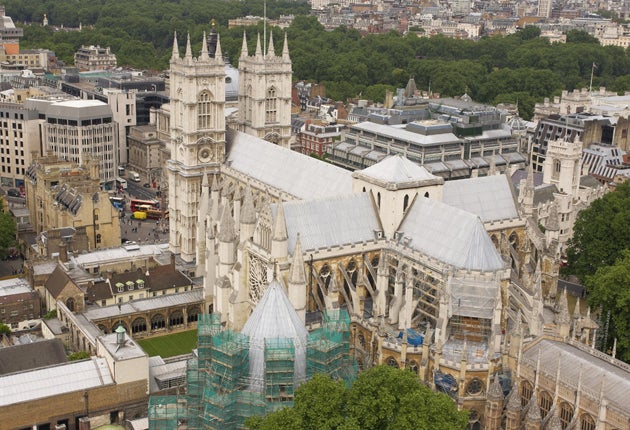
More than a 1,000 years on, the Abbey authorities are to launch a public consultation on plans to change the the building once again – with the addition of a 21st century "corona", or crown, to sit on top of the roof at an estimated cost of £10m.
Wren and Hawksmoor are among those who have argued that the building needed a corona (featured atop some cathedrals) to mark its significance on the London skyline. Both sketched designs for this feature, which were later discarded.
Now the Dean of Westminister, the Very Reverend Dr John Hall, has resurrected the idea. The Queen has been briefed on the plan and if the concept proves popular, the Abbey will hold an architectural competition, and invite the Royal Institute of British Architects (RIBA) to oversee entries.
It is hoped the work will be ready in time to mark the 60th anniversary of the Queen's Coronation at the Abbey in 2013 with the large crown a symbol of the royal milestone.
The Abbey was founded after King Edgar granted the Benedictine monks permission to stay there. A stone Abbey was built around 1045 by King Edward the Confessor as part of his palace there and it was consecrated in 1065. It was rebuilt after 1245 by Henry III, who had selected the site for his burial. Since the coronations in 1066 of King Harold and William the Conqueror, all English and British monarchs (except Edward V and Edward VIII, who did not have coronations) have been crowned in the Abbey. Seventeen monarchs lie buried there.
Wren, who worked for the Abbey, made a wooden model of a smaller tower bearing a 12-sided spire on top, constructed as a corona, but the idea was rejected because it would have been too heavy for the pillars below to support.
Hawksmoor, who designed the top sections of the Abbey's two west towers in 1745, and Scott, who remodelled the north side, also had plans for the roof that never came to fruition. Scott similarly submitted plans for a corona in the 19th century.
Rev Hall said the mix of architectural styles was part of the Abbey's appeal. Just as Wren's Gothic west towers had not been in keeping with the Romanesque architecture of the rest of the Abbey, the design of the corona could be "21st century" although it would have to be in keeping with the rest of its surroundings too.
"It is an odd accident of history that, where so many great churches have a magnificent tower or spire or dome, the Abbey remains unfinished over the site of every coronation since that of William the Conqueror on Christmas Day 1066. Now is the time to consider afresh what should be built there.
"The idea, in broad terms, for a corona, is to imagine a lifting of the eye. It could be made of wood, lead, stained glass with a cross the top, something which says this is where coronations have happened," he said. "It needs to be 21st century but also in keeping with the surrounding."
Rev Hall cited the crown on St Giles' Cathedral in Edinburgh as a fine example of a corona, but said there was no specific design in mind yet for the Abbey's crown.
An exhibition setting out the Abbey's development plans and inviting public comment launches today. The Abbey also plans to open its upper gallery, known as the Triforium, to the public for the first time to house an exhibition which will show its historic treasures and artefacts.
Subscribe to Independent Premium to bookmark this article
Want to bookmark your favourite articles and stories to read or reference later? Start your Independent Premium subscription today.
Join our commenting forum
Join thought-provoking conversations, follow other Independent readers and see their replies