Where do you teach the Liberian police to keep the peace? In Exeter
Officers from former war-torn African state have come to Devon to find out how law and order works there. Mark Hughes joins them

Get the free Morning Headlines email for news from our reporters across the world
Sign up to our free Morning Headlines email
Most weekdays, Assistant Commissioner Clement Wisseh investigates rapes or hunts the gangs of armed robbers that plague his home country.
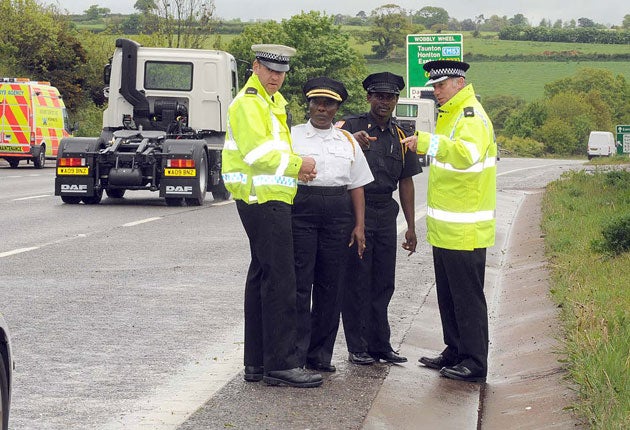
Yesterday the 32-year-old officer from the Liberia National Police was dealing with a minor road traffic accident involving a Rover 45 and a caravan on the A380 just outside Exeter.
"It is very different," he said. "I am used to dealing with much more serious crimes much more often in Liberia."
Mr Wisseh is one of six senior Liberian officers spending a week shadowing sergeants and constables from Devon and Cornwall Constabulary.
They have also spent a fortnight at the national police training college in Bramshill, Hampshire.
While Devon and Cornwall has 3,500 policemen and women, more than 1,000 unwarranted officers and 1,800 staff members to serve its population of 1.6 million people, the Liberia National Police has 3,996 officers and 190 staff to police a country of 3.3 million.
The British force has a fleet of 1,232 vehicles, including motorcycles, riot vans and a helicopter. Their Liberian counterparts have just 35 cars – one vehicle for every 114 officers.
Despite working in a country where tensions simmer from two civil wars, the Liberian police do not have riot gear, tear gas or guns. There are no CCTV cameras to help them investigate crime. And only senior officers have access to email, but even then, their addresses are web-based Yahoo accounts.
Deputy Commissioner Robert Saah, the most senior Liberian officer to have made the trip to Britain, said: "The technology here is very different. In Liberia we cannot use CCTV. If someone is attacked in the street the only technology we have to rely on is mobile phones – someone phoning us to report the attack. But even then, the person phoning us is usually the victim so by the time we get there the criminal has gone.
"Here policing is so much more advanced. You have officers on patrol, but we do not have enough cars to do that. If there is a homicide in Liberia we cannot perform the autopsy. We have to send the body to Ghana and wait a long time for the results.
"Also, I visited the CCTV room in Exeter and I was amazed – so many cameras. It was a joyous sight, but I thought 'How much would this cost?' Too much for Liberia. But we can learn from the UK police, they are our role models."
A lack of technology and resources is not their only obstacle. The force was established in 1962 but, after the start of the first civil war in 1989, the police lost the public's confidence. Crime remains high, mainly due to an unemployment rate of 85 per cent.
Assistant Commissioner Micckee Gray said: "There was a breakdown around 1990. People were not comfortable with the way the police handled the issues. They thought the police was not fair and they shied away from us.
"Now we are trying to gain their respect back. I would say that we have the respect of 80 per cent of the population but we do not have the support of the community that the British police has.
"This week I went to a primary school with neighbourhood officers and it was interesting to see that the children will interact with police; they respect the officers and give them information.
"The thing I have learnt most from my visit is the importance of neighbourhood policing: To police proactively – getting to know the community – and not just reactively when a crime occurs.
"I think the Police Community Support Officers are a great idea. They plug a very important gap. If we could do that in Liberia it would be fantastic."
Superintendent Nick Jarrold has been responsible for looking after the Liberian officers in Britain. "They have learnt a lot, but we have learnt too. Before they arrived, I did not realise just how massive a challenge they faced," he said. "Certainly if we were suddenly faced with a situation where we had only 30 vehicles and no technology, policing would be virtually impossible."
When asked if he had any criticisms of Devon and Cornwall, Deputy Commissioner Saah replied: "Yes. The weather is too cool."
How they compare
*Liberia
Population: 3.3 million
Size of police force: 4,186; 35 vehicles
Most common crime: armed robbery
Life expectancy: 49
Largest city: Monrovia pop. 1 million
Unemployment rate: 85 per cent
*Devon and Cornwall
Population: 1.6 million
Size of police: 6,360; 1,232 vehicles
Most common crime: criminal damage
Life expectancy: 80
Largest city: Plymouth, pop. 250,000
Unemployment rate: 4 per cent
Subscribe to Independent Premium to bookmark this article
Want to bookmark your favourite articles and stories to read or reference later? Start your Independent Premium subscription today.
Join our commenting forum
Join thought-provoking conversations, follow other Independent readers and see their replies