Wikileaks to 'disclose tax dodge files'
On Wednesday morning former banker Rudolf Elmer will appear before a court in Zurich for the start of a criminal trial that could see him bankrupted and imprisoned.
His alleged crime is to have broken Switzerland’s notorious secrecy laws by daring to blow the whistle on some of the shady practices used by the country’s lucrative banking industry to hide client’s wealth in off-shore tax havens in the Caribbean.
The trial is the culmination of a vicious eight year battle that has pitched one man against Switzerland’s economic mainstay – the country’s massively lucrative international financial industry.
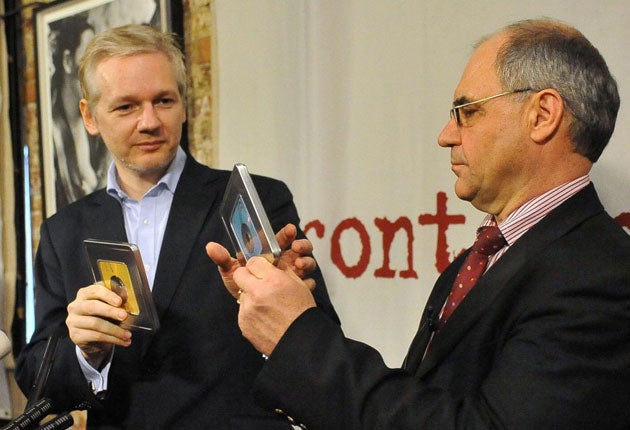
But even before proceedings begin, Mr Elmer had one final card to play. Today the 55-year-old former employee of Julius Baer bank travelled to London to hand WikiLeaks what he claimed were further documents detailing attempts by wealthy elites – including politicians, celebrities and major corporations – to avoid paying tax.
Although he refused to give any details about who or which companies are contained in the two DVDs, he claimed to be in possession of more than 2,000 account holders who had used off-shore tax havens to keep money out of reach of the tax-man.
"I do think as a banker I have the right to stand up if something is wrong," he said in a press conference alongside Julian Assange, the first time the WikiLeaks founder has publicly put his seal of approval on a new publishing project since releasing thousands of secret American embassy cables. "I am against the system. I know how the system works and I know the day-to-day business. From that point of view, I wanted to let society know what I know. It is damaging our society.”
For Mr Assange, who clearly has no intention of lowering his public profile as he fights his own legal battles, the handover was a moment of delicious schadenfreude. Key banking organisations have refused to process donations to WikiLeaks since the US diplomatic cables were released and the 39-year-old transparency fundamentalist lost little time in pointing out how pleased he was to be receiving documents that could severely embarrass the same system.
"In our case we have been economically censored by Visa, including Visa Europe, MasterCard, Moneybookers, Bank of America, PayPal, Amazon, Western Union, and so on,” he said. “We will treat [Mr Elmer’s] information like all other information we get. There will be a full revelation."
Today’s meeting was a partnership come full circle. In many ways it was Mr Elmer who first put WikiLeaks on the international map. Until he was fired in 2002, Mr Elmer had worked as chief operating and compliance officer for Julius Baer in the Cayman Islands.
He had become increasingly convinced that Swiss banks and Swiss secrecy laws are specifically designed to ensure that Swiss bankers continue to reap massive profits by helping major corporations, drugs traffickers, and corrupt politicians hide away thousands of billions of untaxed dollars.
In 2008, after years failing to get journalists and judicial authorities in his home country to follow up on his information, he used WikiLeaks to make publicly available a mass of incriminating Julius Baer documents, internal memos and communications with its clients.
Julius Baer sued Wikileaks in California and, in a foretaste of recent attacks on the site, obtained an injunction ordering its shutdown.
But the genie was out of the bottle as defenders of Wikileaks established mirror sites to ensure Elmer’s information remained publicly available. After a huge campaign by American civil liberties and newspaper groups, the California judge reversed his own injunction. Far from reinforcing secrecy, Julius Baer had shot itself in the foot and quietly withdrew the US lawsuit.
The win brought WikiLeaks international attention and powerful allies in North America, leading to the slew of US-orientated leaks that have since made it public enemy number one in Washington. For Mr Elmer, a whistleblower willing to put his name to the information he was his leaking, it was a brief victory in an ongoing fight to open up Switzerland’s banking industry.
That fight has frequently turned nasty. In an interview with The Independent he says over the past eight years his family has been stalked and received threatening emails. One read: “We will send the guys again to give you a hard time if you ever talk about the bank bussiness[sic]”. Another, apparently from a public internet terminal nearby his home read: “We are here. Your daughter will be killed if you do not stop....” Police and public prosecutor said they would only act if they could trace the sender, but closed the case after four months.
Late at night, tyres screeching, cars would drive at high speed into the quiet close where the Elmers lived, terrifying his family and neighbours. At one point, private detectives approached work colleagues with photographs of Mr Elmer saying they were looking for a man on the run.
The Bank denies ordering any stalking or intimidation, but has acknowledged to Mr Elmer and his lawyer that it spent more than one million Swiss Francs keeping a watch on his movements and activities. The Bank – as one of the plaintiffs along with the Zurich prosecutor – could reclaim these surveillance costs if Mr Elmer is convicted next week.
Responding to yesterday’s press conference with WikiLeaks, Julius Baer spokesperson Jan Vonder Muehll said: “"He didn't attack us at this press conference, he explicitly targeted not us but 'the system".
Even so, Elmer says he is looking forward to his trial which he hopes will shed an uncomfortable spotlight on Article 47 of the Swiss banking law – the catch all confidentiality clause that is so broad even public officials fear prosecution if they act on a whistleblower’s information.
When he complained to the police about the campaign of harassment and sought protection for his family, he says officials refused to act.
“They asked what motives anyone could have for such a campaign,” he said. “When I told them it concerned bank secrets, which I would have to disclose to pursue an action, they said they could not intervene.”
So instead he returned to WikiLeaks, giving the world’s most notorious whistle-blowing platform an opportunity to show it is still in business. Although it may be weeks or months before the information is made public, Switzerland’s banking elite will no doubt sleep less soundly until they discover what exactly is in those files.
Join our commenting forum
Join thought-provoking conversations, follow other Independent readers and see their replies
Comments