Worth the risk? UK goes for broke with supercasinos
A high-stakes expansion is set to sweep the nation. Jonathan Brown reports
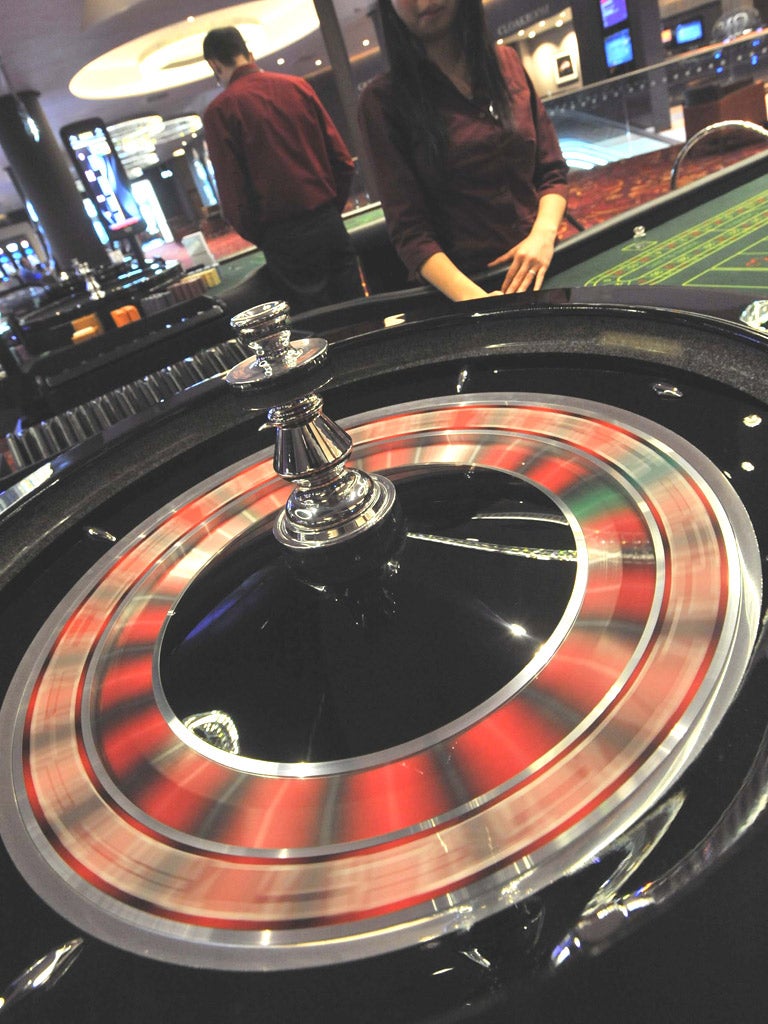
An unprecedented expansion in Britain's casino industry is under way, with plans to create a new generation of gambling venues larger than anything seen in this country before. It is estimated that casinos in a dozen towns and cities could generate up to £250m a year in winnings for operators and potentially pave the way for the return of controversial Las Vegas-style super casino complexes, an idea ditched by Gordon Brown in one of his first acts as Prime Minister.
Click here to see 'Place your bets: casinos coming your way' graphic
Church groups are urging caution over any further rapid growth in Britain's casino base, fearing it could swell the number of problem gamblers and hit poor families. The addiction charity GamCare said that the growing number of gambling outlets underlined the urgent need for education over the risks associated with gaming.
Leighton Vaughan Williams, the director of the Betting Research Unit at Nottingham Business School and an adviser to the government, said the new casinos were always intended as a testbed for future expansion. "We have waited a long time. It has been years since these were chosen and people were starting to forget they had ever been given the go-ahead," he said. "This could be the beginning of something very big. Without this the casino industry would be stuck where it is now."
The new venues are expected to swell the gross win estimate – the amount lost by punters to the house – by 30 per cent, pushing the figure above £1bn a year for the first time.
In December last year the first of eight so-called large casinos created under the 2005 Gambling Act opened its doors, close to the Olympic Park at Westfield shopping centre in Stratford, east London. Next month councillors in Solihul in the West Midlands are expected to give the green light to a £120m gambling complex at the National Exhibition Centre.
Similar schemes are also well under way in Hull, Middlesbrough, Great Yarmouth, Southampton and Milton Keynes, with decisions due in the coming months. Last week Leeds invited applications from operators seeking a licence there.
Large casinos will be able to offer 30 gaming tables for punters to play blackjack and poker as well as 150 fruit machines paying out a maximum jackpot of £4,000.
Another five authorities – Bath and North East Somerset, Luton, Swansea, Wolverhampton and Scarborough – are planning to exercise their right to host "small" casinos. Despite their name these will be bigger than any of the 145 casinos now operating, with the exception of Stratford. They will offer 40 gaming tables and 80 fruit machines paying out top prizes of £4,000.
Some local authorities such as Southampton and Hull see the casinos as central to ambitious regeneration plans. Others see them as a ready source of revenue to promote run-down areas.
Aspers, which runs the casino in Stratford, has agreed to pay Newham Council a minimum of £1m a year from its revenues as well as creating 440 jobs.
But the gaming industry ultimately wants to see restrictions relaxed to allow the market to dictate the number of fruit machines and tables at each venue.
A spokesman for GamCare said there was little evidence to suggest the expansion would lead to more problem gamblers – currently estimated at 0.9 per cent of the population. He said: "Casinos in Britain are well regulated and we will be encouraging and helping any new casino to ensure all staff are expertly trained to spot someone who is potentially in trouble and quickly signpost them to our national helpline and counselling services."
The former Labour government carried out a dramatic about-face over casino expansion. At the height of his ambitions for the industry Tony Blair was said to support the creation of 30 super casinos, each with 1,250 slot machines and unlimited jackpots linked to huge hotel complexes, as well as 100 large and 50 small venues.
But Labour bowed to pressure from backbenchers and church groups and scaled back the plan to just one regional casino which was unexpectedly awarded to Manchester over Blackpool and the Millennium Dome.
Church groups including the Salvation Army and the Quakers have recently stepped up their campaign urging the Government to introduce a compulsory levy on the betting industry to fund research, education and treatment for problem gambling.
Daniel Webster from the Evangelical Alliance said it was important there should be no further liberalisation of the gambling laws until the full impact of the 2005 Act was understood. "We are really concerned that a culture is being created where gambling and losing money is seen as normal," he said.
James North, public issues policy adviser for the Methodist Church in Britain, said: "The figures speak for themselves: problem gambling is on the rise. But the government seems determined to liberalise gambling laws. It is vital that the government understands the challenge posed by this worrying increase in harmful gambling and takes action to reverse it."
VIEW FROM THE SLOTS 'BETTER TO HAVE LARGER CASINOS, FURTHER APART'
It takes a few moments for the eyes and brain to adjust from the light of a late-January afternoon to the flashing lights of 150 slot machines in Aspers casino in the Westfield Stratford City shopping centre, east London. Once they have, the most striking thing about the UK's largest gambling house is that it really isn't that big. Moreover, it doesn't appear to be inhabited by desperate-looking people, pouring the remainder of their souls into a flashing machine which will only ever let them win enough to keep them coming back. Perhaps mercifully for the early afternoon, it doesn't seem to be inhabited by that many people at all.
Syed Naeem Kazmiu, 18, said he had been told by staff that he is one of the youngest they see at the casino. "I have probably dropped around £2,500 in the last two weeks," he said. But, he added, "I play for the fun. I put down money when I can afford it and, when I can't, I don't."
Poppy Smith, 35, from Los Angeles, said: "At home, large casinos bring the surrounding areas down but I don't know if it would be the same here. It is not just about the size of the room, though." Another customer said: "It is probably better to have larger casinos, further apart, than lots in small towns. That way, fewer people have them on their doorsteps and will just fall into them."
KEVIN RAWLINSON
Join our commenting forum
Join thought-provoking conversations, follow other Independent readers and see their replies
Comments