Zuma visit: 'Thanks for the show, cultural imperialists!'
South African President accuses Britain of anti-Zulu 'snobbery'
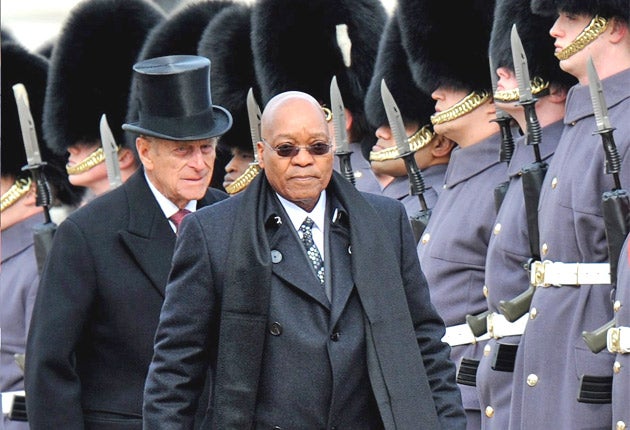
It was all polite smiles and meticulous protocol as Jacob Zuma met the Queen yesterday afternoon. But just hours before he left for his state visit to Britain, South Africa's flamboyant President revealed what he really thought of his hosts.
In an astonishing interview given shortly before he boarded his flight to London, Mr Zuma launched a scathing attack on the British, accusing them of being cultural imperialists with colonial attitudes who still viewed Africans as "barbaric".
"When the British came to our country they said everything we did was barbaric, was wrong, inferior in whatever way," he told The Independent's sister group of newspapers in South Africa. "Bear in mind that I'm a freedom fighter and I fought to free myself, and also for my culture to be respected. And I don't know why they are continuing thinking that their culture is more superior than others, those who might have said so."
The catalyst for Mr Zuma's remarkable outburst was criticism from a number of British columnists who questioned the President's polygamy, a common and accepted practice among South Africa's Zulus.
Many visiting heads of state might have chosen to ignore the stinging barbs of tabloid journalism, but Mr Zuma – who has married five times and currently has three wives – is a political bruiser who enjoys taking on his detractors in public.
Rather than stick to the protocols of a state visit (pomp, splendour and no criticism of either the host or visiting nation) the South African President clearly felt compelled to speak out against what he perceived to be British cultural snobbery.
"I am very clear on these issues," he said. "I've not looked down upon any culture of anyone, and no one has been given an authority to judge others. The British have done that before, as they colonised us, and they continue to do this, and it's an unfortunate thing."
However, at a state banquet last night, Mr Zuma praised the help Britain had given South Africa in its transition to a new democratic government. "We cannot forget the extraordinary role they [the British people] played at the forefront of a global movement for a free South Africa, as the global anti-apartheid movement has its roots in this country."
His comments in the interview threatened to overshadow what was supposed to be a three-day visit to strengthen ties between Britain and South Africa. Gordon Brown stood alongside the Queen to greet Mr Zuma and the two leaders will hold talks today.
Downing Street was at pains yesterday to avoid being drawn into a diplomatic clash with South Africa following the President's comments. It made clear that the visit could hold lucrative financial rewards for Britain, as well as cementing cultural ties between the two countries.
Mr Brown's spokesman described his stay as a "very welcome visit by a very important member of the international community". Whitehall sources also stressed that Mr Zuma's comments were aimed at the British press rather than the Government.
Mr Brown missed Prime Minister's Questions, which took place as he greeted dignitaries at the welcoming ceremony half a mile away. Tory sources accused Mr Brown, for whom Harriet Harman deputised, of "ducking out" of his weekly Commons appearance.
Mr Brown's spokesman refused to be drawn on suggestions that the Prime Minister had used the time he would usually have spent preparing for PMQs to ready himself for his appearance at the Iraq Inquiry tomorrow.
For his opening meeting with the Queen and Prince Philip on Horse Guards Parade, Mr Zuma wore a long coat and black suit to protect him from the March chill. In South Africa, the 67-year-old often greets dignitaries wearing the traditional Zulu dress of leopard skin loincloth and shield. Mr Zuma's Zulu heritage may also have provided the impetus behind the Queen's gift to him of a mounted bronze stag and a book entitled Hunting And Stalking Deer. A representative from Mr Zuma's office, however, admitted he had no knowledge of the President being interested in hunting.
Mr Zuma's gift to the Queen was a sculpted chess set depicting traditional Zulu warriors – although he soon discovered that a similar present had been given to the Duke of Edinburgh by his predecessor Nelson Mandela years earlier. Noticing the hand-painted ceramic set on display in the Palace Picture Gallery, a slightly crestfallen Mr Zuma remarked: "Oh, that's another set."
Fit for a President: The state banquet
* Pavé de Saumon Glamis
* Noisettes d'Agneau Narbonnaise; Courgettes Jaunes et Vertes Sautées; Pommes Forestière; Salade
* Sablé aux Pommes de Sandringham
* Fruits de Dessert
* Les Vins: Pol Roger, White Label Brut Réserve NV; Puligny-Montrachet 1er Cru, les Referts, Louis Jadot 2002; Château Lynch-Bages, Pauillac 1986; Louis Roederer 'Carte Blanche' Demi-Sec NV; Royal Vintage Port 1963
Join our commenting forum
Join thought-provoking conversations, follow other Independent readers and see their replies
Comments