A casualty of free speech
"I pass protesters every day at Downing Street, and believe me, you name it, they protest against it. I may not like what they call me but I thank God they can. That's called freedom" - Tony Blair, April 2002<br/><br/>"Everyone has the right to freedom of opinion and expression; this includes freedom to hold opinions without interference and to seek, receive and impart information and ideas through any media and regardless of frontiers" - Universal Declaration of Human Rights, article 19
Sign up for the View from Westminster email for expert analysis straight to your inbox
Get our free View from Westminster email
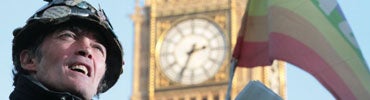
At first light yesterday, Brian Haw was dragged from his slumber by police officers and arrested. His crime was that his bed - or to be more precise his sleeping bag - is within shouting distance of the Prime Minister's bedroom.
Mr Haw may be a dedicated peace activist and human rights award nominee to some but to the two constables standing over him, he was a criminal. "I'm not breaching the peace. I'm fighting for it," he said indignantly.
So on the eve of International Human Rights Day, the 56-year-old - who has spent the past four-and-a-half years encamped outside Parliament to highlight the plight of Iraqi children - became the latest anti-war activist to be arrested.
Since the introduction this April of new draconian laws that forbid spontaneous free speech within a one-kilometre radius of the House of Commons, many demonstrators have fallen foul of the legislation. Only three days ago Maya Evans, 25, was convicted of breaching Section 132 of the Serious Organised Crime and Police Act 2005 after reading aloud the names of the 97 dead British soldiers next to the Cenotaph on Whitehall.
Voices from across the political spectrum have condemned the Government for trying to suppress free speech and deny protesters their right to demonstrate. In making the case for the war in Iraq, Mr Blair has often stated his ambition that Iraqis should be allowed the political freedoms enjoyed in Britain. But the evidence is that those freedoms are being steadily eroded in the United Kingdom. Speaking at the George Bush Snr presidential library three years ago, Mr Blair celebrated the right to protest, telling his audience: "I may not like what they call me, but I thank God they can." But in the bitter aftermath of the war in Iraq, the margins of domestic dissent are being squeezed.
Alex Salmond, the leader of the Scottish Nationalist Party, said yesterday: "All governments have been sensitive to criticism, but this Government has taken the suppression of dissent to a new level - it is nervous to the point of paranoia and frightened of being told the truth."
John McDonnell MP, chairman of the Campaign Group of Labour MPs, added there was an increasing build-up of anger in Parliament: "Freedom of speech has never been under such attack in the UK and it is shameful this is happening under a Labour government. We need a concerted campaign in Parliament and if necessary in the courts to counter this full-frontal attack on our centuries' old democratic rights."
Mr Haw was driven to Charing Cross police station to answer accusations that he had breached the peace. Ironically, while his vocal vigil outside the House of Commons inspired the new Socpa law, High Court judges in July ruled that he was exempt from the ruling as his protest began before it came into force. But, he insisted, he continues to be "harrassed" by the police.
"I wrote to Tony Blair and said dissent is the lifeblood of democracy. I am not a lone ranger. I am not the saviour of mankind. But I do know that I am responsible. We each have a responsibility."
He explained that he was asleep yesterday morning while a supporter - a freelance photographer, Maeve Tomlinson, 29 - kept a vigil by his side.
"I heard all these loud voices. I called out: 'Can you keep the noise down.' Finally, I stuck my head out and these two PCs - one man and one woman - were giving Maeve the tenth degree. She was just sitting in a chair minding her own business."
At the station, Mr Haw protested loudly on the phone to his solicitor and within the hour the desk sergeant released him to walk back to his permanent post on Parliament Square.
Having joined a protest against sanctions in Iraq in early 2001, the father-of-seven was so moved he came back in June that year with a plastic grey chair and a small sign proclaiming "Stop Killing Kids, Let Iraq's Infants Live". Bar three spells in hospital and many court cases, as defendant and witness, he has kept that vigil night and day ever since. His one sign has now been joined by hundreds of others.
Yesterday, one of his most devoted fans, Peggy Preston, 82, turned up and announced: "I went to Charing Cross and I told them off."
Once freed from police custody yesterday, Mr Haw solemnly read out the names of dead British soldiers as well as Iraqi victims of the conflict in the shadow of Big Ben, mimicking Maya Evans' "crime". But - unlike most people in this country - the law, or to be more precise the High Court judge who decreed he was exempt, was on his side.
Subscribe to Independent Premium to bookmark this article
Want to bookmark your favourite articles and stories to read or reference later? Start your Independent Premium subscription today.
Join our commenting forum
Join thought-provoking conversations, follow other Independent readers and see their replies