Anglo-French deal rewrites military history
Britain and France will today announce a landmark defence alliance ranging from military operations in land, sea and air to nuclear weapons.
David Cameron and Nicolas Sarkozy will sign two declarations during a summit in London paving the way for the sharing of an aircraft carrier, sending a joint military force into battle, working together on cyber warfare and developing warheads for nuclear missiles.
The British Prime Minister and the French President are said to have been personally involved in driving forward the agreement – to be ratified into a treaty after parliamentary approval – which, it is claimed, will lead to considerable savings in economically straitened times in a variety of fields, from the cost of research to maintenance of equipmentto wage bills for personnel.
The two countries account for almost half of defence spending and 70 per cent of the research and development by the European Union, as well as providing more than 55 per cent of operational armed forces. This has, however, led to a degree of duplication in procurement and manpower.
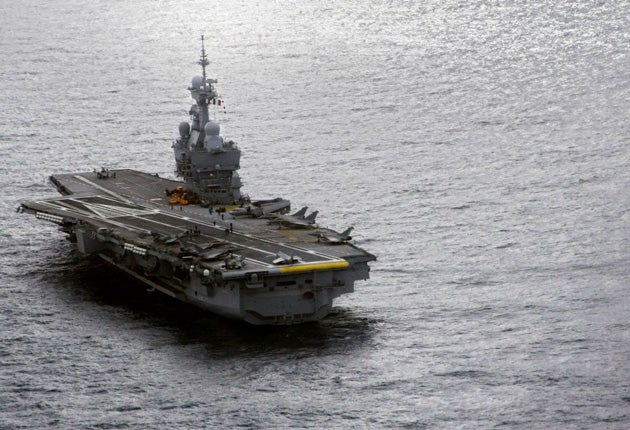
However, at the same time, the sharing of resources also potentially means that each country having to sacrifice some military and political options. This is highlighted in one of the main planks of the agreement, the use of aircraft carrier, under which the lone carrier of one navy will cover for the other during refit. However, the government owning the vessel would have the right of veto to a mission and thus the French, for instance, could refuse to send their current carrier, Charles De Gaulle, to the Falklands during a confrontation with Argentina.
Senior Whitehall sources insist, however, that in the overwhelming majority of potential crises the British and French will have a common stance. Thus one of the British carriers under construction, the HMS Prince of Wales, is now being fitted with catapult and landing equipment which can be used not only by Joint Strike Fighters being bought by the UK, but French Rafale jets as well. The other carrier, HMS Queen Elizabeth, will be mothballed soon after coming into service while attempts are made to sell it off. The French have not shown any inclination to buy the vessel as a replacement for the ageing Charles De Gaulle.
The planned rapid reaction force, of around 6,500, could be ready for deployment by next year. It will comprise of units from both countries, including special forces, under a commander who could be either British or French depending on the mission. The troops will train together and take part in joint exercises, but will be based in their respective countries. General Sir David Richards, the new head of Britain’s armed forces, said “We are going to fight in something called an expeditionary joint force, which sees us possibly working alongside them at brigade level, but not within the same brigade.”
The deployment of the force would take place only after agreement between the two governments and after rules of engagement have been agreed between the two forces. In Afghanistan, the rules used by the British differ from those of the French.
The nuclear co-operation will see British and French scientists using each others’ facilities to simulate explosions for the preparation of warheads and thus, say the Government, cut costs.
A US-UK treaty prevents Britain from sharing its nuclear secrets with a third country because this country’s deterrent, the Trident D5 missile, is based on American technology. British officials stated, however, that Washington has given its full approval to the work being done with the French.
David Cameron said yesterday on the eve of his meeting with President Sarkozy, “ We have similar-sized armed forces, similarly-structured armed forces, we both have a nuclear deterrent, we both want to enhance our sovereign capability while also being more efficient at the same time.”
How the plan will work
* The two countries will share one aircraft carrier, with the government owning the vessel having right of veto over deployment.
* The two countries will co-operate on developing nuclear warheads and use each others facilities.
* A joint rapid reaction force will draw troops from respective countries to be deployed at short notice.
Join our commenting forum
Join thought-provoking conversations, follow other Independent readers and see their replies
Comments