Blair attacks his critics' tendency to 'conspiracy theories'
Former Prime Minister takes swipe at Iraq Inquiry in TV interview with US Republican
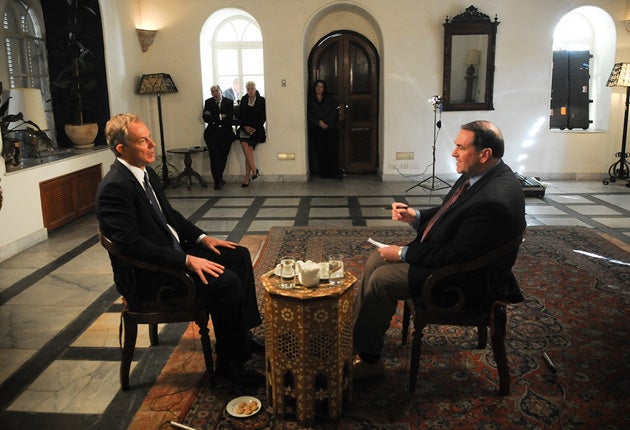
Tony Blair took a swipe at the Iraq Inquiry last night, claiming that it was part of a British obsession with conspiracy, deceit and scandal.
He called for an end to speculation over his motives for taking the country to war in his first interview since his appearance before the inquiry last month.
Yesterday Sir John Chilcot, the inquiry's chairman, ended the first phase of its investigation with a warning that some witnesses could be recalled where there were "gaps" in their evidence or official documents.
Mr Blair betrayed his frustration during a television interview in the United States. Mike Huckabee, a Republican who made a failed attempt to contest the presidency for his party in 2008, asked why there had been four "relentless" inquiries into the Iraq war.
The former Prime Minister smiled ruefully and replied: "I think it's partly because we have this curious habit – I don't think it's confined to Britain actually – where people find it hard to come to the point where they say: 'We disagree – you're a reasonable person, I'm a reasonable person – but we disagree.' There's always got to be a scandal as to why you hold your view. There's got to be some conspiracy behind it – some great deceit that's gone on, and people just find it hard to understand that it's possible for people to have different points of view and hold them reasonably for genuine reasons. So I think there's continual desire to sort of uncover some great conspiracy when actually there's a decision at the heart of it – but there it is."
During his cross-examination at the Chilcot inquiry, Mr Blair defended his decision to back the invasion and denied that the intelligence used to support the war was manipulated. He also faced tough criticism for refusing to express regret for the conflict, in which 179 British soldiers died.
It is widely expected that Mr Blair will be among the witnesses who are summoned back before the inquiry. Yesterday, Sir John said his team was receiving new paperwork relating to the war all the time. He said: "Over the next few months we shall examine all the evidence we have received, including those documents.
"That will enable us to see where the evidence joins together and where there are gaps. Only then can we decide the further evidence we need, the issues and points which need to be clarified and the identity of the witnesses we may wish to question in the next round of public hearings in the summer."
Making his second appearance before the inquiry, Jack Straw, who was Foreign Secretary, denied blocking detailed cabinet discussion on the Attorney General's advice on the legality of military action.
He said: "The Cabinet were fully aware that the arguments were evenly balanced. It was impossible to open a newspaper without being fully aware of the balance of the arguments."
He insisted he had no recollection of the claim by the then International Development Secretary, Clare Short, that she was "jeered" when she tried to question Lord Goldsmith's opinion.
Mr Straw, who is now the Justice Secretary, said it was "simply untrue" to claim that the system of cabinet government had broken down under Mr Blair. He also defended his decision to overrule the advice of the senior Foreign Office legal adviser, Sir Michael Wood, that the use of force would be illegal without a specific mandate from the United Nations.
Join our commenting forum
Join thought-provoking conversations, follow other Independent readers and see their replies
Comments