Blair 'was told Iraq had disarmed - but still went to war'
Sir John Scarlett tells inquiry of pre-war intelligence doubts
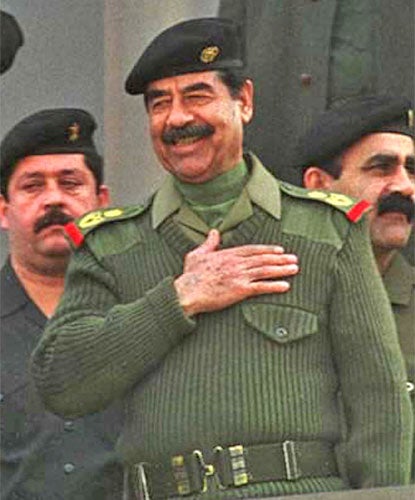
Tony Blair was aware of last-minute intelligence revealing that Saddam Hussein had probably dismantled his chemical and biological weaponry, a key adviser has said.
Sir John Scarlett, who was the head of the Joint Intelligence Committee in the run-up to the war, said that two reports received in March 2003, which suggested that Iraq's weaponry had been taken to pieces, were sent directly to the former prime minister. He also said that Mr Blair was made aware of doubts over Saddam's access to the warheads needed to deliver them.
Sir John, who was responsible for the Government's dossier that claimed Saddam had weapons that could be used within 45 minutes, denied that he had come under pressure to "sex up" the document. However, he admitted for the first time that a crucial part of the dossier was not clear about the threat posed by Saddam, meaning that the seriousness of the claim that the Iraqi leader could launch an attack was "lost in translation".
He told the Iraq inquiry that the document should have made clear |that the 45-minute claim was only meant to refer to battlefield weapons and not those that could be used to attack other countries. "The matter would not have been lost in translation, if it had been spelt out in the dossier that the word was ‘munitions' not ‘weapons'," Sir John said. "There was absolutely no conscious intention to manipulate the language or obfuscate or create a misunderstanding as to what they might refer to."
He said the dossier had been based on "reliable and authoritative" intelligence, received at the start of September, that was "sufficiently authoritative to firm up whether or not Iraq did currently possess chemical and biological agents".
However, he distanced himself from Mr Blair's foreword to the document, published in September 2002, which claimed that intelligence information meant that it was "beyond doubt" that Saddam had weapons of mass destruction. Though Sir John admitted he had seen the foreword, and even made several alterations to it, he concluded that it was "quite separate" from the contents of the dossier. "The foreword was an overtly political statement by the Prime Minister so it was his wording and his comments throughout," he said.
On 7 March, less than two weeks before the invasion, Sir John confirmed that new evidence suggested that "Iraq had no missiles that could reach Israel and none that could carry germ or biological weapons". A second piece of intelligence on 17 March, and discussed at a meeting on the day before the invasion, said "chemical weapons had been disassembled and dispersed and would be difficult to reassemble".
A report in December 2002 had already reported Iraq may not have warheads to deliver chemical and biological weapons. "That was the picture that was being presented both through the reporting and through the updates," he said. "Those reports, I understand, went directly to the Prime Minister's office. The updates were certainly available to him, too. This information was definitely known."
The new evidence was not acted upon because intelligence forces believed Saddam had dismantled his weapons as a ploy to avoid detection. Nevertheless, Sir John said it was made clear to ministers that the policy would "have consequences on [Iraq's] ability to deploy chemical and biological warheads".
Ed Davey, foreign affairs spokesman for the Liberal Democrats, attacked the inquiry team after it was revealed Sir John would be giving more evidence in private. He also said that the former MI6 chief's claim that there were no attempts to manipulate the September dossier "stretched credibility".
"John Scarlett was a central figure in the intelligence claims that were made to support the illegal invasion of Iraq," he said. "The cursory level of questioning undertaken in public – and the announcement that further appearances will be behind closed doors - is deeply disappointing. It looks like the Chilcot Inquiry may have failed its first test on transparency."
Campbell and Scarlett: Was there pressure to 'sex up' intelligence?
* Sir John Scarlett, who until recently was the head of MI6, was chairman of the Joint Intelligence Committee when it produced the now notorious dossier of September 2002 which spelled out the case for military action against Iraq. It contained the claim that Saddam Hussein's regime could launch weapons of mass destruction at British targets within 45 minutes - which would later lie at the heart of a row between the Government and the BBC and culminated in the death of weapons expert Dr David Kelly.
* While Sir John told the Iraq inquiry that he did not come under any pressure to "sex up" the dossier, a number of key figures within the Government at the time did have influence over the document.
* Although Alastair Campbell had no role in the claim that Mr Hussein could launch an attack within 45 minutes, he did suggest 11 changes to a draft copy, all of which were accepted. They included altering how biological weapons "could be used" to "are capable of being used", and changing "may have" to "have", in regard to the authority of Mr Hussein's sons to launch weapons.
Join our commenting forum
Join thought-provoking conversations, follow other Independent readers and see their replies
Comments