Brown on Iraq: I wasn’t at fault
Prime Minister at pains to distance himself from the errors and evasions of war
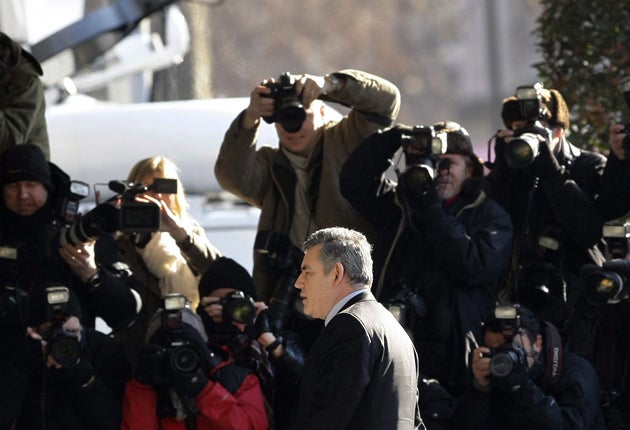
Gordon Brown attempted to distance himself from Tony Blair's divisive handling of the Iraq war yesterday as he refused to accept any blame for the series of catastrophic mistakes made during the campaign.
He insisted that he stood by the decision to topple Saddam Hussein, telling the Iraq inquiry: "It was the right decision made for the right reasons." But he revealed he knew nothing about crucial last-minute changes to advice over the invasion's legality or the private assurances given by Mr Blair to President George Bush about Britain's support for US-led military action.
Mr Brown, who was Chancellor at the time of the war, also defiantly dismissed accusations he had starved the armed forces of resources, denying he could be blamed for shortages of military equipment. He also blamed the failure to plan for the chaotic aftermath of the invasion on the US government, claiming he had pleaded with the White House to prepare more thoroughly for the power vacuum created by Saddam's removal.
A major security operation was mounted at the Queen Elizabeth Centre for Mr Brown's appearance, but fewer demonstrators turned up than when Mr Blair gave evidence in January. He also did not have to face the jeers directed at the former Prime Minister when he declared he had no regrets for ordering the war. The only interruption came as members of the audience laughed when Mr Brown repeatedly sidestepped a question.
Mr Brown, who has been identified by previous witnesses as a key adviser to Mr Blair over Iraq, said he had been "aware of what was happening" in the months leading up to the March 2003 invasion. However, it emerged during his four-and-a-half hours of evidence to Sir John Chilcot's inquiry that there were significant gaps in his knowledge of the plans made to tackle Saddam.
He said he had not seen confidential letters sent by Mr Blair to President Bush, stating that British troops would "be there" beside their US counterparts should military action become necessary. "I had regular conversations with Tony Blair and we talked about these issues," he said. "But I do not have copies of these letters, and I don't know the exact conversation, and he wouldn't expect me to." He also said he had not seen a detailed "options paper" on Iraq, drawn up in March 2002, and had been absent from some war Cabinet meetings.
Crucial changes to the advice handed to the Government over the invasion's legality were kept from him, he said. He had been informed that the then Attorney General, Lord Goldsmith, had concluded days before the war that military action was legal. However, Mr Brown had not been told that an earlier version of the peer's legal opinion had only concluded that a case "could be made" that the invasion was within the law. He added he had only learnt that there were doubts within the Foreign Office about the legality of the war from reports in the media.
He denied claims by Army chiefs and the relatives of soldiers killed in Iraq that Treasury cost-cutting had been to blame for the deaths of servicemen and women forced to travel in lightly-armoured Snatch Land Rovers. Mr Brown said he always accepted requests for more money for armoured cars and helicopters. But he added: "I have to stress it is not for me to make the military decisions on the ground about the use of particular vehicles."
He also hit back at a complaint by a former Ministry of Defence permanent secretary, Sir Kevin Tebbit, that he had been forced to run the department on a "crisis budget" before the war because of Mr Brown. The Prime Minister retorted that MoD plans to spend an extra £1.3bn on new equipment had been drawn up in 2002 after it claimed it was finding the money through efficiency savings. But he doubted whether the savings had been achieved – and said it would have cost the taxpayer £12bn a year if every Whitehall department was allowed to operate by the same rules.
Mr Brown opened his evidence by expressing regret for the death toll in Iraq. But, after watching his testimony, Susan Smith, whose son Philip was killed in a roadside blast in Iraq, accused the Prime Minister of passing the buck for his death. She said: "It's very low of him to blame commanders. Philip's commander died in the Snatch Land Rover alongside him."
In a swipe at the hawkish attitude of the Bush administration, Mr Brown said he had not been ideological about removing Saddam. "I never subscribed to what you might call the neo-con proposition that somehow at the barrel of a gun overnight liberty or democracy could be conjured up," he said.
He explained he was given detailed briefings by the intelligence services on five occasions during 2002 and 2003, during which he was assured that Saddam needed to be confronted. "I was given information by the intelligence services which led me to believe that Iraq was a threat and had to be dealt with by the actions of the international community," he said. It was only at the "last minute" before the invasion that he had accepted military action needed to be taken, he said. "We wanted a diplomatic route to succeed," he said. "Right up to the last minute, I think many of us were hopeful that the diplomatic route would succeed."
He also batted away claims that the Government had failed to plan adequately for the aftermath of the invasion, telling the inquiry that he had begun planning for the reconstruction effort within the Treasury from June 2002. One of his "regrets" was his failure to be "more successful" in convincing the Bush administration to devote more resources to post-war planning. "The planning for reconstruction was essential, just the same as planning for the war," he said. "I wish it had been possible to follow it through much more quickly in the aftermath."
Opposition parties seized on Mr Brown's performance as further evidence that he was incapable of taking responsibility for the failings over Iraq. "Gordon Brown was a member of the inner circle, but, true to form, he didn't want to take any responsibility for decisions which had negative consequences," said Liam Fox, shadow Defence Secretary. Nick Clegg, the leader of the Liberal Democrats, said that the British public had been "betrayed" by Mr Brown. "For years Gordon Brown has sought to make us believe that this war wasn't anything to do with him – it was Tony Blair's war," he said. "This was the day that he finally had to come clean. And he has said today, finally, that he believes that the Iraq war was right."
Brown at Chilcot: What he said and what he meant
*"Obviously the loss of life is something that makes us all sad. We have got to recognise that war may be necessary, but it is also tragic in the effect it has on people's lives."
I'm not going to make the same mistake as Blair and seem unfeeling about the deaths in Iraq. I don't want to be jeered as I give evidence.
*[On Tony Blair's private letters to George Bush]: "I had regular conversations with Tony Blair and we talked about those issues, but I do not have copies of those letters and I don't know the exact conversation — and he wouldn't expect me to."
If he secretly committed Britain to backing US military action, I knew nothing, and he'll have to answer for himself. You wouldn't catch me having secret contacts with Republicans.
*"I was given information by the intelligence services which led me to believe that Iraq was a threat and had to be dealt with by the actions of the international community."
The security services blundered badly over weapons of mass destruction. You can't blame me for believing them. After all everyone else in the Cabinet did (even Robin Cook was against the war for other reasons).
*[On lack of planning for the war's aftermath]: "It was one of my regrets that I wasn't able to be more successful in pushing the Americans on this issue."
It's not our fault that Iraq descended into bloodshed and chaos – things could have been so different if they had listened to me.
*"I have never subscribed to what I called the neo-conservative proposition that somehow, at the barrel of a gun, overnight liberty or democracy could be conjured up".
I might have supported the war, but I was never as gung-ho as George Bush and his Republican cronies. Thank heavens Barack Obama's in the White House now.
*"I have to stress it is not for me to make the military decisions on the ground about the use of particular vehicles."
Get real – I can hardly be held responsible for the details of all operations. I gave the army top brass all the cash they asked for.
Nigel Morris
Join our commenting forum
Join thought-provoking conversations, follow other Independent readers and see their replies
Comments