Cameron's first 100 days
Preparing for Power - Starting Out & Europe: In the last of our series, Andrew Grice, Political Editor, examines how the Tories plan to hit the ground running after winning an election and whether divisions over Europe will return to haunt the party
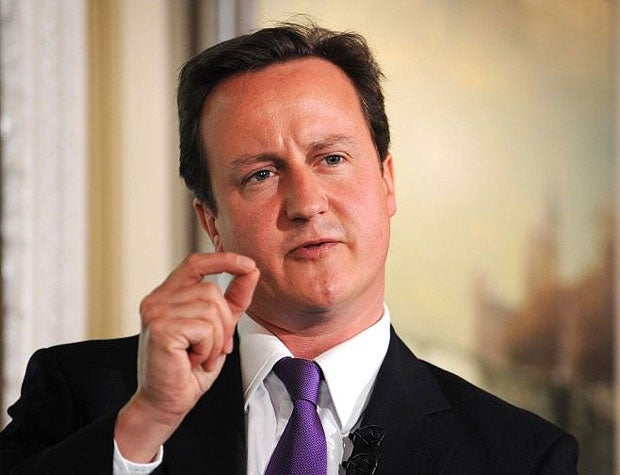
Tony Blair has become an unwitting model for a Tory government – but only in how NOT to act on coming to power. David Cameron admires the New Labour election machine, but is convinced that the party did not prepare enough for what it would actually do when elected in 1997. He is determined not to make the same mistake, and has set up an implementation unit headed by Francis Maude, a Shadow Cabinet member and former party chairman, and Nicholas Boles, the former director of the Policy Exchange think-tank.
"Blair's biggest failure was his first term," Mr Maude told The Independent yesterday. "By the middle of the second term, he knew what he wanted to achieve and had a pretty good idea how to achieve it. But his authority was diminished, there was Iraq, and Gordon Brown was obstructing his public service reforms. We are not interested in winning for the sake of it. We have a vision of how Britain can be. It will take a ling time to deliver it, so we had better start from day one."
So what would Mr Cameron's first 100 days be like? One close ally gave a candid answer: "The scope to be hugely different on the economy will be limited, so the fireworks will be on the social agenda."
The two centrepieces of the first Queen's Speech are likely to be education and welfare. The first may be easier to achieve than the second. An Education Bill would allow parents, philanthropists, charities and other groups to set up new state schools.
A Welfare Reform Bill would use private firms to get the unemployed, sick and disabled into work on a payment-by-results basis. But its scope may be more limited than the Conservatives originally planned, since James Purnell, the Work and Pensions Secretary, will bring in a Bill containing similar ideas in the parliamentary session starting in December.
The first 100 days would see George Osborne's first Budget. The Queen's Speech could also include an NHS Bill to set up an independent board to reduce ministers' day-to-day control; an Immigration Bill to set a limit on the number of migrants from outside the EU; and a Prisons and Rehabilitation Bill under which state-run prisons would also be responsible for inmates after their release.
How would Mr Cameron run his government? "The Blair-Brown style is all about central control," said Mr Maude. "There would be a return to something much more like more conventional cabinet government, with a strong prime minister showing leadership and direction at the top." He added: "To have a strong centre, you don't need a prime minister's department. What you need is a strong prime minister who sets direction clearly. David Cameron will be more trusting of his colleagues, with their departments being held accountable but not constantly being second-guessed and interfered with."
Formal contacts between the Opposition and the Civil Service will begin next January. Whitehall is studying the speeches and statements of Conservative frontbenchers more closely as the prospect of a Cameron government grows. Some officials may welcome a change.
"The Civil Service is extremely demoralised and fed up. It is not being treated with respect," said Mr Maude. "Civil servants don't mind if their advice is not taken – decisions are up to ministers. But there is real resentment that advice is not being sought."
But preparations, however extensive, only get you so far. Mr Maude, a former minister, said: "In my experience, 75 per cent of what you do in government is not implementing your programme but dealing with events."
Europe – the issue that won't disappear
While David Cameron has talked up the environment, poverty and health as part of his rebranding of the Conservatives, more traditional Tory issues have been relegated further down the agenda – notably Europe.
Its ability to split the Tories was painfully illustrated during the Thatcher and Major governments. Today the party's centre of gravity is Eurosceptic, with Europhiles such as Kenneth Clarke reduced to a rump. That has made Europe less of a headache in opposition; but senior party figures admit it could become one in government, when tricky decisions could no longer be fudged.
Mr Cameron has tossed a few bones to his Eurosceptic MPs, who think he is "one of us". It is no coincidence that the two most Eurosceptic members of the Shadow Cabinet, William Hague and Liam Fox, hold the jobs – on foreign affairs and defence respectively – that place them on the front line of relations with the rest of Europe.
Yet the Europhobes might be disappointed if Mr Cameron becomes Prime Minister. He could have an early decision to make on the Treaty of Lisbon, designed to streamline EU decision-making, which the Tories oppose because it would increase majority voting. The party has promised to call a referendum if the treaty has not been ratified by all the other 26 EU states when it takes office. The process has been delayed by Ireland's "no" vote in a referendum. A similar rejection by Britain could plunge our relations with the EU into chaos.
If the treaty has been approved, the Tories have said they would not "let the matter rest", but refuse to spell out precisely what they would do. They might try to win back control of some powers handed to the EU under Lisbon, but would almost certainly be given short shrift by other EU members.
Similarly, the Tories would find it very difficult – if not impossible – to implement their pledge to withdraw from the EU's social chapter of workers' rights. Eurosceptics would then demand a renegotiation of Britain's membership, but Mr Cameron is unlikely to want the early years of his government overshadowed by trench warfare with the EU. On relations with the US, meanwhile, Mr Cameron has had a pop at the unilateralism of the current White House, but his approach would essentially be the same as Gordon Brown's.
Unanswered questions
* Could the Tories' blueprint for government be blown off course by the state of the economy they inherit from Gordon Brown?
* Has the Tory plan to put welfare at the heart of their first Queen's Speech been wrecked by Labour's decision to bring in very similar proposals?
* How would a Tory government try to change Britain's commitments under the Treaty of Lisbon if the treaty has already been approved by all 27 EU member states?
* Would the Tories try to renegotiate EU membership if the other nations refuse to let it withdraw from the social chapter?
Face to watch: Nicholas Boles
A key moderniser who heads the implementation unit drawing up the blueprint for the early months of a Cameron government. Set up by the Policy Exchange think-tank in 2002, road-testing some of the ideas taken up by David Cameron. Selected to fight Grantham, Margaret Thatcher's home town, at next election. Could rise swiftly up the ministerial ladder.
Join our commenting forum
Join thought-provoking conversations, follow other Independent readers and see their replies
Comments