UK

Mostly Cloudy with Showers 6° London Hi 9°C / Lo 6°C

Budget speech

Darling reveals 50% tax rate for high earners
By Gavin Cordon, Press Association

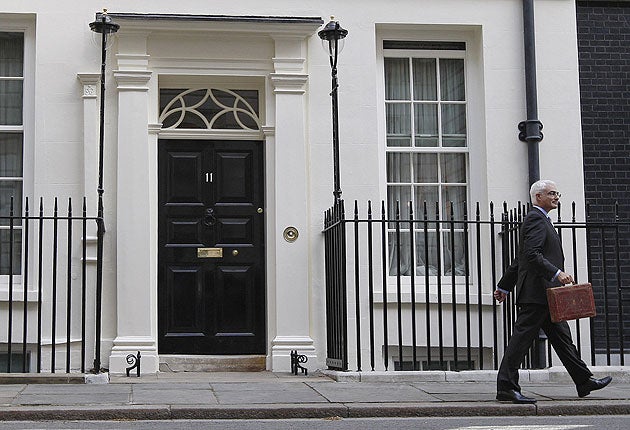
Alistair Darling with Gladstone's old Budget box  outside 11 Downing Street in London today

REUTERS/Stephen Hird

Alistair Darling with Gladstone's old Budget box outside 11 Downing Street in London today

Chancellor Alistair Darling today gambled on a rapid economic recovery to rebuild Britain's battered finances as he revealed that borrowing this year would hit a record £175 billion.

In a grim Budget statement he outlined the full depth of the economic crisis.

Mr Darling warned that output would shrink by 3.5 per cent this year - more than doubling his previous forecast.

And he revealed that borrowing this year would soar to £175 billion - with another £173 billion in 2010 - as the country battled with the worst global downturn in 60 years.

He also said deflation would plunge to minus three per cent by September.

Despite the bleak figures, Mr Darling insisted public finances would get back on track with a halving of borrowing within four years as the economy began to recover from the end of the year.

But Tory leader David Cameron launched a scathing attack on the Government's handling of the economy.

He said: "As of today any claim they have ever made to economic competence is dead, over, finished."

The Chancellor made clear that his plans depended on a rapid economic bounce-back - with a forecast of 1.25 per cent growth next year rising to 3.5 per cent in 2011.

Nevertheless, he admitted that the economy would first face of period of deepening deflation with the Retail Price Index falling to a low of minus three per cent by September.

The Chancellor warned that rebuilding the public finances would take "tough decisions"

He said the planned new top income tax rate of 45 per cent on incomes above £150,000 will be increased to 50 per cent and take effect from next April - a year earlier than planned.

And from April 2011, pension tax relief would be restricted for those with incomes over £150,000.

Mr Darling defied calls from transport and motoring groups for another freeze on fuel duty which will rise by 2p a litre in September and then by 1p a litre above inflation each April for the next four years.

But he confirmed the Government would attempt to kick-start the ailing motor industry by introducing a car-scrappage scheme.

Anyone with a car registered before 31 July 1999 will get a cash incentive of £2,000 to trade in their old vehicle for a brand new one.

A total of £1,000 will come from the Government and the remaining £1,000 from car companies, with participants being able to buy any new vehicle, including small vans, rather than just low-pollution models.

Around £300 million has been put aside by the Government to fund the scheme which is expected to come into effect as early as mid-May and will last until the grant runs out, thus enabling 300,000 consumers to benefit.

Drinkers and smokers will be hit with alcohol duties to go up by 2 per cent from midnight tonight, while there will be an increase in tobacco duty of 2 per cent from 6pm tonight.

Post a Comment

View all comments that have been posted about this article.

Offensive or abusive comments will be removed and your IP logged and may be used to prevent further submission. In submitting a comment to the site, you agree to be bound by the Independent Minds Terms of Service.

Comments

Budget
[info]sjkillman wrote:
Wednesday, 22 April 2009 at 07:17 pm (UTC)
Does anyone know whether the 175 billion borrowing requirement includes the money spent on part nationalising the banks? If so, surely much of this could be recouped when the economy gets back on track, by selling them off again.
Re: Budget
[info]kodak321 wrote:
Wednesday, 22 April 2009 at 09:32 pm (UTC)
Look in the Business Section. Assuming they use the financial year as a basis of calculation, then the Bank bailouts would not be included in this years calculations...ie April of this year (175 billion) onwards. Borrowing was significantly lower in the last financial year. I believe the bailouts are included in the debt. Still, like you I'd like an expert to comment.
Re : buget
[info]kodak321 wrote:
Wednesday, 22 April 2009 at 10:39 pm (UTC)
Regarding bank sales, the Government is taking on Institutions with highly problematic balance sheets, most likely they will deteriorate, and this deficit relies on Government borrowing. This attracts an additional cost (interest payments), on the World markets. It's most likely this will be a costly (estimates 60-200billion), real cost (or loss,as it should be classified), to the UK balance sheet.
Little Darlings Budget
[info]grumpyashell wrote:
Wednesday, 22 April 2009 at 10:47 pm (UTC)
All I can say is that Nero Darling is just fiddling the figures whill Britian goes down the tubes.

Typical Labour.....Party before Country.

Empty minds vote Labour in,Empty wallets vote Labour out........its happened before.
Great Depression all over again, but worse this time
[info]someofusknow wrote:
Wednesday, 22 April 2009 at 11:00 pm (UTC)
'"as the economy began to recover from the end of the year."

Exactly what happened in 1930 and 1931. Wall Street Crashed, speculative bubbles bust and politicians pretended it was just a very temporary blip in the scheme of things, and that everything would quickly return to normal.

Of course, this time round most of the oil and coal are gone. largely up in smoke, and there are three times as many mouths on the planet to feed. But we won't talk about anything in the real world.

Isn't it all so surreal? -like Chamberlain telling everyone: "Peace in our time"; 18 months later bombs were falling on London.

And as for this: 'participants being able to buy any new vehicle, including small vans, rather than just low-pollution models'. Now we know for certain the government is sabotaging the next generation's future in desperate attempts to maintian business-as-usual at a time when busienss-as-usual is no longer possible.


Guillotine the 0.3 percent who own two thirds of Britain
[info]victoremmanuel3 wrote:
Wednesday, 22 April 2009 at 11:08 pm (UTC)
The financial bubble, which began in the mid 1990s, has finally burst. However, the roots of that unsustainable boom go back much further, to the late 1980's.

It was after nearly ten years of Thatcherism when in around 1988 Britain's economy slipped behind France's and Italy's. The writing seemed to be on the wall for both Thatcherism and British style capitalism but then the Berlin wall fell. German unification put a massive strain on the West German economy, which affected France and Italy, its biggest trading partners, very badly.

By the mid 1990s, the European economy was recovering and had started to close the gap with Britain, again. In desperation, British Governments from John Major's onwards encouraged consumers to borrow recklessly for the benefit of the economy. They closed their eyes to suspect financial reporting of company accounts that inflated profits and underreported balance sheet debts. Since 1995, our economy has been living on borrowed time but the day of reckoning has finally come.

I think only revolution can save Britain. We need to democratise our government, abolish both the House of Lords and the Monarchy and finally make our politicians accountable to the common people, for the good of the commonwealth. Our politicians need to turn their backs on the land owning elite, who only care about preserving the inflated values of their properties and living off investments in the city, like parasites.

We must reform land ownership now, kick out the aristocrats, many of whom are refugees from previous revolutions in Europe and start investing the real people of Britain. We must join the Euro and see Britain is in Europe, realising our shared history and opening our eyes to the potential common ground that is out there for our taking.
Tragic!
[info]kodak321 wrote:
Wednesday, 22 April 2009 at 11:25 pm (UTC)
Agreed. I believe, we were over 600bn in debt, at the beginning of this crisis. Darling has admitted, the near future will add approximately 700bn, near 100% of our GDP. And personal debt is, circa 1.4trillion. Bloody awful deficit(s), and the IMF know it, as do our Political masters.

Most popular in UK News


Article Archive

Day In a Page

Sun | Mon | Tue | Wed | Thu | Fri | Sat

Select date