David Cameron: The five lessons I learned as father of disabled child – and intend to put into practice
The Conservative leader reveals how his experiences have helped to shape his party's welfare policy
ROGER TAYLOR
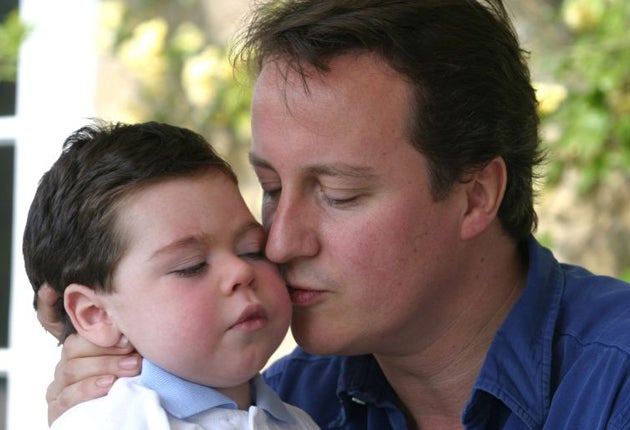
David Cameron with his son, Ivan, who suffered from cerebral palsy and epilepsy, died in February
When it comes to the policy decisions they make, politicians are influenced in a number of ways. You take advice from experts, you learn from history and you listen to what people tell you in your own constituency and as you travel around the country.
But a lot of the time, you go with your instincts and your values – what you believe to be right and what your experience tells you works. It's because I had the benefit of a good education that I'm so passionate about reforming our schools so that every child gets the best start in life. It's because I have such great parents who have supported me throughout my life that I am committed to strengthening families.
The same is true with my approach to disability. My son Ivan was born with a profound disability, and my experience of looking after him has changed the way I see a lot of things – not just as a father, but as a politician, too. Samantha and I went on a steep learning curve. From that I learned five big lessons that have had a direct impact on what my party wants to do in government for those with disabilities and their families.
The first lesson I learned was the importance of early intervention and help. The day you find out your child has a disability you're not just deeply shocked, worried and upset – you're also incredibly confused.
It feels like you're on the beginning of a journey you never planned to take, without a map or a clue which direction to go in. That's one of the reasons why the next Conservative government is going to increase radically the number of health visitors. I'm not suggesting it's their job to diagnose disabilities, but for decades they've been in the home with parents, spotting warning signs early and offering sound advice. I know how crucial that early help is, which is why we need more of it.
The second lesson was that life for parents of disabled children is complicated enough without having to jump through hundreds of government hoops. After the initial shock of diagnosis you're plunged into a world of bureaucratic pain. Having your child assessed and getting the help you're entitled to means answering the same questions over and over again, being buried under snow drifts of forms, spending hours on hold in the phone queue.
I am determined to make life simpler for parents. One option we're looking at is inspired by something they're doing in Austria. There a crack team of medical experts – doctor, nurse, physio – act as a one-stop-shop to assess families and get them the help they need. That would have been such a help to us and families like us, so we're looking closely at the evidence and considering how we could do something similar here.
The third lesson is that we've got to make it easier for parents to get the right education for children with disabilities. So many parents get stuck on a merry-go-round of assessments, appeals and tribunals to get a statement of special needs and the extra help their child needs. There's a structural reason for that. The people that decide who gets specialist education – the local education authorities – are also the ones who pay for it. We're seriously looking at how we can resolve that conflict of interest so that parents don't have to enter into such a huge battle for special education.
Something else that many parents have to fight tooth and nail for is a place in special school. Following the gospel of inclusion, the Government has closed dozens of special schools down in the last decade. Inclusion is great for some, but it's often the case that putting a disabled child in a mainstream classroom is a square peg-round-hole situation. So we're going to stop the closure of special schools and give parents more information and greater choice.
The fourth lesson is that like all other carers, parents need a break. One of the biggest challenges when your child is severely disabled is finding time to do normal family stuff – playing in the park with your other children, doing the weekly shop, mum and dad going out for a meal.
Respite made a massive difference to my family. Knowing that Ivan was with people who knew him, who would love and look after him gave us a huge wave of relief. Backing respite means backing the voluntary sector, giving parents and carers greater choice over the respite that suits them and looking at all ways of making sure there's a clear entitlement to respite.
The fifth and final lesson I'm going to share is this. The very painful thing about disability – whether your own or your loved one's – is the feeling that the situation is out of your control. When the system that surrounds you is very top-down, very bureaucratic, very inhuman, that can only increase your feelings of helplessness. So a really big difference we can make is to put more power and control right into the hands of parents, carers or those with disabilities – through personal budgets and direct payments. That means that instead of giving a little bit of money from health, from education, from children's services, we say to people: "Here is the total budget for you or your child, you choose how it's broken down." And instead of insisting on separate, bureaucratic bank accounts for that money, it is right people should be paid directly if they choose. This is the support, trust and respect that parents of those with disabilities deserve.
Because we can never forget what an amazing job they do. Just consider what it would mean if the army of parents and carers in this country gave up, packed up, said they couldn't cope any more. The financial cost of looking after those children would be immense – and the emotional cost doesn't bear thinking about. We need to recognise that by staying strong and holding their families together, these parents are doing a great, unsung service to our society.
View all comments that have been posted about this article.
Offensive or abusive comments will be removed and your IP logged and may be used to prevent further submission. In submitting a comment to the site, you agree to be bound by the Independent Minds Terms of Service.
- Print Article
- Email Article
-
Click here for copyright permissions
Copyright 2009 Independent News and Media Limited


Comments
I voted Labour in 1997, 2001, and 2005 but am absolutely fed up with Gordon Brown. The man is just awful. He lies, he never thinks beyond the next headline, and he
Of course Cameron will disappoint us eventually. They always do.
But as someone who has had to fight and fight and fight with the local authority to get the right wheelchair, I really do trust him to do the right thing on this one.
When I read about poor Ivan I couldn't stop looking at my daughter and crying the whole day.
Why do you think he did not vigorously support the Balls Private Members Bill to legislate disabled children's legally enforceable right (for the first time in Britain) to be law-abidingly assessed and treated 'free of charge', by NHS and town hall 'legs' of "children's services"?
Why do you think that when the Balls Bill was torpedoed in the House of Snouts he didn't use the influence of his high office to rescue it and push it through?
Do you believe that he, despite his wealth (or more accurately because of his wealth and 'influence'), was obliged like many far less wealthy and less 'influential' parents. to 'go private'?
1. implement fraudulently ratified UNCRC;
2. legislate for disabled children an enforceable right to be law-abidingly assessed (let alone treated on a 'free of charge' basis, as enjoyed by influential wealthy toffs like this guy, although they can afford to buy privately unlike most parents);
2.1. Balls to his credit did try to do it with a Private Members Bill (unsupported by our slippery toff Blair lookalike);
3. restore Article 13 to the HR Act bananarepublicanised version of ECHR;
4. ratify Protocol 12;
all denied because, wait for it... in the opinion of rat-brains like Harperson and Straw, British children don't need them because governed and judged by jolly good chaps, not quisling snouts and cerebral prostitutes
Is there a single virtue now remaining amongst you? Is there one vice you do not possess? Ye have no more religion than my horse; gold is your God; which of you have not barter'd your conscience for bribes? Is there a man amongst you that has the least care for the good of the Commonwealth?
Ye sordid prostitutes, have you not defil'd this sacred place, and turn'd the Lord's temple into a den of thieves by your immoral principles and wicked practices? Ye are grown intolerably odious to the whole nation; you were deputed here by the people to get grievances redress'd; your country therefore calls upon me to cleanse the Augean Stable, by putting a final period to your iniquitous proceedings, and which by God's help and the strength He has given me, I now come to do.
I command ye, therefore, upon the peril of your lives, to depart immediately out of this place! Take away that shining bauble there, and lock up the doors. You have sat here too long for the good you do.
Parents are seeking labels for their children to avoid admitting their poor parenting. He's not un-disciplined he's ADHD and can I have extra benefits please ? The medical profession is then prescribing drugs to match the mother's desribed symptoms ~ which are not matched by behaviour seen by teachers and social workers.
The loop needs to be tied, and all sides need a coherant approach.
Being able to bring a suit before a court is far more effective than dribble about 'crack teams' to do this that or the other - if they feel so inclined and don't instead extort fifty pound notes from parents, as I have seen happen as brown envelopes "for the doctor/therapist".
Don't believe me? Ask Great Ormond Street for example how many of their staff are on a privately circulated 'moonlight' list. If they say none, then I'll consider publishing a copy of the one before me now.
Simple assessment process, 'crack team' of prefessionals = key working!
The right choice for education = key working!
Short breaks = key working!
Greater family input and control, family-centred approach = key working!
Care Co-ordination Network UK (CCNUK) is the networking organisation funded by the governments in England, Scotland and Wales to promote the concept of key working/care co-ordination for families with disabled children. Key working/care co-ordination is the essential service required and should be integral in the implementation of the Aiming High programme. The government endorsed Key Worker Standards must be adopted across the UK to ensure a multi agency approach to service delivery for disabled children and their families. A named key worker for every family with a disabled child would prevent other fathers, and families, reaching crisis point and having to learn these hard lessons for themselves.
If anyone at David Cameron's office is monitoring these responses, please contact CCNUK:
t: 01904 567303
e: info@ccnuk.org.uk
This is still not enough and it will take time for all the new plans to work their way through. Parents will doubtless still have to battle to get their local authorities and primary care trusts to spend the new money and give families the improved services they need.
But PLEASE don't let anyone think that change isn't on its way. If the Tories get elected, they won't need to start afresh. Instead, we will we have to insist that what is now in place for disabled children doesn't get lost.
Sorry to be so emphatic but it is really important that what politicians do gets recognised because that's the only way to get them to keep on doing it.
The hours of filling in forms (not to mention how harrowing it is spelling out the every day things that your child is unable to do (tears are shed every 3 years filling in DLA forms when nothing has changed.) we were offered respite care some years ago when we felt we needed it most. The offer was a placement in what can only be described as a 'victorian orphanage'. When the director of social services was defending this service my husband asked him outright if he would put his child there, he eventually admitted that 'he wouldn't but what he thought was irrelevant' - actually I think it was very relevant!
Bureacracy, being treated like we are trying to fiddle the system to get the best for our child, brick walls, poor & non existant services - this is not going to change & Cameron is a fool if he thinks he can make us believe that he has a magic wand to make the DWP/social services or local authorities treat our children as individual people & not benefit fiddlers, & stop them labelling parents/carers as bolshy troublemakers when we ask for what is our childs right.
Whilst I absolutely agree with his sentiments he left out point 6 World Peace! because let's face it if he can do what he promises he surely is a god! I won't be conned into voting tory based on a myth.
I believe him and am more than willing to support him whilst he endeavours to implement what will benefit these families most.
I've been a great believer in Cameron for some time now. This reaffirms the support he might deserve from others.
However, our research suggests that while 10,500 disabled children are currently enjoying short breaks, another 3,500 are currently waiting for a short break carer and we estimate that another 10,000 could benefit if enough carers are recruited.
Over the next two years, Shared Care Network hopes to recruit an additional 2,500 carers as part of our BIG recruitment challenge. We have also just established a national carers’ network to support our existing short break carers.
For more information about short breaks or about becoming a short break carer please see www.sharedcarenetwork.org.uk or call 0117 9415361.