Davis resignation: Unlikely hero of liberal Britain shocks the political establishment
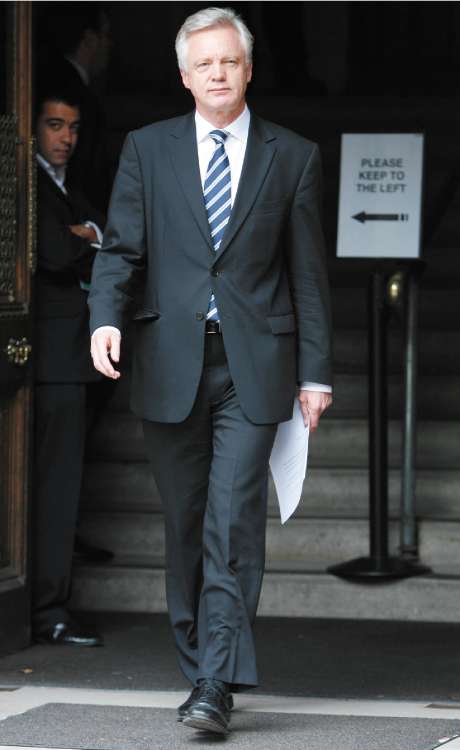
David Davis became an unlikely hero of liberal Britain yesterday by sacrificing his political career to launch a one-man crusade against the Government's plan for suspected terrorists to be detained for 42 days without charge.
The former SAS reservist, who supports the death penalty for premeditated murder, shook Britain's political establishment to its roots by announcing he would stand down as an MP to fight a by-election to stop the "slow strangulation of fundamental British freedoms".
The former shadow home secretary's bombshell left David Cameron and many Tory colleagues seething. But outside the Westminster village, the reaction was very different. Mr Davis's Commons office was flooded with telephone calls and emails from members of the public praising him for putting his principles before his career.
While Tory MPs queued up to denounce Mr Davis as "barmy" and "mad", the reaction of the party's grassroots was more favourable. A poll of 1,200 Tory members by the ConservativeHome website showed that 65 per cent of them were "inspired" by his decision. Only 24 per cent share Mr Cameron's anxiety that the Tories need to be careful not to get on the wrong side of public opinion on 42-day detention, while 72 per cent disagreed. Some 70 per cent of Tory members want Mr Davis to be reinstated as shadow home secretary if, as expected, he wins a by-election that neither Labour nor the Liberal Democrats will contest.
The findings pose a headache for Mr Cameron, who tried but failed to talk Mr Davis out of his move after MPs voted narrowly to support 42 days' detention on Wednesday. The Tory leader has no intention of restoring Mr Davis to his former post. Cameron aides made clear last night that he could not leave such an important position on hold when issues such as knife crime had to be addressed. They said the appointment of Dominic Grieve, the new shadow Home Secretary, was a permanent one.
Ironically, after 21 years in Parliament, the prospect of a seat in the Cabinet finally beckoned for Mr Davis, with the Tories enjoying a commanding lead in the polls. Some will find it bizarre that he has almost certainly given it up even though, as home secretary, he would have had enjoyed much more power to defend civil liberties than he would as a mere backbencher.
Mr Davis knows that. He thinks it is more important to make a stand now; that 42-day detention is such an infringement of our liberties dating back to Magna Carta that his ambitions must take second place. It may sound pious in the Westminster village but it may play well in the real world, where people have switched off from political parties – the MPs and MEPs who fiddle their expenses and do grubby backroom deals, as Mr Brown did to squeak through 42-day detention with the votes of nine Democratic Unionist Party (DUP) MPs who are normally natural bedfellows of the Tories.
It was the manner of Mr Brown's hollow victory that pushed Mr Davis over the edge. He was spitting blood that the Prime Minister had resorted to offering "30 pieces of silver" to the DUP to overturn civil rights enjoyed in Britain for 800 years.
The political cross-dressing has been extended by Mr Davis's announcement. The Ramadhan Foundation, a Muslim youth group, said: "His principled defence of civil liberties and the rule of law is an inspiration for the nation. We look forward to a debate based on the issues and evidence and not jumped-up proposals for political benefits."
Mr Davis is already planning his campaign for an "anti-Big Brother by-election" on 10 July. He wants to start a debate on aspects of Britain's "surveillance society", including what he regards as "the most intrusive identity card system in the world" and the scale of the DNA database.
Nick Clegg, the Liberal Democrat leader, backed Mr Davis. "I think it is right from time to time to signal as a party leader that we are capable of setting aside the pursuit of narrow party-political advantage in the name of that wider principle," he said.
The Haltemprice and Howden declaration
"The name of my constituency is Haltemprice and Howden – [which] is derived from a medieval proverb meaning noble endeavour. Until yesterday I took a view that what we did in the House of Commons – representing our constituents was a noble endeavour because for centuries ... we defended the freedom of people. Well, we did, up until yesterday.
"This Sunday is the anniversary of Magna Carta, a document that guarantees the fundamental element of British freedom, habeas corpus. The right not to be imprisoned by the state without charge or reason.
But yesterday this house allowed the state to lock up potentially innocent citizens for up to six weeks without charge. The Counter-Terrorism Bill will, in all probability, be rejected by the House of Lords very firmly. After all, what should they be there for, if not to protect Magna Carta?
"But because this is defined as political, not security, the Government will be tempted to use the Parliament Act to overrule the Lords.
"It has no democratic mandate to do this since 42 days was not in its manifesto. Its legal basis is uncertain ... but, purely for political reasons, this Government is going to do that. Because the generic security argument relied on will never go away – technology, development complexity, and so on – we'll next see 56 days, 70 days, then 90 days.
But in truth perhaps 42 days is the one most salient example of the insidious, surreptitious and relentless erosion of fundamental British freedom.
"And we will have shortly the most intrusive identity card system in the world. A CCTV camera for every 14 citizens, a DNA database bigger than any dictatorship has, with thousands of innocent children and millions of innocent citizens on it.
"We have witnessed an assault on jury trials, a bolt against bad law and its arbitrary use by the state. And short cuts with our justice system, which will make our system neither firm nor fair and a creation of a database state opening up our private lives to the prying eyes of official snoopers and exposing our personal data to careless civil servants and criminal hackers. The state has security powers to clamp down on peaceful protest and so-called hate laws to stifle legitimate debate, whilst those who incite violence get off scot-free. This cannot go on... and for that reason today I feel it is incumbent on me to take a stand.
"I will be resigning my membership of this House and I intend to force a by-election... I will fight it, I will argue this by-election against the slow strangulation of fundamental British freedoms by this Government.
"Now, that may mean I have made my last speech to the House ... But at least my electorate and the nation ... would have had the opportunity to debate and consider one of the most fundamental issues of our day... And if they do send me back here, it will be with a single message – that the monstrosity of a law that we passed yesterday will not stand."
Join our commenting forum
Join thought-provoking conversations, follow other Independent readers and see their replies
Comments