Fears that Chancellor's cuts could foster massive rise in unemployment
George Osborne says that without the cuts that loom in tomorrow's Budget, Britain will be on 'the road to ruin'. But does the Chancellor risk creating unemployment on a scale not seen since the 1970s?
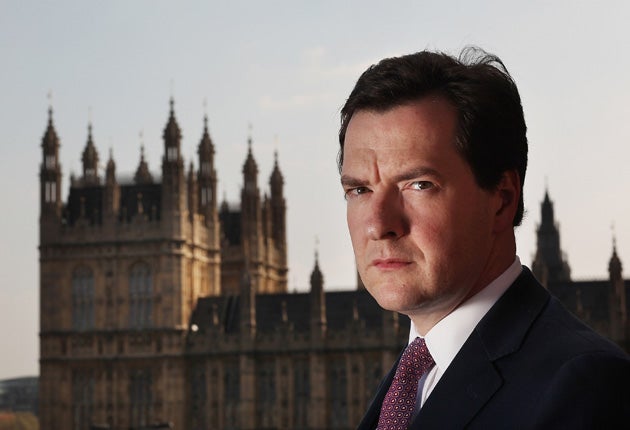
The toughest Budget since the Second World War will be delivered by the Chancellor, George Osborne, tomorrow as he prepares to slash public spending in some departments by up to 30 per cent, strip away middle-class perks and deliver one of the biggest tax hikes in history.
Fresh economic forecasts from the new independent Office for Budget Responsibility, which will take into account Mr Osborne's squeeze on the economy, are likely to signal lower growth and a substantial jump in unemployment over the next few years – closer to 10 per cent or 3 million jobless than the current 2.5 million – figures that recall the dark days of the 1970s.
Mr Osborne is expected to outline a further £27bn in cuts, compared with the plans laid down by the last Chancellor, Alistair Darling, in March, as well as around £15bn in tax rises, bringing the total squeeze on the economy to £75bn a year by 2015. This represents a real-terms cut of a fifth in public spending, and, if job losses were proportionate to those cuts, then there would be one million fewer public sector jobs in five years' time. Some say that Mr Osborne may go further, perhaps to £85bn. The National Institute of Economic and Social Research has said that the £6bn in cuts this year alone will see 30,000 to 60,000 posts disappear.
In what the Prime Minister, David Cameron, described over the weekend as a "tough but fair" approach, tax hikes will be balanced by some concessions for the less well-off. Though the package will be grim, the alternative would be worse, the Chancellor implied yesterday. Without tough measures, the UK would be "on the road to ruin", he said. "We sit here as the country in Europe with the largest budget deficit of any major economy, at a time when markets are looking around the world at countries that can't control their debts, and so we've got to deal with that," the Chancellor said.
For householders in England, a generally grim Budget is expected to be sweetened by an announcement that Mr Osborne is making funds available to encourage a freeze in council tax.
The average council tax bill for a middle band house in England is now around £1,400 a year, compared with £688 in 1997-98. There is a belief in the City that Mr Osborne will announce a rise in VAT to 20 per cent from next year, higher capital gains tax, airplane duty, insurance premium tax and a freezing in thresholds for 40 and 50 per cent rate taxpayers.
The abolition of the child trust fund and the withdrawal of child tax credit from middle class families are also on the cards. The former Labour welfare reform minister Frank Field has been asked to look at the future of child benefit. Means testing, or ending it at an earlier age, are two options. Another former Labour minister, John Hutton, will review public sector pensions.
On the other hand, Mr Osborne will probably take the opportunity to raise the personal tax allowance from £6,475 to the £10,000 pledged by the coalition. An increase of £1,000 in the allowance would be no surprise. Thus, poorer paid workers will be around £200 a year better off, though this will be eroded by an increase in employee national insurance contributions from next year.
A national insurance contribution holiday for employers in depressed regions outside the South-east was also announced over the weekend. Pensioners too will see some good news, as Mr Osborne is set to confirm the Government's intention to restore the link to earnings on state pension payments from next year.
Given these plans and the ring-fencing of spending on overseas development, NHS budgets, and Trident, the Institute for Fiscal Studies has estimated cuts of 30 per cent to other departmental budgets. Areas such as schools, transport and housing are likely to be hardest hit.
While the broad outline of public spending to 2015 will be set out, detail on which departments will suffer the deepest cuts will follow in the autumn spending review.
A new bank levy will help the Chancellor raise funds from a politically unpopular source. However, any move that weakens a fragile financial system and makes it less willing to lend to business and first-time buyers would have the perverse effect of holding back credit growth and the recovery.
But it is the rise in unemployment as a result of the fiscal squeezes now being planned that is forming a focus for worries. The lower-than-feared rise in UK unemployment during the recession has helped prevent an even more painful meltdown in the housing market, through lower repossession rates; a reversal of that trend would have dire consequences for property values.
In a letter to fellow world leaders in advance of the G20 Summit in Toronto next week, President Obama warned that the world must learn from the "mistakes of the past when stimulus was too quickly withdrawn and resulted in renewed economic hardship and recession".
Mr Obama was referring to the global economy in the 1930s and the Japanese experience in the 1990s, where a deep slump was prompted by tax hikes and cuts to public spending.
Robert Skidelsky and Joseph Stiglitz are two acclaimed economists who have recently voiced concerns about a "double-dip" recession. The shadow Chancellor, Mr Darling, said that "it is not inevitable that the private sector steps in when the public sector cuts back. That is why we must now avoid derailing a fragile recovery."
Ministers hope that the Chancellor's cuts will prevent a collapse in international confidence in the pound and enable the Bank of England to continue with its ultra-low interest-rate policy.
However, the Bank's task will be complicated if VAT is raised quickly. Usually the Bank would try to "see past" such short-terms variations, but recent evidence suggests that inflation expectations are starting to become unanchored; that would imply higher wage demands which will push up costs for employers and add to unemployment, even if the Government cancels the rise in employers' national insurance rates next year – the so-called "tax on jobs".
The danger would be that the Bank could be forced to push rates higher at the same time that the Government is raising taxes and cutting public spending, a pincer movement that the recovery would be unlikely to survive. Inflation, at more than 3 per cent, is already much higher in the UK than in comparable economies, as well as far exceeding the official 2 per cent target.
Brendan Barber, general secretary of the TUC, warned yesterday: "The Chancellor's approach is based on a series of myths. Deep urgent cuts are not needed, and run the risk of the double dip. Cutting spending now will do nothing to stimulate a private sector that is already running under capacity."
Join our commenting forum
Join thought-provoking conversations, follow other Independent readers and see their replies
Comments