Former MI5 chief demolishes Blair's defence of the Iraq war
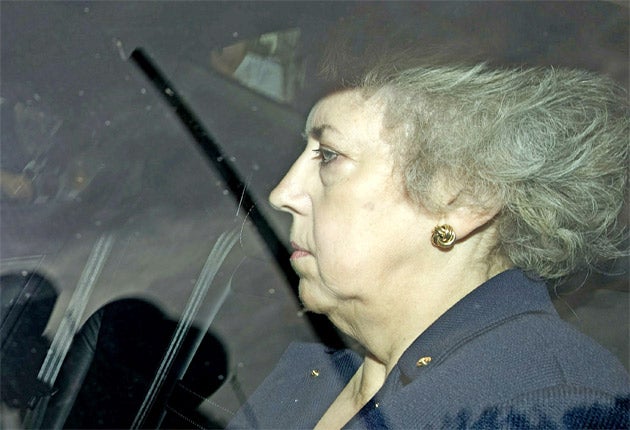
Tony Blair's evidence to the Chilcot Inquiry that toppling Saddam Hussein helped make Britain safe from terrorists was dramatically undermined by the former head of MI5 yesterday.
Giving evidence to the same inquiry, Eliza Manningham-Buller revealed that there was such a surge of warnings of home-grown terrorist threats after the invasion of Iraq that MI5 asked for – and got – a 100 per cent increase in its budget. Baroness Manningham-Buller, who was director general of MI5 in 2002-07, told the Chilcot panel that MI5 started receiving a "substantially" higher volume of reports that young British Muslims being drawn to al-Qa'ida.
She told the inquiry: "Our involvement in Iraq radicalised, for want of a better word, a whole generation of young people – a few among a generation – who saw our involvement in Iraq and Afghanistan as being an attack on Islam."
She added: "Arguably we gave Osama bin Laden his Iraqi jihad so that he was able to move into Iraq in a way that he was not before."
Her words are in stark contrast to the claim that Mr Blair made in front of the same inquiry on 29 January. The former prime minister told Sir John Chilcot: "If I am asked whether I believe we are safer, more secure, that Iraq is better, that our own security is better, with Saddam and his two sons out of office and out of power, I believe indeed we are.
"It was better to deal with this threat, to remove him from office, and I do genuinely believe that the world is safer as a result."
But the evidence presented by Lady Manningham-Buller does not just call Mr Blair's credibility into question, it also throws down a challenge to the coalition Government, warned Lord Carlile of Berriew, a Liberal Democrat peer who has acted since 2005 as the independent reviewer of anti-terror laws. He told The Independent: "It's certainly the case that the threat and number of home-grown terrorists – and 'not home-grown' terrorists coming into the UK – increased after the Iraq war.
"This makes life difficult both for the old government, who have criticisms to answer, and for the current Government. It makes their review of current terrorism law a delicate exercise because there is no evidence of any significant reduction in the threat. We are where we were."
Sir Menzies Campbell, former leader of the Liberal Democrats, added: "I should be astonished if Mr Blair were to return to give further evidence, but questions will remain as to what it was which prompted him to disregard the reservations of officials and their advice. If only Britain had been as well served by its politicians as it was by Eliza Manningham-Buller then we would never have got ourselves into the illegal mess of Iraq."
Lord West, who was counter-terrorism minister in the Home Office under Gordon Brown, told the BBC that he had "no doubt" that the Iraq war increased the threat of terrorism in the UK, which hit the government like a "bow wave" in 2003.
Ken Livingstone, who was Mayor of London at the time of the 7 July bombings, said: "Eliza Manningham-Buller's evidence is a damning indictment of a foreign policy that not only significantly enhanced the risk of terrorist attacks in London but gave al-Qa'ida the opening to operate in Iraq too."
Before 2003, MI5's concern had been the possibility that foreign terrorists would infiltrate the UK. Afterwards, she said: "We realised that the focus was not foreigners. The rising and increasing threat was a threat from British citizens and that was a very different scenario to stopping people coming in. It was what has now become called home-grown."
She added: "We were pretty well swamped – that's possibly an exaggeration – but we were very overburdened with intelligence on a broad scale that was pretty well more than we could cope with in terms of plots, leads to plots and things that we needed to pursue.
"By 2003 I found it necessary to ask the Prime Minister for a doubling of our budget. This is unheard of, but he and the Treasury and the Chancellor accepted that because I was able to demonstrate the scale of the problem."
The Chilcot panel published a previously classified document which showed that the former MI5 boss was not simply being wise after the event. A year before British troops went into Iraq, she sent the Home Office a memo which – though phrased in official language – demolished the idea that Saddam Hussein's regime represented a credible terrorist threat to the UK.
In a memo to John Gieve, Permanent Secretary to the Home Office, in March 2002, Lady Manningham-Buller told him that Saddam was not likely to use chemical or biological weapons unless "he felt the survival of his regime was in doubt".
The memo went on: "We assess that Iraqi capability to mount attacks in the UK is currently limited."
Lady Manningham-Buller also hinted at tension between Mr Blair's office and MI5 over the dossier that the Prime Minister presented to Parliament in September 2002, to prepare public opinion for the likelihood of war.
"We were asked to put in some low-grade, small intelligence to it and we refused because we didn't think it was reliable," she said.
Evidence: What he said – and what she said
False claims of links between al-Qa'ida and Saddam Hussein
Tony Blair claimed on 21 Jan 2003:
"There is some intelligence evidence about loose links between al-Qa'ida and various people in Iraq... It would not be correct to say there is no evidence whatever of linkages between al-Qa'ida and Iraq."
Foreign Office spokesman claimed on 29 Jan 2003:
"We believe that there have been, and still are, some al-Qa'ida operatives in parts of Iraq controlled by Baghdad. It is hard to imagine that they are there without the knowledge and acquiescence of the Iraqi government."
Eliza Manningham-Buller, former head of MI5, yesterday:
"There was no credible intelligence to suggest that connection and that was the judgment, I might say, of the CIA."
Hand-picking flimsy 'intelligence'
Blair, to the Commons 24 Sept 2002:
"It [the intelligence service] concludes that Iraq has chemical and biological weapons, that Saddam has continued to produce them, that he has existing and active military plans for the use of chemical and biological weapons, which could be activated within 45 minutes; and that he is actively trying to acquire nuclear weapons capability..."
Blair, to the Commons 25 Feb 2003:
"The intelligence is clear: He [Saddam] continues to believe his WMD programme is essential both for internal repression and for external aggression. The biological agents we believe Iraq can produce include anthrax, botulinum, toxin, aflatoxin and ricin. All eventually result in excruciatingly painful death."
Manningham-Buller, yesterday:
"The nature of intelligence – it is a source of information, it is rarely complete, it needs to be assessed, it is fragmentary... We were asked to put in some low-grade, small intelligence to it [the September 2002 dossier] and we refused because we didn't think it was reliable."
Iraq posed no risk to Britain
Blair, to the Commons 10 April 2002:
"Saddam Hussein is developing weapons of mass destruction, and we cannot leave him doing so unchecked. He is a threat to his own people and to the region and, if allowed to develop these weapons, a threat to us also."
Manningham-Buller, yesterday:
"We regarded the direct threat from Iraq as low... we didn't believe he had the capability to do anything in the UK."
Ministers were told that invading Iraq would increase the threat of terrorism to Britain
Blair, farewell speech at the Labour conference, 26 September 2006:
"This terrorism isn't our fault. We didn't cause it. It's not the consequence of foreign policy."
Manningham-Buller, yesterday:
"It was communicated through the JIC assessments, to which I fed in... I believe they [senior ministers] did read them. If they read them, they can have had no doubt."
The Iraq war made Britain a more dangerous place and allowed al-Qa'ida to gain a hold in Iraq
Blair, 29 Jan 2010:
"If I am asked whether I believe we are safer, more secure, that Iraq is better, that our own security is better, I believe we are. The world is safer as a result."
Manningham-Buller, yesterday:
"Our involvement in Iraq radicalised a generation of young people who saw our involvement in Iraq and Afghanistan as an attack on Islam. We [MI5] were pretty well swamped... with intelligence on a broad scale that was pretty well more than we could cope with in terms of plots, leads to plots and things that we needed to pursue.
"We gave Osama bin Laden his Iraqi jihad so that he was able to move into Iraq in a way that he was not before.
The post-Iraq plots
7/7 bombers - 2005
The bombs detonated on London Underground trains and a bus in July 2005 killed 52 members of the public and injured around 700. Three of the four suicide bombers had been born in Yorkshire; the fourth, born in Jamaica, came to the UK aged five. In his video, one bomber said: "Your democratically elected governments continuously perpetuate atrocities."
London Haymarket/Glasgow Airport attacks – 2007
Bilal Abdulla, a doctor, and Kafeel Ahmed, a PhD engineering student, tried and failed to set off bombs outside a London nightclub on 29 June. The following day they drove a jeep filled with gas canisters into Glasgow Airport. Abdulla's trial heard his involvement was "because of events in Iraq".
Liquid bomb plot – 2006
A terror plot was exposed in which liquid bombs were to be smuggled on to airliners. Many of the men made 'suicide' videos citing British foreign policy. Umar Islam said in his video: "If you think you can go into our land and do what you are doing in Iraq, Afghanistan and Palestine and... think it will not come back on to your doorstep, you have another think coming."
Join our commenting forum
Join thought-provoking conversations, follow other Independent readers and see their replies
Comments